It was 150 years ago today, on August 20, 1866, that President Andrew Johnson issued Proclamation 157, which formally brought to an end all the hostilities of the American Civil War, as the insurrection status had ceased in all the southern states that had ceded from the United States.
This anniversary today comes at the end of a string of 150-year anniversary commemorations that have occurred over the past few years, which have given opportunity to reflect on the significance of this conflict, which I refer to as the Sectional War: After studying about it in American History class in high school, I came to realize that the title "Civil War" isn't the best fit for this conflict. In the case of other civil wars throughout world history in other countries, the term is used to describe a conflict in which people of the same country fight against each other. I feel that definition only partially describes this conflict. The people of the Southern states sought to remove themselves from the Union and even formed a separate country, though its status was in question. After consideration, I decided upon the title "Sectional War" because this conflict was based in sectional differences that existed in the United States in the 19th Century, which were largely defined by Northern and Southern States, distinct socially as much as they were geographically.
Now, I'm a big buff of the American Revolution, which I feel was a significant period in USA history because it set the tone for the kind of nation the USA has become, establishing it in principles of freedom and liberty. Yet there's no doubt that the Sectional War is significant because it was a point when those ideals were tested when sectional differences among the people in the North and the South reached a breaking point, resulting from a strained relationship between them. The conflict ended slavery, which brought notable changes to the society of the South, and steered the course of USA history to what happened over the next century and a half, especially in regards to social inequality and race relations. Even the present controversies today regarding police shootings of innocent African-Americans has roots in the Sectional War.
Indeed, the battles that we have remembered these past few years and the whole war itself have been more than just about a fight over sectional differences. They have come to reflect much more on the course of this nation's history. While a strained relationship that reached a breaking point, giving way to war, had the outcome of ridding the evil of slavery, there's more work to be done to enhance race relations in this country, as scars still remain. It's time to build on the momentum gained through legal actions like the abolition of slavery, the Reconstruction amendments to the US Constitution, and the Civil Rights Acts of the 1960's to work to overcome racism, achieving the vision of our founders more holistically for our entire society.
Saturday, August 20, 2016

Tuesday, August 16, 2016
(Re)connections

The last time I had seen a sign like the one above was over five years when I was on a storm chase trip with a group of meteorology students from Valparaiso University. Our pursuit of storms took us to the High Plains of Eastern Colorado, where we witnessed all chaos break loose in the skies above after four days without storms. We left the state under cover of darkness on I-70, with a severe thunderstorm following us, which dumped so much hail that plow trucks came in for the clean-up.
The last time I had received a hearty Colorado-style welcome from my relatives clustered in and around the fine city of Denver was eight years ago. So it was certainly about time I had a chance to go back to the wonderful state of Colorado. I was very pleased the opportunity came recently to do just that, as I joined with much of my family there for a weekend in celebration of my Great Aunt Carmen's birthday.
Indeed, this trip was all about reconnections, starting when I boarded the Amtrak California Zephyr train at Chicago Union Station, which I rode to Denver Union Station. I had ridden this line going eastbound 19 years before when my family took a great long train trip as a vacation, looping around the western United States. This ride would be my first time riding westbound on the California Zephyr.
Ah, how wonderful it was to pass through the resplendent suburbs along the BNSF Corridor headed out of Chicago toward Aurora, and then to pass through vast fields of Illinois (see picture below).
 |
| Between Sandwich and Princeton, IL |
 |
| The Mississippi River crossing, just east of Burlington, IA, with the US 34 bridge off in the distance |
 |
| Here's the sunset over south central Iowa, west of Ottumwa. |
While the destination of my trip was ultimately for a family weekend, I also relished the opportunity to experience camraderie with others along the way, especially fellow passengers with whom I shared the train ride--one of a few reasons why I enjoy Amtrak long-distance travel so much. As my Abuela likes to say, "Happiness is making friends along the way." And that literally happened later in the evening. There were two gals sitting behind me, and at one point, one of them got up looking for a trash receptacle. When I noticed her looking around, I indicated to a trash receptacle not too far away. She was so glad to hear me say that, and then she said, "You're my new best friend." I then got talking with her, Alex, and her friend Kenzie, for a little bit.
Later that night, the train reached Omaha, which turned my thoughts to the St. Augustine Mission on the Winnebago Reservation in Nebraska, up the Missouri River from Omaha, and Father Dave, who just moved from being mission director there to a new assignment in Omaha.
The next morning, I awoke to a splendid sunrise (see picture below) over the fields of northeastern Colorado--though there's a small possibility that maybe it was in southwestern Nebraska.

My feelings soared up as we traveled through those wide open Plains, continuing along Route 34, which the California Zephyr nearly paralleled from Chicagoland, all the way through Fort Morgan. (We traveled along part of US 34 in eastern Colorado when navigating around a storm on the storm chase trip five years ago.) Ah, what beautiful country it was in Colorado as we neared Denver, and I beheld the scenic view of the mountains coming into focus off to the west, which is one big reason why I enjoy visiting there (see picture below).

I enjoyed some more conversation with fellow passengers as the train made a series of maneuvers, backing up into Denver Union Station. Upon our arrival, I exchanged high-fives with Alex and Kenzie, grateful for sharing in their company and friendship for the 20-hour ride, before disembarking. I then walked over to another platform at the station and boarded RTD's new B Line train to the Denver suburb of Westminster, where my cousin Laura and her husband Doug live. This line had literally just opened a couple days before. It was exciting to take in the new public transport offering in the Denver area, as the RTD is expanding its routes significantly. And I appreciated the convenience of boarding the B-Line just feet away from the Amtrak platform at Denver Union Station.
After getting myself settled at Laura and Doug's house, I departed for my day's outing. I stopped by the National Center for Atmospheric Research on a lovely mountainside just beyond Boulder to view their museum on weather, and also visited their library, which I enjoyed seeing, with all its meteorology materials (see picture below).

I then headed through Boulder, which was an interesting city drive, onto US 36 toward Estes Park. I made a short stop at Rocky Mountain National Park, as I wanted to visit a national park during the National Park Service's Centennial Year. I found a nice spot to walk around at Lily Lake.

 |
| Thanks to the fellow visitors who took the two above pictures of me. |
I then got on US 34 headed east to Loveland, then cut north towards Fort Collins, with the scenic mountain views to my left as I traveled through open fields. I then arrived at the apartment of my good friends Nathan and Aura Lee, where I spent a good chunk of time visiting and catching up with them over dinner. It was wonderful to see them happily married for over a year now, and tending well to life as graduate school students at Colorado State University. I was also honored to be their first guest in their new apartment.
I then enjoyed a pleasant drive back to Westminster along I-25 through the open country with rushing breezes across my face.
I spent almost all of the next day, Thursday, at Aunt Carmen's house in Denver. It was wonderful being back at her place, receiving her kind hospitality. I also enjoyed a lovely walk around her neighbor, making a point especially to climb up a hill with a water tower at the top, and great views of the Denver skyline, the Metro Area, and the mountains (see the three pictures below).

 |
| The Denver skyline appears in the center of this picture, off in the distance. |
 |
| The Rocky Mountains are faintly visible in the distance. |
In the afternoon, her son John and his wife Charlotte, and their granddaughter Jenesis arrived from California, and we spent the afternoon and evening visiting, as we awaited for the arrival of my parents and Abuela, the last people to arrive from outside the Denver area. I went with John and Charlotte for groceries, which was my first visit to a King Sooper's, a grocery store chain in the Denver area. We were glad to receive Mom, Dad, and Grandma Vel, who experienced a significant flight delay, but were nevertheless in good spirits upon their arrival (see picture below).
 |
| My Mom is a pinkish shirt to the far left. My Dad is just to her right in the picture, in an orangish shirt. My Grandma Vel is to the far right in the picture. |
The next day, Friday, I took advantage of the opportunity to bike around the north Denver Metro Area, going from Westminster to Old Towne Arvada, finding some nice bike trails to use.
In the afternoon, our grand family weekend together commenced, when we assembled at Aunt Carmen's house to make our carpool arrangement. I met up with Cynthia and Mark Grubbs, whom I had seen back in April when they came to Chicago, as well as their children, Mark and Jennifer, both of whom I hadn't seen in a while. Before leaving the Denver Metro Area, we stopped at Fort Logan National Military Cemetery to pay our respects to Uncle Leonard, which I specifically requested, and to which Cynthia, and the others, agreed. Then, we were off into the mountains, for an approximately 2-hour ride on scenic mountain-view roads to Cripple Creek and the Alpine Vista Retreat vacation rental home we had for the weekend, enjoying the ride with the Grubbses.
 |
| John took this photo of me at a grand welcome sign, just outside of Cripple Creek on Colorado State Route 67. |
The city is at an elevation of 9494 feet above sea level, and we had to go up a road 800 feet to reach the house. So we were pretty close to 2 miles in elevation, which made quite a difference with cooler temperatures than at the mile-high elevation in Denver.

After we marveled at the grandeur of the house (see picture above), and got settled, with a drawing from a hat used to determine who would take which room, preparations for dinner commenced. Meanwhile, the five of us present under the age 30 (see picture below) headed into town to amble around for a few minutes before going back for dinner, and to welcome the two other family groups who arrived later in the evening.
 |
| The "Under 30 Club" in downtown Cripple Creek, taken by a person enjoying the evening downtown. From left to right: Jennifer, Jenesis, me, Chris, and Mark |

We enjoyed each other's company and hearty laughs. We had a fine time gathered together on Saturday afternoon showering Aunt Carmen with gifts and loving sentiments to celebrate her birthday.
 |
| Aunt Carmen is beaming as she comes to the table with the family for cake, gifts, and loving sentiments. |
The accolades certainly got started early on Saturday as my Grandma Vel started gathering people she saw awake as early at 7 AM to sing "Las Mañanitas" to Aunt Carmen. It was special for me because it was the first time I had ever been with Aunt Carmen on her birthday. (And come to think of it, this was also the first time I had spent time in Colorado with Grandma Vel there, too.)
We spent some time in town, too. Cripple Creek (see picture below) is a nice place, once a big mining town.

We attended Mass at a lovely church, St. Peter's (see picture below), with a guest priest from Kenya, talking about his missionary work.

There was also a sign at Bobbie B's Ice Cream Shoppe that claimed Cripple Creek was where the root beer float was invented, and I enjoyed a root beer float there (see picture below).
 |
| Dad got this picture of me at Bobbie B's. |

 |
| Charlotte took this picture of me keeping calm as the herd of donkeys approaches me. I was grateful for her agricultural expertise when interacting with the donkeys. |
I also had opportunity to take hikes up a ridge that overlooked the town and the valley.
 |
| Mark Grubbs, Sr., got the pictures of me above and below. In the above, you can see the house we stayed at near the bottom of the picture. In the picture below, you can see the city of Cripple Creek near the center of the picture, off in the distance. |

At night, there were great views of the stars from the wrap-around porch, and during the day, there were times when we could view rain shafts. And I woke up early both morning to watch the sunrise over the mountains--on Monday, I watched the whole transit from the sun's first rays to the disc of the sun emerging from the mountains (see picture below).

And in addition to Aunt Carmen's birthday, I also had the chance to mark the birthday of Colorado on Monday, August 1. I felt some songs stirring within me on Monday morning as a group of us sat out on the porch overlooking the valley, awaiting our departure back to the Denver Metro Area, and I burst out "America, the Beautiful", with "spacious skies" above us, and "mountain majesties" all around.
When we stopped for a meal at the Hungry Bear restaurant in Woodland Park, and our waitress found out toward the end of our meal that it had been Aunt Carmen's birthday, she brought out a cup of hot chocolate and led a singing of "Happy Birthday" for her (see picture below).

Heading back to Denver with John, Charlotte, and Jenesis in their truck took us along roads I recall from the storm chase trip 5 years ago, as we traveled along I-25 from Colorado Springs to Castle Rock, to have a chance to view the Rocky Mountains, and especially Pike's Peak, which I gazed upon once more, in all its grandeur.
After getting back to Aunt Carmen's house, Laura, Doug, Mom, and Dad accompanied me to Union Station, which provided Laura and Doug their first chance to ride the B Line, which was exciting.
 |
| Dad took this photo of our having some fun before boarding the B Line at Westminster Station. From left to right: Laura, Mom, Doug, me. |
In the couple of hours before my train came, we ambled around in downtown Denver. We rode on the Mallride bus to Civic Center, and then walked over to the Colorado History Center--which was free of charge in celebration of Colorado's Statehood Day--to spend a few minutes looking around at exhibits about life in Colorado, which covered a good amount about the state. (It's also where the "Welcome to Colorful Colorado" sign was that appears at the start of this post, a photo which I believe Laura took me, or maybe Doug.)
 |
| A giant map of Colorado on the floor in the museum, with Dad and Doug walking around on it. |

And then, it back to Union Station to board the California Zephyr train to head back east to Chicago, just like I did 19 years ago.
 |
| Mom got this picture of me, all excited and ready to board the California Zephyr at Denver Union Station |


I was up early the next morning to take in some views of the sunrise over the fields of western Iowa (see picture below).

 |
| While taking in the sunrise, I had a fellow passenger get this picture of me in the sightseeing/observatory/lounge car. |

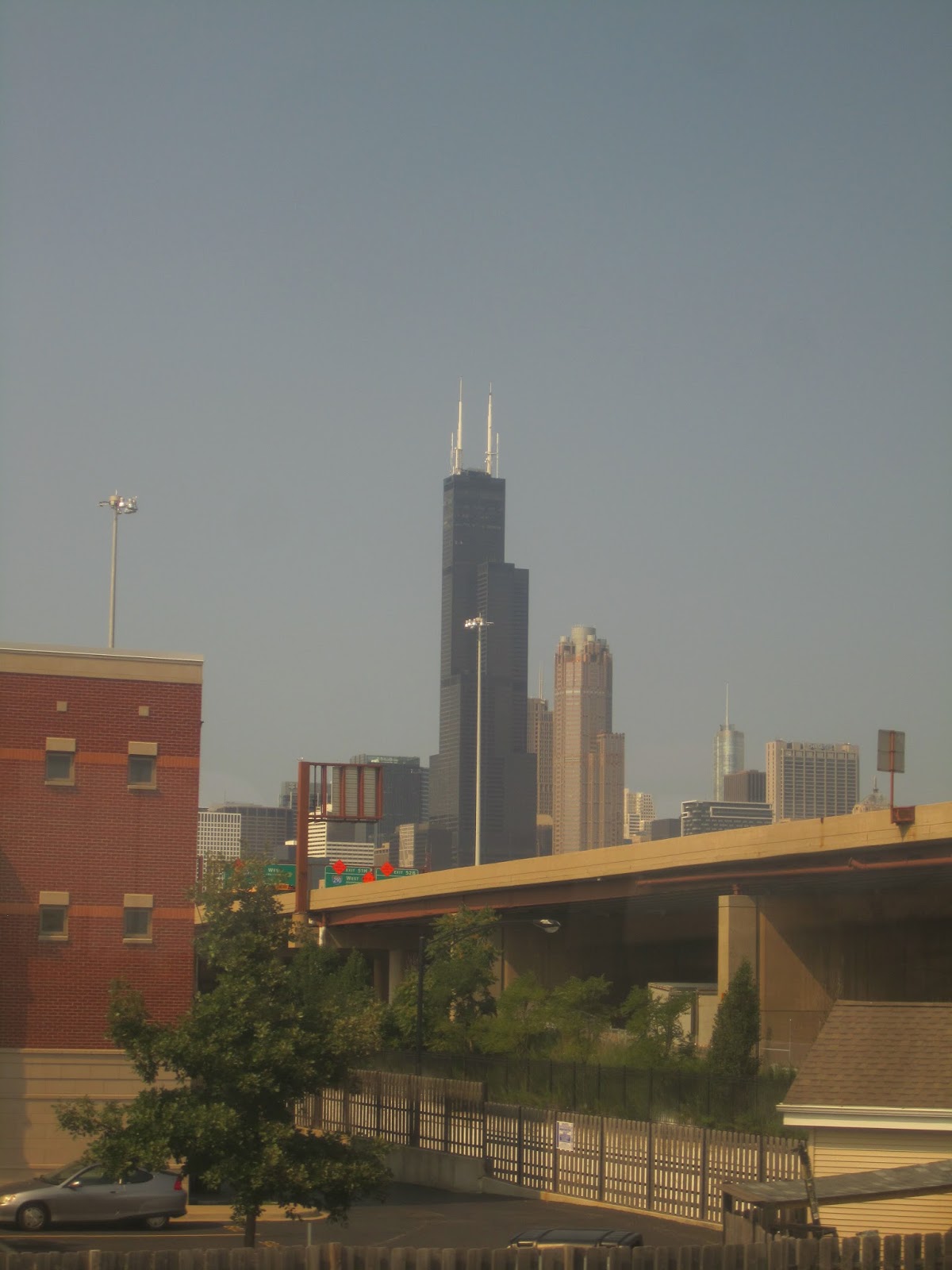
I passed some of the time in conversation with a woman named Peggy sitting next to me, especially as the train entered the Chicagoland area. I got to pointing out many places along the route, especially when we got to Berwyn, where I could see Clarence Avenue from the train, one sign among many of being back home, just like the Sears Tower as we entered the railyards just south of Chicago Union Station (see picture below).
While exiting Chicago Union Station, I saw an advertisement for Colorado (see picture below), which immediately took me back in my mind to the wonderful vacation I had just had there.

 |
| With this trip, I got to add to the "Infinite Stories" that Amtrak makes possible, as it says on this ad in Chicago Union Station, which was right next to the Colorado ad. |
 |
| Charlotte got this picture of me along a street just north of downtown Cripple Creek. |
Indeed, Love is our Mission. Pope Francis said in his homily at the Concluding Mass for the World Meeting of Families, before a million people gathered in Philadelphia, that the love God shows us we show to one another, starting in the family: It's where we cherish the relationships we have with those closest to us, and learn to support one another, helping each other through the difficulties we face in life, aiding each other in our various pursuits, offering little acts of kindness to one another day by day. That is the kind of love we celebrated as we gathered to mark Aunt Carmen's birthday. What love she has shown to her children and beyond to the succeeding generations, especially as I experienced in her gracious hospitality. This love keeps on giving, as our wonderful throng experienced in each other's company on this weekend.
And the love doesn't stop there. As it truly represents the love God has shown us through the Paschal Mystery of Christ, it pours forth and envelopes others. It allows us to engage in meaningful relationship with other people, as I experienced on my train rides, enjoying the company of fellow passengers, and even visiting with my dear friends in Fort Collins.
Indeed, love is a source of great joy, something to give thanks to God for, something to celebrate and experience each and every day. I think one of the best parts of this vacation was reconnecting with the love of the family I spent time with during a marvelous weekend.
Saturday, August 13, 2016
Reveling in Rio, Simple Style
The world has come together again for another Olympic event, and as is my custom, I make a point to be present to watch it get started.
The disappointment that Chicago was not selected host of the 2016 Summer Olympic Games has long worn off for me. So on Friday evening, August 5, I was able to get right into enjoying the Opening Ceremony for the Rio de Janeiro Summer Olympics.
In comparison to other summer olympics opening ceremonies I've watched, especially Beijing 2008 and London 2012, the one aspect of ceremony in Rio de Janeiro that stood out to me was its simplicity. And it was nice, especially given how the ceremony in Beijing tried to hard to impress the global audience. The 2016 ceremony kept to the point of expressing Brazil, even displaying results of investing heavily in a projector.
Rather than go through all the details of the country's story, the focus was kept on the major themes of the indigenous peoples, the arrival of the Europeans, and then the music scene, including the Samba.
I also thought it was a nice touch to have a tree planted for each participating country, as a way to go beyond the doomsday talk of global climate change to some form of meaningful action.
I couldn't help but notice the sense of simplicity even in the Brazilian National Anthem. as the seated performer softly strummed the song on a guitar.
Indeed, Rio de Janeiro didn't need to pull out all the stops with lots of bells and whistles to put on a good show for the opening ceremony. Certainly it kept a good show going for a while, as I don't recall an opening ceremony ending as late as 11:30 PM CDT on NBC's coverage. The Rio Olympics kept the opening ceremony plain and simple, and that was nice.
Here's to the athletes, that they engage well in the competitions of these two weeks.
The disappointment that Chicago was not selected host of the 2016 Summer Olympic Games has long worn off for me. So on Friday evening, August 5, I was able to get right into enjoying the Opening Ceremony for the Rio de Janeiro Summer Olympics.
In comparison to other summer olympics opening ceremonies I've watched, especially Beijing 2008 and London 2012, the one aspect of ceremony in Rio de Janeiro that stood out to me was its simplicity. And it was nice, especially given how the ceremony in Beijing tried to hard to impress the global audience. The 2016 ceremony kept to the point of expressing Brazil, even displaying results of investing heavily in a projector.
Rather than go through all the details of the country's story, the focus was kept on the major themes of the indigenous peoples, the arrival of the Europeans, and then the music scene, including the Samba.
I also thought it was a nice touch to have a tree planted for each participating country, as a way to go beyond the doomsday talk of global climate change to some form of meaningful action.
I couldn't help but notice the sense of simplicity even in the Brazilian National Anthem. as the seated performer softly strummed the song on a guitar.
Indeed, Rio de Janeiro didn't need to pull out all the stops with lots of bells and whistles to put on a good show for the opening ceremony. Certainly it kept a good show going for a while, as I don't recall an opening ceremony ending as late as 11:30 PM CDT on NBC's coverage. The Rio Olympics kept the opening ceremony plain and simple, and that was nice.
Here's to the athletes, that they engage well in the competitions of these two weeks.
Friday, August 12, 2016
Abraham Lincoln, in Places
It's Abraham Lincoln's half-birthday today. This occasion takes me back 10 years and 12 days ago when my family was headed south to spend a few days on vacation in Nashville, TN. While passing through Kentucky, we stopped at Abraham Lincoln Birthplace National Historical Park, near Hodgenville, KY. The site is nestled among some wooded areas and fields at what was once Sinking Spring Farm. Visitors can see that spring, and ascend 56 steps (one for every year of Mr. Lincoln's life) up a hill to a structure that houses a replica of the log cabin in which Mr. Lincoln was born.
As the NPS ranger led our tour, he stopped by a wall near the visitor's center, which had some quotations in which Mr. Lincoln described himself. After reading them, the ranger asked us what our impressions were of him based on the quotations. As I considered them, I couldn't help but notice how self-effacing Abraham Lincoln was. The words he used suggested he didn't think too highly of himself. In fact, he claims the circumstances surrounding his birth would fit a line from Gray's Elegy, "The Short and Simple Annals of the Poor". Yet from such humility, he rose to become an important leader who played a significant role in a momentous time in our nation's history.
The summer before, in late July 2005, I had another opportunity to get to know Mr. Lincoln when my parents and I visited the Lincoln Presidential Museum in Springfield, IL. We went there just a few months after it opened. The depth of the two main exhibits on his life gave so much insight into what formed his character, especially the circumstances of the times in which he lived. The part about his years as president opened up about all the criticism he and even Mrs. Lincoln received. The two multimedia shows also illuminated the importance of his story in American history itself. As we walked through the exhibits, there were signs indicating the location of where certain events being discussed occurred, and their distance from the museum. While some were nearly 800 miles away in Washington, DC, some were just blocks away in Springfield. It was really cool to see that how much history related to Mr. Lincoln happened so close by. And how wonderful a privilege it is to have these institutions and historical sites that evoke a physical sense of place that helps us consider the significance of the history that impacts our today, especially in regards to places and circumstances that shaped people like Abraham Lincoln.
As the NPS ranger led our tour, he stopped by a wall near the visitor's center, which had some quotations in which Mr. Lincoln described himself. After reading them, the ranger asked us what our impressions were of him based on the quotations. As I considered them, I couldn't help but notice how self-effacing Abraham Lincoln was. The words he used suggested he didn't think too highly of himself. In fact, he claims the circumstances surrounding his birth would fit a line from Gray's Elegy, "The Short and Simple Annals of the Poor". Yet from such humility, he rose to become an important leader who played a significant role in a momentous time in our nation's history.
The summer before, in late July 2005, I had another opportunity to get to know Mr. Lincoln when my parents and I visited the Lincoln Presidential Museum in Springfield, IL. We went there just a few months after it opened. The depth of the two main exhibits on his life gave so much insight into what formed his character, especially the circumstances of the times in which he lived. The part about his years as president opened up about all the criticism he and even Mrs. Lincoln received. The two multimedia shows also illuminated the importance of his story in American history itself. As we walked through the exhibits, there were signs indicating the location of where certain events being discussed occurred, and their distance from the museum. While some were nearly 800 miles away in Washington, DC, some were just blocks away in Springfield. It was really cool to see that how much history related to Mr. Lincoln happened so close by. And how wonderful a privilege it is to have these institutions and historical sites that evoke a physical sense of place that helps us consider the significance of the history that impacts our today, especially in regards to places and circumstances that shaped people like Abraham Lincoln.
Saturday, August 6, 2016
Travels through Way More than Just Cornfields
Summertime brings opportunities for travel. It was 11 years ago on this day that my family foursome started out on a journey to Lake Lure, NC, to spend a few days together with a number of other family members on my Mom's side.
On our way there, we passed through Indiana. We stopped in Indianapolis, the capital city, to tour the fine-looking State Capitol Building, which are #59 and #60 on my Indiana 200 list. Before Indianapolis became the capital city, Corydon (#61), along the Ohio River, was the capital on a temporary basis, until a more permanent location could be determined. Certainly Indianapolis works well as a capital city, given its central location in state, and where many interstates converge, beftting of Indiana's nickname of "The Crossroads of America". Indianapolis is also quite the bustling, vibrant metropolis. It also has the home of Benjamin Harrison (#62).
After touring the capitol, we went to eat lunch in by the Soldiers and Sailors Monument, surrounded by a circular street (#63). It was a nice visit in Indianapolis, before we hopped back on the road.
Further south along I-65 is Columbus (#64), which is famous for its art, and fittingly has a distinct bridge for I-65 traffic over the road that leads to town. Nearby is Brown County State Park (#65), a scenic natural area.
Earlier this summer 2016, I passed through Indiana while riding Amtrak's The Capitol Limited route east to Washington, DC. The route guide provided fascinating details about the towns we passed through. Here are some highlights for Indiana locations:
#Hammond-Whiting (#66 and #67) was once the home of Alvah Curtis Roebuck (#68), who helped started a mail order company with Richard Sears.
Gary is the location of US Steel (#69).
South Bend (#70), which sits on a bend of the St. Joseph River (#71), is home to the renowned University of Notre Dame (#72) and once the location of the Studebaker Corporation (#73), of which there is a museum here.
Elkhart (#74) was once considered the Brass Musical Instrument Capitol (#75), and has a large RV manufacturing base (#76). Miles Laboratories (#77), which originally made the Alka-Seltzer (#78), was also founded here.
It's also right in Indiana's Amish country (#79), with Amish Acres being a notable attraction in nearby Nappanee (#80). Shipshewana (#81) is another notable Amish city in northern Indiana. Nearby is Goshen (#82), site of Goshen College (#83), a Mennonite school.
Waterloo (#84) is the "Crossroad of Northeast Indiana", according to the official Waterloo government website. Not too far away is the city of Fort Wayne (#85). Among other notable attractions, it has Johnny Appleseed Park (#86), and hosts a Johnny Appleseed festival in September annually (#87). Its public library has a sizable genealogy center (#88).
Indeed, while traveling these roads through Indiana might make the average person think there's nothing but cornfields, there's so much else to see in Indiana. It's just like the ads for Indiana Beach (#89) by Lake Shafer (#90) in Monticello, IN (#91), "proving once again that there's more than corn in Indiana!" (#92)
On our way there, we passed through Indiana. We stopped in Indianapolis, the capital city, to tour the fine-looking State Capitol Building, which are #59 and #60 on my Indiana 200 list. Before Indianapolis became the capital city, Corydon (#61), along the Ohio River, was the capital on a temporary basis, until a more permanent location could be determined. Certainly Indianapolis works well as a capital city, given its central location in state, and where many interstates converge, beftting of Indiana's nickname of "The Crossroads of America". Indianapolis is also quite the bustling, vibrant metropolis. It also has the home of Benjamin Harrison (#62).
After touring the capitol, we went to eat lunch in by the Soldiers and Sailors Monument, surrounded by a circular street (#63). It was a nice visit in Indianapolis, before we hopped back on the road.
Further south along I-65 is Columbus (#64), which is famous for its art, and fittingly has a distinct bridge for I-65 traffic over the road that leads to town. Nearby is Brown County State Park (#65), a scenic natural area.
Earlier this summer 2016, I passed through Indiana while riding Amtrak's The Capitol Limited route east to Washington, DC. The route guide provided fascinating details about the towns we passed through. Here are some highlights for Indiana locations:
#Hammond-Whiting (#66 and #67) was once the home of Alvah Curtis Roebuck (#68), who helped started a mail order company with Richard Sears.
Gary is the location of US Steel (#69).
South Bend (#70), which sits on a bend of the St. Joseph River (#71), is home to the renowned University of Notre Dame (#72) and once the location of the Studebaker Corporation (#73), of which there is a museum here.
Elkhart (#74) was once considered the Brass Musical Instrument Capitol (#75), and has a large RV manufacturing base (#76). Miles Laboratories (#77), which originally made the Alka-Seltzer (#78), was also founded here.
It's also right in Indiana's Amish country (#79), with Amish Acres being a notable attraction in nearby Nappanee (#80). Shipshewana (#81) is another notable Amish city in northern Indiana. Nearby is Goshen (#82), site of Goshen College (#83), a Mennonite school.
Waterloo (#84) is the "Crossroad of Northeast Indiana", according to the official Waterloo government website. Not too far away is the city of Fort Wayne (#85). Among other notable attractions, it has Johnny Appleseed Park (#86), and hosts a Johnny Appleseed festival in September annually (#87). Its public library has a sizable genealogy center (#88).
Indeed, while traveling these roads through Indiana might make the average person think there's nothing but cornfields, there's so much else to see in Indiana. It's just like the ads for Indiana Beach (#89) by Lake Shafer (#90) in Monticello, IN (#91), "proving once again that there's more than corn in Indiana!" (#92)
Tuesday, July 26, 2016
Learning and Celebration
At the end of last month, I went to St. Teresa's to participate in Father Kevin's Farewell Weekend Fesitivities. Among the various elements in the liturgy that were befitting of Father Kevin was doing the "Party Hard with Jesus Christ" routine. (Or is it "Party Hard like Jesus Christ"? I'm not entirely sure.)
It was very fittting to do that at the end of Mass, because Father Kevin has masterfully taught us that our faith really is a great celebration of having a relationship with the God Who loves us so much and desires so greatly to be in relationship with us, which we as Roman Catholics express most especially by attending Mass each weekend.
As we "Partied Hard with Jesus Christ", my mind drifted back to teaching Religious Education (RE) class the past year. I've written about my experiences teaching RE before on my blog, given how significant of an experience it is in my life, and I wish to focus a little more on it in this blog post.
I actually led my students how to "Party Hard with Jesus Christ" toward the end of the year in April. The vast majority of my students were going through, and are still in, preparations for the sacrament of Confirmation this coming October. One of the tenets of faith that Father Hurlbert, Ascension's pastor, has been heavily emphasizing is the importance of baptized Roman Catholics attending Mass on a regular basis, and particularly emphasized this with the students as part of their preparation for Confirmation.
Aware that sometimes teens struggle to find meaning in the experience of Mass, I felt it was important to continually talk in class about why Mass is significant, and help them think about it differently. That's when I decided to lead them in the "Party Hard" routine, and used that as an object lesson to demonstrate how Mass is our opportunity to celebrate our faith. This was one of several object lessons I used throughout class sessions from January onward, when the Confirmation preparations began.
Indeed, teaching RE has given me much reason to celebrate faith, because it's an opportunity for us to grow in it together as we spend time each week learning about various parts of it. Even I learn as I lead the students in exploring various aspects of faith. It was amazing to hear students express profound insights about faith, and also pose some good questions in exit slips I had them fill out at the end of class sessions, which was a way for me to assess how they were learning in class. I remember one students once asked a question about how we know Jesus really resurrected, and when I addressed that question at the start of the following class, I started by commending the student who wrote it for posing such a question, which is about a matter at the heart of our faith.
And ultimately, I see that the purpose of Religious Education is to help stimulate a measure of growth in my students so that they make meaning of faith, take ownership of it, and carry it on throughout their lives. It's exciting in the role of teacher to see growth take place, even in small ways, marveling at what may happen years in the future.
That actually connects with what I learned while studying for my MLIS: One of the ALA's Core Values of Librarianship is Lifelong Learning, which libraries foster by providing access to information that help people continually grow in knowledge and understanding. (I thought about that as I was exiting the graduation ceremony. One of the student volunteers remarked we wouldn't have any more school, and I turned around to say as LIS professionals, we're still engaged in lifelong learning.)
With RE, I start something, and then let the growth take hold as students build upon a foundation I lay. Indeed, teaching RE has been such an extraordinary experience because I'm making an investment that has eternal implications as I spend time with these young people. And while spending time with them, I am taken back to the time in my life when I experienced significant growth in my own faith, and it stirs something in my soul to be part of this process for the next generation. Certainly I experienced so much growth taking on the role of caring for the souls of the young people in my charge, and working, even through challenges, to create an environment that stimulates their own growth in their faith. (It was wonderful to reflect on this when I went back to Julian Middle School and was taking with my former 7th grade science teacher about what it means to be a teacher and have an impact on students, and how to show true care towards them.) When I step back to take stock of it all, it's amazing to see what an investment I have made, and the impact I've had on 30 students at Ascension Parish.
Furthermore, this experience has taught me what really matters most in life, and has directed my gaze upward to Heaven above, knowing that faith reveals to us that which is everlasting, and life finds truly great meaning in directing our efforts to build up treasure that is lasting. And that has been a true joy.
Saturday, July 2, 2016
Patriotic Greetings 2016: In the Setting for a Movement
Patriotic Greetings!
Independence Day is one of my favorite holidays, for it takes us back to the origins of this country, most especially to those
pivotal days in 1776.
Tensions between Britain and its 13 North American Colonies that had been increasing since the end of war between Britain and France in 1763 over issues of taxes and tightening
control of the colonies erupted into fighting on April 19, 1775, in
Massachusetts. On June 7, 1776, Richard Henry Lee, a Virginia delegate in
the Continental Congress, meeting at the Pennsylvania State House in
Philadelphia, offered the following resolution: "Resolved. That
these United Colonies are, and of right ought to be, free and
independent states. That they are absolved from all allegiance to the
British Crown. And that all political connection between them and the
State of Great Britain is, and ought to be, totally dissolved."
Over the next three weeks, the
delegates considered this significant resolution. Meanwhile, Congress
appointed a Committee on June 11, with the task of creating a
document to address the move for independence. The task of drafting the declaration fell to Virginia delegate Thomas Jefferson.
On July 2, Congress held a vote
on the independence resolution, and with a unanimous vote of approval, the
United States became independent. Then, Congress turned to the draft of
the Declaration, spending the next couple of days editing it. On July 4,
Congress adopted the Declaration of Independence, and it was sent to the
printer to create broadsides. The first public reading occurred outside
the Pennsylvania State House on July 8. On August 2, the Declaration was
signed by most of its signers.
I celebrate Independence Day this
year in an extra special way, because I recently visited the
place where these proceedings took place. Aware of the importance of
Independence Hall in the city of Philadelphia to the founding of this country,
I eagerly desired to visit there, to get a sense of the physical place that
bore this nation. My long wait finally came to an end last month when I went on a trip to Philadelphia.
 |
| Thanks to the fellow tourist who kindly got this picture of me standing outside the north side of Independence Hall, with a statue of George Washington behind me. |
What an incredible feeling it was
to stand outside Independence Hall as I waited to go inside for a tour. I
must have been beaming as I stood at one of the most important places in the
United States. And what a rush I felt as I stepped inside, walking in the
very halls where the founders of this nation walked over two centuries ago.
The tour started first in the
court chamber, and then moved into the Assembly Room, where the Continental
Congress met, and where the independence of the United States became a reality.
The ranger leading our tour spoke about the reality of democratic government back in the colonies in 18th Century. The government established a number of rights for
citizens, but they were limited, because, for a time, they only applied to
Caucasian male landowners. It was a start, but there was much room for
their expansion in scope. Even the freedoms mentioned in the Declaration
of Independence weren't realized fully for all in society, given the status of
women and the existence of slavery at the time to name a couple of examples. And when the Constitution was created
in that same room just over a decade later, liberty wasn't perfectly and fully realized, although that document made important strides toward securing liberty.
The tour guide alluded to how the history of this nation is a process of
embracing more fully the reality of liberty and freedom for all, which is now our work.
Independence was declared in a place that had already been making significant strides in the cause of liberty. For example, Philadelphia was founded in the 17th Century by William Penn, who intended it as a place where people could practice religion freely. As a result, there was a diverse collection of religious congregations in Philadelphia. Old St. Joseph's Church is a Roman Catholic parish founded by Jesuits in the 1730's, and for many years was the only place in the 13 Colonies where Mass could be publicly celebrated, a testament to the unique nature of Philadelphia's stance on religious tolerance. A sign outside the church describes how the congregation had to advocate for its right to freely worship before the Pennsylvania legislature, which decided in favor of them based on what William Penn established, over other laws in place at the time.
 Since then, US society has fostered greater tolerance of free religious practice for not just Roman Catholics, but other Christian denominations and religious groups. It adds depth to my sense of who I am to know that my Roman Catholic forebears in this country overcame much discrimination to have the presence we have today in society.
 |
| Hearing from the ranger while on tour inside the Assembly Room |
Independence was declared in a place that had already been making significant strides in the cause of liberty. For example, Philadelphia was founded in the 17th Century by William Penn, who intended it as a place where people could practice religion freely. As a result, there was a diverse collection of religious congregations in Philadelphia. Old St. Joseph's Church is a Roman Catholic parish founded by Jesuits in the 1730's, and for many years was the only place in the 13 Colonies where Mass could be publicly celebrated, a testament to the unique nature of Philadelphia's stance on religious tolerance. A sign outside the church describes how the congregation had to advocate for its right to freely worship before the Pennsylvania legislature, which decided in favor of them based on what William Penn established, over other laws in place at the time.

The Declaration of Independence started a new nation that soon came to be governed by the Constitution that was created in the same building. That new government met in buildings flanking Independence Hall, in Congress Hall to the west, and the Old City Hall building just to the east, where the Supreme Court met. Congress expanded the scope of the Constitution by specifying the rights of citizens in creating the Bill of Rights, which contain important principles for how we live out liberty in our society, even to this day.
As the tour guide mentioned in Independence Hall, we are indeed part of the process of advancing liberty in our own day, which was a theme I kept encountering throughout the sightseeing I did in Philadelphia. An
important movement was launched in Philadelphia, where a nation was born, and
from its start was committed to liberty and freedom for the many, not a select few. In the years since
then, we as a nation have progressed toward expanding that liberty, with important strides being made by those who advocated for abolition of slavery, women's voting rights, and civil rights for African-Americans. And
the work continues today.
This idea was emphasized in the National Liberty Museum, just east of Independence Hall on Chestnut Street, which had artwork speaking to the efforts of making liberty a broader reality, as did the stories shared in the museum's introductory video. One story was about a musical band that goes on tour performing at concerts. All its members have one form of disability or another, and their purpose is to bring dignity to those with disabilities by highlighting their incredible abilities.
This idea was emphasized in the National Liberty Museum, just east of Independence Hall on Chestnut Street, which had artwork speaking to the efforts of making liberty a broader reality, as did the stories shared in the museum's introductory video. One story was about a musical band that goes on tour performing at concerts. All its members have one form of disability or another, and their purpose is to bring dignity to those with disabilities by highlighting their incredible abilities.
Another story highlighted in the
video was about Katie Stagliano. She grew a vegetable for a school
project to a very large size, and then took it to a local charity kitchen to
donate it. Seeing the long lines of people waiting for a free meal
spurred her to do more to help those in need. She created an organization called Katie's Krops,
which has expanded throughout the United States, so that other young people are
now involved in the efforts of growing vegetables in gardens that are served at
charity kitchens.
Certainly I would consider both
of these stories as great examples of works of social justice for those who are on the
margins of society. But to think of them as acts advancing the cause of liberty in
our own day was an enlightening new perspective for me. These people are engaging in efforts that are about something larger than themselves. And such acts of allowing people to live more fully in liberty find even greater purpose when they point toward the God Who makes us free, that we may serve higher purposes.
The National Constitution Center
is a great museum that gives visitors the opportunity to explore the
implications of the Constitution's workings for freedom and liberty. In the Sidney Kimmel Theater, visitors view a presentation called "Freedom Rising", which it talks about the
foundations of the United States in principles of freedom and liberty, as well as how
they have expanded throughout the history of this country in their being worked out by the Constitution. The take-away
point stated at the end of the presentation challenges us to take charge of the task of continuing
the advance of liberty and freedom.
A big part of this effort is understanding the history and the meaning of these principles, like visitors can do at a place like the National Constitution Center. In the Independence National Historical Park Visitor's Center, I noticed this quotation:
 It speaks to the importance of learning in the process of advancing liberty. We must learn about these matters in order to make our efforts count, just as much as we have the responsibility to use learning to further higher purposes. And as a recently MLIS-degreed person, I know how important it is to be learning all throughout life, to have knowledge ready at hand for meaningful purposes--and librarians are important in our society to help facilitate access to knowledge.
I also think about the role the National Park Service (NPS) plays in helping us learn about our nation's rich heritage by preserving sites of natural, historical, and cultural significance. We certainly owe a debt of gratitude to the work the NPS does as stewards of our national treasures, which is all the more reason to join in the celebration of the NPS's Centennial this year, and to go out and visit these sites. Certainly I feel that all Americans should have the opportunity to visit Philadelphia and tour Independence Hall, to have that physical sense of where independence became a reality.
My recent trip to Philadelphia was timed so that I was there on June 14, Flag Day, and I attended a ceremony at Independence Hall, where Congress adopted the flag resolution in 1777. One of the speakers at the ceremony did a reenactment of the "Flag Makers" speech given by Franklin Lane, Secretary of the Interior in the Wilson administration. His speech was a metaphorical dialogue between a government employee and the US flag. The flag spoke about good works being done by that employee to help out citizens, and the good works done by others, like a mother raising her child, and a schoolteacher instructing her students. In these acts, these people were flagmakers, not because they were sewing pieces of fabric together, but because they were giving meaning to the US flag:
"I am what you make me, nothing more."

I also think about the role the National Park Service (NPS) plays in helping us learn about our nation's rich heritage by preserving sites of natural, historical, and cultural significance. We certainly owe a debt of gratitude to the work the NPS does as stewards of our national treasures, which is all the more reason to join in the celebration of the NPS's Centennial this year, and to go out and visit these sites. Certainly I feel that all Americans should have the opportunity to visit Philadelphia and tour Independence Hall, to have that physical sense of where independence became a reality.
"I am what you make me, nothing more."
On this Independence Day, I think that quotation speaks to this task that the Founding Fathers took up in the Pennsylvania State House so many years ago, and the task that has been handed on through the generations to us today. Our country was born with a rich heritage of a commitment to liberty and freedom. It is our responsibility to make those principles a reality today so that all may live fully in freedom that we receive from God.
The meaning of symbols like the US flag and the Liberty Bell; the meaning of the 200-something-year-old Charters of Freedom documents housed in special cases in the rotunda at the National Archives building in Washington, DC; and the meaning of places like Independence Hall and the events that unfolded there, is something that we create today as we advance liberty in our society.
The meaning of symbols like the US flag and the Liberty Bell; the meaning of the 200-something-year-old Charters of Freedom documents housed in special cases in the rotunda at the National Archives building in Washington, DC; and the meaning of places like Independence Hall and the events that unfolded there, is something that we create today as we advance liberty in our society.
That makes any effort to spread
liberty on any day a celebration in the spirit of 1776, and the spirit of Independence
Day.
I salute the Spirit of God, and the Spirit of America,
Paul
I salute the Spirit of God, and the Spirit of America,
Paul
 |
| Above: the Liberty Bell with Independence Hall appearing in the backdrop Below: Independence Hall, looking to the south from Independence Mall |

P.S. This is my annual Patriotic Greetings note. now in its 4th year in digital form. Please feel free to share with others to spread the Patriotic cheer. Hard copies of this note are available. You can use the contact form on this blog to let me know if you would like a hard copy and where I should send it.
All pictures in this blog post were taken by me unless otherwise noted.
All pictures in this blog post were taken by me unless otherwise noted.
Subscribe to:
Posts (Atom)