
This museum was the fifth NARA presidential museum I have visited, and the first time I would visit a museum of a president from within my lifetime.
A few minutes after 12 noon on Thursday, July 15, I left home and about half an hour later, Mom dropped me off at Chicago Union Station. I waited there a few minutes before boarding the train.

Right on the dot at 1:45 PM CDT, I felt the lurch of the Texas Eagle train beginning its journey southward. (Please note, all times in this post are CDT.) There were plenty of places I recognized as we traveled through the Southwest Side of Chicago and then into the Southwest Suburbs toward Joliet, following the Canal corridor. We rode along the Orange Line tracks for a time, crossed over the South Branch of the Chicago River and Bubbly Creek, passed close by Midway Airport, and crossed under Harlem Avenue and LaGrange Road, which are part of my daily commute to work.
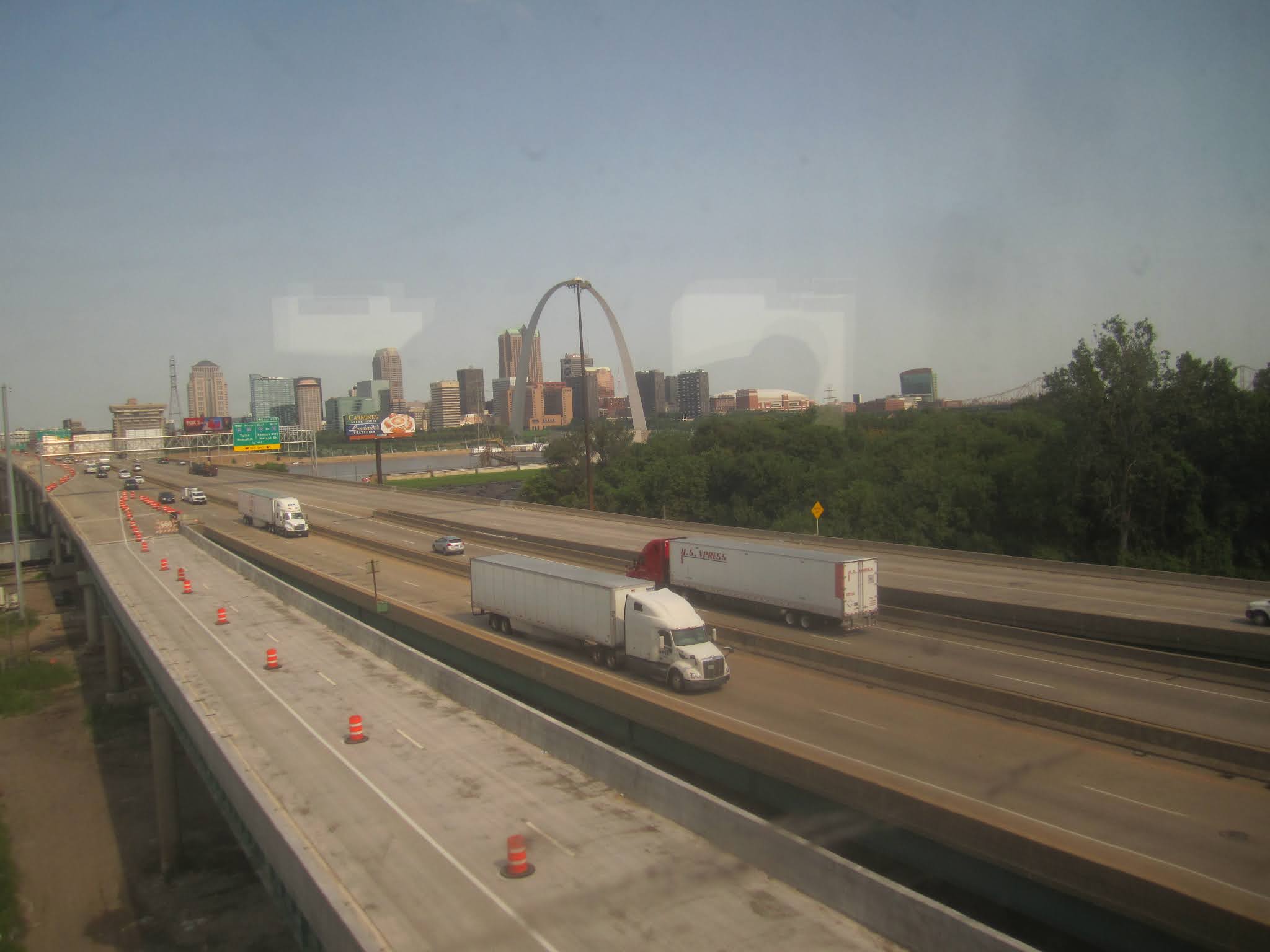
South of Joliet, we passed by Lincoln National Cemetery, which is a place that gives me pause to pay my respects to my Grandpa Martin. Then we followed the Route 66/I-55 corridor through vast farm fields, which put me in the mood to play the movie soundtrack album of Cars. Further along, I switched to the album of the movie soundtrack for Lincoln as we neared Springfield. I also got myself in the mood for visiting the Bush Presidential Center by reading more of No Higher Honor, Condoleezza Rice's memoir of her service in the Bush administration. It started to rain at Bloomington-Normal, with some thunderstorms. As we got close to St. Louis, we got great views of the skyline. After we departed St. Louis, I joined my friend Roy's Bible study gathering by calling in to the Zoom session he hosted.
The next morning, on Friday, July 16, I awoke to the scenery of rural Arkansas, which was picturesque in its own delightful way.

Station at Hope, AR
I stepped off the train at Texarkana, in the photo below, to walk around a few minutes after 8 AM.

Then we entered Texas. During this time, I listened to Speaking for Myself on audiobook, Sarah Huckabee Sanders's book, which seemed fitting since part of this trip went through Arkansas.

The view of the Piney Woods from the final car of the train as we await our arrival at the station at Marshall, TX
I stepped off to walk around at the Longview station a few minutes after 11 AM, my entry into the blast of Texas summertime heat. I also reminisced about my last trip to Texas, when I traveled to Austin via the Texas Eagle, and stepped onto Texas ground for the first time at the Longview station--please see photo below.

We headed west from Longview, and after passing through fields for a while, we then reached the sprawl of the Dallas Metro Area. We arrived around 1:30, about 2 hours late.

The Texas Eagle, train #21, at Dallas Union Station
I got my bearings with the DART system, and then boarded the Red Line train. I disembarked at the Tyler/Vernon station, where my AirBnb host, John, awaited to pick me up and take me to his home, where I had booked my lodgings.
Before this trip, my mental picture of Dallas was as a big Texas city, but this time was a chance to get a feel for the neighborhoods like Oak Cliff, where I stayed. It was a quiet place, without sidewalks or much vehicular traffic, and tree-lined streets, which helped provide shade in the intense Texas summertime heat.

Entry area into the neighborhood where my AirBnb lodings were, at Vernon Avenue (in the foreground) and Monssen Drive, which heads off from the foreground
After getting settled, I went to get lunch at the Tacos La Gloria food truck by the Tyler/Vernon station. Following a trip to the nearby Kroger for groceries, I decided to head into downtown Dallas.
So I got on the DART, and once in downtown, I walked to the Central Library. (The photo below shows a view of the library building from the southwest.)

I arrived with about half an hour before closing, which gave me enough time to tour the highlights. It is a spectacular building, housing not only library resources, but also great exhibits and displays of artwork. I was particularly impressed with the Declaration of Independence display, with an original Dunlap broadside printing, among the first printed copies of the Declaration from July 4, 1776.


There was also a special room with wooden paneling that houses a Shakespeare Folio. And there were great views of the surrounding blocks. I was also pleased that staff on the 2nd floor at the children's desk reached out and offered me a guided tour sheet that highlighted the displays.
I walked north from the library, and stumbled upon Thanksgiving Square--please see photo below. It's an interreligious meditation/prayer space that celebrates the universal human act of thanksgiving. Its main plaza is below street level, by design. There's a waterfall feature with the sound of water so noisy, it actually drowns out the sound of the traffic at street level--this feature appears to the left in the photo below.

And then I walked to the Cathedral of Guadalupe for 7 PM Mass in Spanish. The steeple soars high above the street level.


The interior had a very sacred, and quaint feel, and the air conditioning was so refreshing after having walked in the still humid and warm evening. Following Mass, I returned to my lodgings.

Shortly after 8 AM the following morning, on Saturday, July 17, I left my lodgings for the principal part of my Dallas excursion. I rode the DART to the SMU/Mockingbird Station, which is below street level. Then I walked to the Bush Presidential Center arriving around 9:20. The architecture of the building is very impressive, especially as you view it while walking toward the entrance.
After I got my bearings, I headed straight for the main exhibit. Unlike other presidential museums I've visited, this one doesn't have a collection of items from George W. Bush's youth. It shows some photos from his youth, and then jumps right into how his service as Governor of Texas gave way to his announcement to run for president in 1999. There was a video montage of the events in the post-election period when the results were in limbo. It was interesting for me to hear the details of what happened during those weeks as I was too young to really latch on to all the details back when it happened. And there was lots of memorabilia from his first inauguration.
The exhibit then moved into a look at his major policy aims of the first few months of his administration: tax reform, education, and faith-based initiatives.


There was a marked shift in the tone of the exhibit with the displays about September 11. Prominently displayed was a piece of twisted metal from the World Trade Center wreckage, as shown in the photo below.

There were video displays from the news coverage that day, and other artifacts, some of which are in the photo below, like notes from the speech he gave that evening.

From there, the exhibit discussed his administration's efforts to combat terrorism. The exhibit then changed to a much lighter tone with exhibits about his life in the White House. Featured there was a full-size replica of the Oval Office, which, notably, visitors can actually walk into, unlike at other presidential museums, and they can even sit at the Resolute Desk.


Visitors can also step outside into a recreation of the colonnade and the Rose Garden.


The exhibit also took a look at other major aspects of policy his administration addressed, including foreign relations, like addressing disease in Africa, the 2008 financial crisis, immigration reform, and social security reform. The end of the exhibit focused on his post-presidency activities.
On display were items like memorabilia from state dinners, statues of the Bush dogs, gifts from people of foreign countries, and documents like his statement nominating Samuel Alito as an Associate Supreme Court Justice.
Besides the main exhibit, there was a special exhibit featuring his portraits of immigrants--painting is a hobby he's taken up in retirement. Included with the portraits are displays explaining the current immigration system and policy suggestions for reform. I had checked out the book he published featuring the portraits and had read many of the immigrants' stories. It was wonderful to see the actual works on display, with a range of people including government official Dina Powell McCormick and Arnold Schwarzenegger.
 |
| Here are three of Mr. Bush's portraits: At the top is Madeleine Albright. Below her is Alfredo Duarte. To the right is Indra Nooyi. |
 |
| Above is a display with a bar graph showing US foreign-born population over the years. On the surface is a display with examples of immigrant contributions, including inventions and food items. Below is a close-up. |

I then went back to the main exhibit to take a second look at a few areas before I went to lunch at Cafe 43 at 2 PM, located in the museum building. I had chicken enchiladas. I also bought some Cowboy Cookies to take home, which is Mrs. Bush's noted recipe.
Following lunch, I walked around in the Texas Native Park on the grounds to the south of the museum, and I lingered there for a while. The four photos below show different views of the park.
 |
| Looking south |
 |
| Looking east |
 |
| Looking north toward the library/museum building |
 |
| a pond feature |
A little after 4 PM, I made my way back to the SMU/Mockingbird DART station, and then rode the train north to the Spring Valley station in the suburb of Richardson. I walked west to St. Paul the Apostle Parish to attend 5:30 Mass. There wasn't too much decor in the sanctuary, but that brought more attention and focus to the crucifix and the window of St. Paul. Following Mass, I walked back to the DART station and then rode the Red Line about 45 minutes back to the Tyler/Vernon Station. Upon arriving there, I decided to get dinner at Tacos la Gloria, tacos accompanied by rice and beans. And then I returned to my lodgings to retire for the night.
I spent time taking it easy the following morning, Sunday, July 18, visiting with the hosts, and walking around the neighborhood. I ended up back at Tacos la Gloria and got a gordita for lunch. After I brought it back and ate it, I got myself packed up, and shortly after noon, John took me to the DART station, where we parted ways, and I traveled to Union Station.
 |
| Tyler/Vernon DART station |
After putting my luggage into parcel check storage, I walked around the downtown area for a while. I trudged through the intense heat and humidity to Trinity Overlook Park to take in views of the Dallas skyline, which is in the photo below.

On my way there and back, I passed through Dealey Plaza, in the photo below, which I learned commemorates the settling of Dallas back in the 19th Century and is named for civic leader G.B. Dealey.

Then I stopped by Thanksgiving Square to see the inside of the chapel and then stopped briefly by the Cathedral of Guadalupe. And then I went to find a meal to take with me on the train, and I ended up at a Thai place and ordered fried rice. I also took a look at Pioneer Square, which is in the photo below, and there is a log cabin there.

A little after 3 PM, I was back at Union Station, and shortly after 3:30, I was on the platform, awaiting the Texas Eagle #22 northbound train, with a throng of other passengers.
On the ride, I visited with my friends over the phone, while having my dinner, and then enjoyed conversing with Chloe, the lady sitting in the seat next to me. I also listened to more of Speaking for Myself. After settling down for the night, I stepped off the train at Little Rock a little before 1 AM to walk around briefly.
The next morning, on Monday, July 19, I awoke in southeastern Missouri. Around 9 AM, the train arrived at the station in St. Louis, and I got off to walk around. The Amtrak staff added two more cars to the train, and then it filled up with a load of new passengers. By 10 AM or so, we crossed the Mississippi River and headed toward Alton, and then northward through Illinois. The fields were bathed in warm summer sunshine.
 |
| Above is the railroad bridge over the Mississippi River. Below is a view of the St. Louis skyline. Both photos are from the Illinois side. |
At Springfield, a WCIA news crew from the Champaign/Urbana area was filming footage on the platform and they interviewed Kenyatta, one of the car attendants working the coach cars on the train, though I never got the full answer of why. (Later, I discovered this video, which features footage of the train I was on, though I don't appear in it. However, it shows Kenyatta.)
 |
| Above is a view of the Illinois State Capitol building. Below is the news crew at the Springfield Amtrak station. |

 |
| The smiley face water tower is in Atlanta, IL. |
 |
| The LaGrange Road Bridge, which I usually cross twice daily during my commutes between home and work. |
 |
| Harlem Avenue Bridge |
 |
| Here's the view of the Chicago skyline as the train crosses over Canal Street. Below is Connie's Pizza. |

 |
| Here's my seat on the train. |
We arrived at Chicago Union Station around 4:45.
 |
| Here's the train parked at Union Station after its arrival. |
I headed off the train and out to Clinton Street, where Mom and Dad were waiting to pick me up and take me home. As I walked outside, I couldn't help but notice the distinct contrast with much less humid conditions in Chicagoland. I was home around 5:30 or so.
There was so much about this trip that speaks to why I am proud to be a citizen of the USA. First of all, this trip brought the fulfillment of my wish to visit George W. Bush's presidential museum. I admired him when he was president, in ways that I felt deep inside of me that I can't necessarily explain in words. Now, in these years after his presidency, I can perceive him through the lens of history. I certainly got that different perspective when I read his memoir Decision Points. He focused the book on a select number of important decisions he made during his presidency, and even before, like his decision to cease drinking alcohol and to run for the presidency. Each chapter was an opportunity to see into his mind.
And that's what I experienced when I visited his museum The displays looked at different areas of policy he addressed during his presidential administration. Even the Oval Office replica gives visitors a chance to see into his mind, by actually walking into it and even getting the chance to sit behind the Resolute Desk, a way to see what he saw as president.
It was like a dream come true to get to know President Bush even more by visiting this museum. And it was special to do it in 2021, as he turned 75 back on July 6. Perhaps this museum also resonated with me because I was born in the presidency of his father, George H.W. Bush, and then came of age during the George W. Bush presidency.
 |
| Thanks to the fellow visitor who photographed me by the first Bush, appearing to the right of me, and the second Bush, appearing to the left of me. |
I was also glad to have the chance to visit Texas once again, reconnecting with my first visit there 8 years ago. This time was a great opportunity to become better acquainted with Dallas, through walking around the downtown area and staying in the Oak Cliff neighborhood. Riding the train into even just a portion of North Texas also helped acquaint me with the setting of the place where George W. Bush has lived for so many years.
Riding Amtrak to get there was another wonderful opportunity to connect with the land of the USA on a different level, traveling at a different pace, just like I did when I rode the Texas Eagle to Austin 8 years ago. And it was a great way to continue the celebration of Amtrak's 50 Years.
 |
| Thanks to Chloe, who got the photos of me above and below on the platform during our fresh air stop at Longview, TX. |

Against the backdrop of the 2nd Bush administration, I came to a greater awareness of what the USA is all about as a country. That awareness inspired me to do my part to edify the USA. I saw efforts of the administration to do so, like building greater respect for the preborn, and empowering faith-based programs in their work of serving their communities. And the Bush Presidential Center continues its efforts to edify the USA and work toward solutions on issues faced throughout the world.
Reconnecting with the times that first inspired me to love and work for the good of the USA, I am reinvigorated to do my part in edifying the USA.
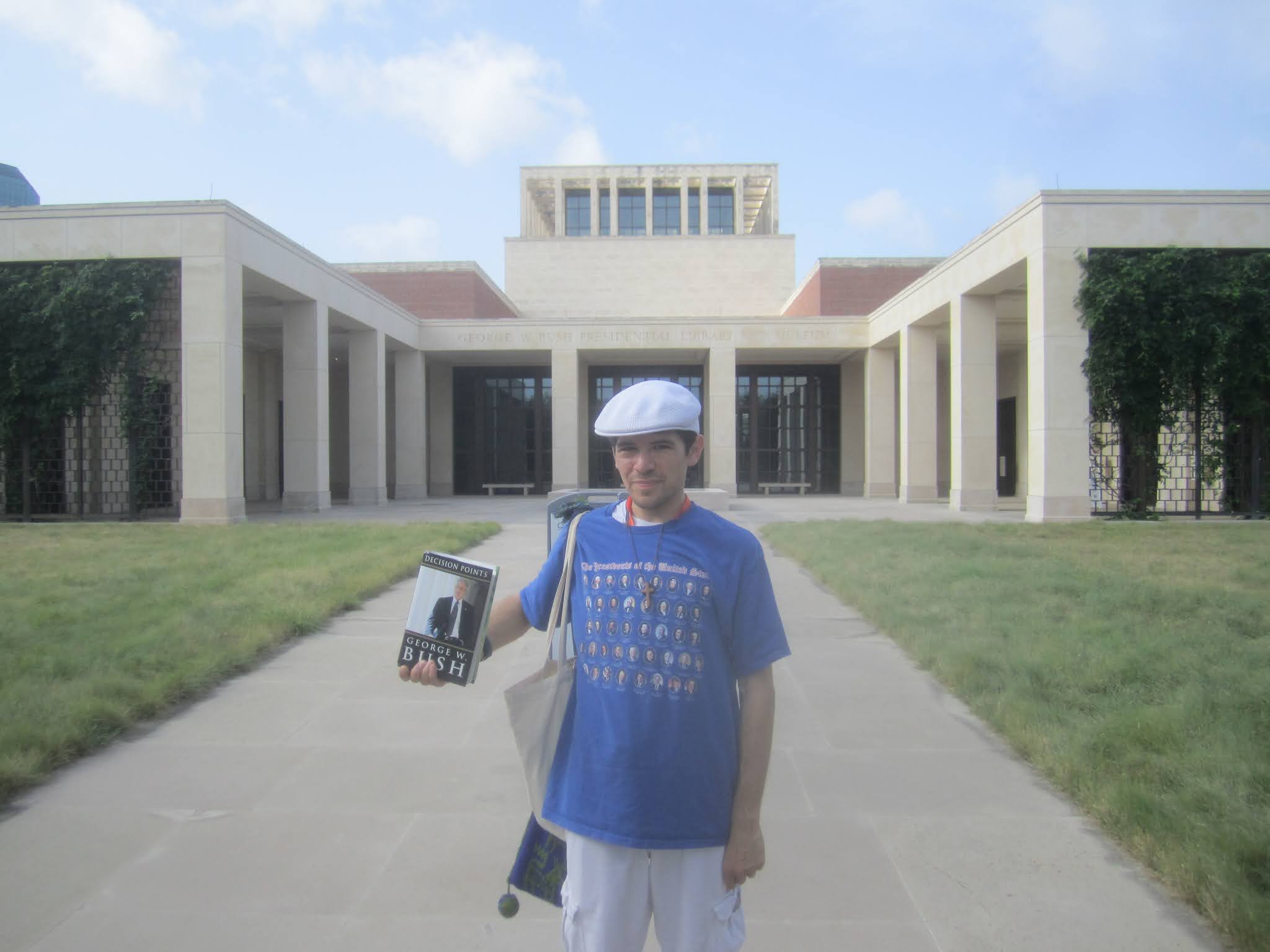 |
| Thanks to the fellow visitor who photographed me as I posed in front of the Bush Center with my copy of Decision Points. |
