Wednesday, July 24, 2019

Seeing History

Traveling to visit Williamsburg 10 years this past week was a great experience for me, especially in providing an opportunity to see the history of the colonial and Revolutionary periods come alive.

Below is a collection of photos from that wonderful trip.

Please note that, to the best of my memory, the photos in which I don't appear were taken by me.  The photos in which I appear were taken by either Mom or Day, unless otherwise noted.  This was with a family digital camera we all shared, as I wouldn't get my own camera until almost three years later.

On Saturday, July 18, after checking in at our hotel resort, upon entering our unit, I was delighted to see the number of the unit was 1826, which was the year the United States marked 50 years since independence.


Below is the fort at Jamestowne, and I am posing by an entrance to it in the photo above.


Below are the excavated remains of the House of Burgesses building.  Notably, it was on July 30, 1619, when the House of Burgesses first met--and the 400th anniversary of that first meeting is in the upcoming week, on July 30, 2019.

The photo above shows the plaza built for the Quadricentennial of the 1607 founding on Jamestown, celebrated in May 2007.  It is outside the visitors' center that serves as the access point for Historic Jamestown site and the Jamestown Settlement living history museum.


Below, I am posing by a sign welcoming visitors to Colonial Williamsburg.

Below is a bridge that leads from the Historic Colonial Williamsburg Visitors' Center to the path leading toward the historic area.  Walking toward colonial Williamsburg are a series of plaques taking people back in time, which give a lot of perspective on history and characteristics of different eras.  Heading toward the visitors' center are plaques that take people toward the present and mark the progress toward greater freedom.


Above and below are images of the same plaque, but oriented two ways so you can read both sides.  As the context would indicate, this plaque is at the end of the bridge leading on to the path toward the colonial Williamsburg historic area.


Above and below are images of the same plaque, but oriented two ways so you can read both sides.  As the context would indicate, this plaque is at the end of the bridge by the visitors' center building.


Here's the plaque right before reaching the end of the bridge at the visitors' center.


Above is the printmaker, and below is the wig shop.


Above is the Governor's Palace in Williamsburg.

Above is the colonial Virginia capitol building, and below is the chamber of the House of Burgesses inside.


On Tuesday, our second day visiting Williamsburg, we attended an outdoor play that was staged mostly on and around Duke of Gloucester Street, recreating scenes from the years leading up to US independence.

Below, I am posing with Patrick Henry, who appears to the left, and Richard Henry Lee, who appears to the right.

The characters in the play act totally in character according to the times:  So when I remarked that my Dad had a machine to take a picture of us instantly, Patrick asked me what tavern I had been to, for clearly I must have had too much (alcoholic) punch to think that a machine could instantly get a picture of us.


Above, Lord Dunmore addresses the gathered crowd about actions the British Crown is taking, which will curtail the democratic processes of government in Virginia.  Before the play started, a costumed figure informed us that we were going back in time: We would all become British subjects, thereby obligating us to properly acknowledge the King's representative, Lord Dunmore, the Governor of Virginia, as he passed by in his carriage.

Below is the crowd gathered on Duke of Gloucester Street, facing toward the capitol.


Above is a cannon salute in the scene in which, so far as I can remember, the characters took decisive steps towards independence.  Below is a parade of fife and drum players, who walked from the Capitol down Duke of Gloucester Street.


I got super excited in the exuberant atmosphere and began cheering loudly.  Dad was a bit taken aback, feeling that if he was living in that time, he wouldn't be as eager to support the movement for independence.

And it's true that by moving toward independnece, the colonists were breaking away from a country that had defined so much of their existence and their land for over a century.  Yet, I became convinced that the colonists were motivated by noble aims that gave them courage to break from Britain and forge a new country.  They were moved by a patriotic spirit that I feel in myself today.

Above and below are photos from Presidents Park, with large busts of all the US presidents.  Unfortunately, it closed.  It was so fascinating to walk around and look at the presidents and read signs that told about each of them and the times in which they lived.  These photos were taken from a balcony on an upper level of the visitors' center building at the park's entrance.  Upon investigating, I found out that currently these statues are being held in a farm somewhere nearby, awaiting an opportunity be part of a new attraction.

Below is a photo Dad took of me at the entrance of Presidents' Park.

On Wednesday, July 23, on our way back to Oak Park, we stopped for a tour of St. John's Church in Richmond.  The photos below and above show the inside.  Back on March 23, 1775, St. John's Church was much smaller than it is today:  The altar would have been in the spot depicted to the far left in the photo below by the large paneling display that contains, so far as I remember, the 10 Commandments and one of the Creeds.  The pews would have faced toward that altar.  Even though much smaller than it was today, the tour guide, Rick, indicated that this church was the largest building in Richmond at that time, which is why the Second Virginia Convention gathered there.

Rick took the photos above and below of the three of us.  Above, we're posing by the main entrance of 1775.  below, we're posing by the main entrance that has been in place since the Church was expanded, so far as I remember, sometime in the 20th Century.

Rick also took the photo above of the three of us posing at the (current) main entrance, which shows the whole church tower to the cross on top.

Wednesday, July 17, 2019

Experiencing the Spirit of America, 10 Years Ago

It was 10 years ago today, Friday, July 17, 2009, that my parents and I departed for a trip to Williamsburg, VA.  This trip was a true highlight during that summer, and probably in the course of my whole life.  In the midst of challenges I faced at that time, not the least of which was my transition to college, it was so wonderful to spend a few days doing something I truly enjoyed, namely in seeing history come alive.  I knew much from my own studying about the history in places like Jamestown and Williamsburg, which made it all the more thrilling to see it.

As I reflect back on that experience, I share from a reflection in the day-by-day account I wrote of that trip:


I like to think that vacations are life-changing experiences, and this one was certainly no exception, for it offered me some much needed refreshment and a new perspective on America.

This trip, however, may have just stayed an idea in my mind.  Originally, Mom was planning a family trip to the Smoky Mountains in Tennessee.  But then, prompted by a change in circumstances, so Mom asked me where I wanted to go.

After much consideration of various locations along the East Coast, I settled upon Williamsburg, VA.  For a long time, I had wanted to go see this preserved colonial-era city, among many other places that suit an American Revolutionary Era buff like me.

One of the first things I looked forward to particularly about this trip was that we were to travel to Virginia by car.  I very much looked forward to a road trip, because I feel that going by car allows a person to really see America while passing through it, right outside the window, not to mention the opportunity to stop and visit a place.  We didn’t stop at too many places, but there were two places we stopped that I had been awaited visiting for a long time.

Last time we were vacationing on the East Coast, I had hoped to stop and visit St. John’s Church in Richmond, VA, the place where Patrick Henry declared, “Give me Liberty or give me death!”  As it turned out, that day we were in Richmond, we first visited the Virginia State Capitol, and by the time we got to the church, it was 4 o’clock, and the site was closed for the day.  So I waited for six years, and finally, this trip afforded me the opportunity to see this place.

Mentioning St. John’s Church reminds me of one aspect of our trip that I was glad to encounter: so many friendly people.  We met them as servers in restaurants, at the check-in process at the resort, at the Food Lion grocery store, and at St. John’s Church.  These people were all so helpful, and I was glad we had the opportunity to have a friendly chat with them, so we could interact as friends before moving on.  (I was particularly impressed that as we walked into Food Lion, a woman greeted us, and I couldn’t recall having been greeted upon entering a grocery store.)

We also got to relive another wonderful place from our 2003 trip: Michie Tavern, near Charlottesville.  This place has some great food, which we thoroughly enjoyed last time, and enjoyed again this time, in a setting that evokes the 18th-century colonial era.

Another place I finally got to see was the West Virginia State Capitol.  I had hoped to see it on the way back during our 2003 trip, but while we passed through West Virginia, it was raining, and I guess I didn’t feel inclined to request stopping, even though I could see the dome from the interstate.  But once again, we passed by the same route, and I got my chance to see this building, which has some well-landscaped grounds.

It’s interesting to note that during our trip, we visited four former or current capital cities, all within an area that was once within the borders of Virginia: Jamestown, Williamsburg, Richmond, and Charleston.  The whole string of these capital cities represents a good slice of American history.  And the best part of this trip was actually seeing the history I had heard so much about before come alive and real before me.  Sure, I may know a lot already about the events that occurred in these places, but it all becomes so much more when I actually get to see it myself.  I was enthralled to walk among the ruins of Jamestown buildings, and see the restored and preserved Williamsburg buildings.

And being in Williamsburg offered me a life-changing experience indeed, for it offered me a refreshingly new perspective on what it means to live in America, the country whose creation was shaped, in part, by events that occurred in Williamsburg.

One of the things I learned was about the relationship of religion and government.  Back in the 18th century, under British rule, the government controlled the church.  Thus, a person was required to attend the Church of England, which was the only officially recognized church in Britain and its colonies.  A person could be fined for not going to attend services at the Church of England often enough.  And the government was wary of other religious groups.  It allowed them to have meetinghouses, but to keep an eye on these groups, required them to keep their doors unlocked at all times.  The government was especially wary of Roman Catholics, who regarded the Pope as higher than the King, and to regard anyone higher than the King was considered treason.  (In fact, it was a felony to build a Roman Catholic Church in the British colony of Virginia.)

Clearly, the founders of America did not want a nation in which the government regulated how people practiced religion.  They wanted that decision to be left to individuals themselves.  So they gave Americans freedom of religion.  Being in Williamsburg convinced me that this is the purpose of religious freedom.  And it is why I consider it so unfortunate that people today misinterpret “freedom of religion” as an excuse to suck every single drop of religion out of public life, when references to religion in public life are definitely not unconstitutional.

One of the most enjoyable parts of Historic Williamsburg was seeing history come alive in the Revolutionary City presentation, an outdoor theater presentation, portraying scenes related to a particular theme or larger event that took place in Williamsburg while it was the capital of Virginia.  On the day I was there, the scenes were about the collapse of the royal government in Virginia, from the years 1774-1776.  In the introduction, one of the costumed interpreters discussed the situation: the British government was imposing more control over the colonies, mainly in levying more taxes.  Some citizens were outraged about what Britain was doing, and desired to revolt.  But it wasn’t such a black-and-white issue to simply side with the patriots against the British.  To join the patriot cause was treason.  Furthermore, the patriots were turning against a nation that had controlled their land for over a century, and had provided them with a government, commercial regulation, a church, and a way of life.  Turning against Britain would mean the end of all that they had known.

Hearing this made me realize something: The people who supported the patriot cause must have had a compelling reason to side with the revolt against Britain.  They obviously had much to lose.  Something must have compelled the desire in them to break away from Britain, and form a new nation: a spirit must have compelled them.  And I’m convinced that this same spirit still compels the existence of this nation today.  We must follow this spirit to keep our nation strong and free.

Indeed, I received a new perspective on America during my visit to Williamsburg, one that everyone should experience.  I am certainly convinced that Williamsburg is one place that should be put on the list of places that all Americans should visit.  It makes our very American identity more meaningful to see this place.

A series of plaques on a footbridge leading from the visitors’ center to the Historic Town area of Williamsburg take visitors back in time, and then bring them back to the present America, step by step.  The last plaque on the side leading to the present asked us, citizens and Williamsburg visitors, what difference we’ll make.  I know what difference I’ll make:  I will stand up and be a patriot.  I will stand up to make this great nation of America even better.  And I will stand up for freedom of religion, knowing that the Constitution gives me the freedom to practice religion as I choose.  I will uphold that freedom that the founders determined to be for all Americans.

I hope all Americans will join me.


Thursday, July 4, 2019

Illinois Bicentennial Follow-up, in Vandalia

Today is the anniversary of the adoption of the Declaration of Independence.

Because of that anniversary, July 4 is also the day that the star of a newly-admitted state is added to the US flag.  And it was 200 years ago today that the 21-star flag debuted, as the 21st star for Illinois was added to the US flag, after it was admitted as a state on December 3, 1818.

So today's occasion seems an appropriate follow-up to the Illinois Bicentennial of December 3, 2018.

As another appropriate follow-up to the Illinois Bicentennial, I participated in the festivities for the Bicentennial of Vandalia, IL, the 2nd state capital city.

Kaskaskia was the first state capital city of Illinois when it became the 21st State in 1818.  To avoid having a city with such an important role in a place vulnerable to Mississippi River flooding, the powers that be decided to move the capital to a different location, the city of Vandalia, in 1819, which was established on March 30, 1819.

And so I headed down south in Illinois once again on Flag Day, Friday, June 14, 2019, to partake of Vandalia's Bicentennial celebration.

Just like I did last year for my weekend excursion that included visits to all the Illinois capital cities, I drove along I-57 closely paralleling the eastern border of Illinois.  Near Mattoon, I exited and went east to Charleston, IL, to the Coles County Fairgrounds (#25 on my secondary Illinois 200 list), the site of the 4th Lincoln-Douglas debate and the 4th debate site I’ve visited.  On the eastern edge of the fairgrounds is a small museum (#26) and statues of the two figures.  

Some people helping out at a tractor pull event were kind enough to get photos of me and then we got chatting, one of which appears above.  (Mr. Douglas is to the left and Mr. Lincoln is to the right.)  I remarked how this was my first visit to Charleston, and something I knew about the city is that it’s the hometown of former Illinois Governor Jim Edgar (#27).  Mr. Lincoln's parents also lived nearby.

(Please note, all photos in this post are mine, except where noted.)

I then drove back west to Mattoon where I got dinner, and then drove about an hour on I-57 to Effingham, and then westward on I-70 to Vandalia.  I exited at US 51 and then drove west along Veterans Drive to stop and admire the fiery breath of the Kaskaskia Dragon (#28) against the dark night sky, which you can see in the photo below.  There was a brilliant moon to the south, and lightning in a thunderstorm to the north.


The next day, Friday, June 15, I waited out a downpour before heading to downtown Vandalia.  I wasn’t clear how the festivities would be held with the rain that had been falling that morning.  I figured a good place to start would be the Old Statehouse building, which you can see all decked out in patriotically festive decor in the photo below.  

The various historical displays with costumed individuals sharing about them were moved inside, which was a good chance to go inside the various rooms of the statehouse, normally cordoned off and viewed from outside in the hallways.
Here's a display for a 19th Century medical professional.

Brian Ellis, a history presenter, invited people to come upstairs to hear about indigenous American perspectives on Illinois history, in the old House of Representatives chamber.  He shared some traditional songs and told stories about tribes like the Sauk and Fox, interweaving stories about creation and going all the way to the time of Blackhawk (#29).  Some of the stories were heartbreaking about what the government did to indigenous peoples.  But it was also awe-inspiring how he concluded, saying his presentation was about sharing stories with us, and he invited us to share stories with him, a kind of sharing of “the light” with each other.

Following this presentation was a musical presenter who shared various songs from 19th Century Illinois history.  Abraham Lincoln walked in as his presentation began, and sat in the area of the room where he likely would have sat while serving as a state legislator, as you can see in the photo directly below.


There was a great variety of songs, like the Illinois state song (including an alternate final verse written in the 1960's), the Shawnee town song, a song used by people steering flatboats on the rivers, and a Lincoln campaign song, "Lincoln and Liberty".  Mr. Lincoln even joined in on a number playing a small harp instrument, which you can see in the photo directly above.

I stepped out after the songs ended and went outside to find lunch.  I was back in the old House chamber by 1 PM for Brian Ellis’s next presentation, in which he portrayed William “Billy” Herndon (#30), Mr. Lincoln's longtime law partner in Springfield, as seen in the photo below.  Mr. Herndon shared his perspective on Abraham Lincoln, particularly related to his lawyer career.  He framed it with 5 different questions that people consider about how Mr. Lincoln learned to be a lawyer, and whether he was more politician or lawyer, and used many stories to shed light on these questions.

There were intriguing stories about cases he tried, like the Illinois Central railroad, a woman going through a divorce (which resulted in a stride toward rights for women), and a woman in her Golden Years accused of murdering her husband.  When that accused woman said she was thirsty, Mr. Lincoln said she could get water in Tennessee.  Mr. Herndon offered us plenty of food for thought, especially toward the conclusion of the presentation, when he spoke about how Mr. Lincoln mastered the art of storytelling, which has a kind of power.  Certainly Mr. Ellis is a master storyteller in the way he brought history alive to give us plenty to ponder from the new perspectives we encounter in those stories.

When he finished his William Herndon presentation, it was almost 2 PM, and the rain had stopped and the sun was starting to shine through the clouds, just in time for the parade on Gallatin Street.

The parade started with a fife and drum group.  There were plenty of other historical characters, like a group of youths dressed up as characters including George Washington, Abraham Lincoln, and the Statue of Liberty.  There were some businesses that compared windows and heating units then and now.  There was one marching band with youths, but I couldn’t read their shirts and tell of what school or group they were part.  There were also cars that had toured the national road in various years throughout the 20th Century up to 2019.  The parade finished with a bubble bus.

Fife and drum group

Costumed figures

Some of the cars that toured the National Road

A cannon rolling along

Climate controls then (a fire) and now, HVAC systems

Window units then and now

Bubble bus


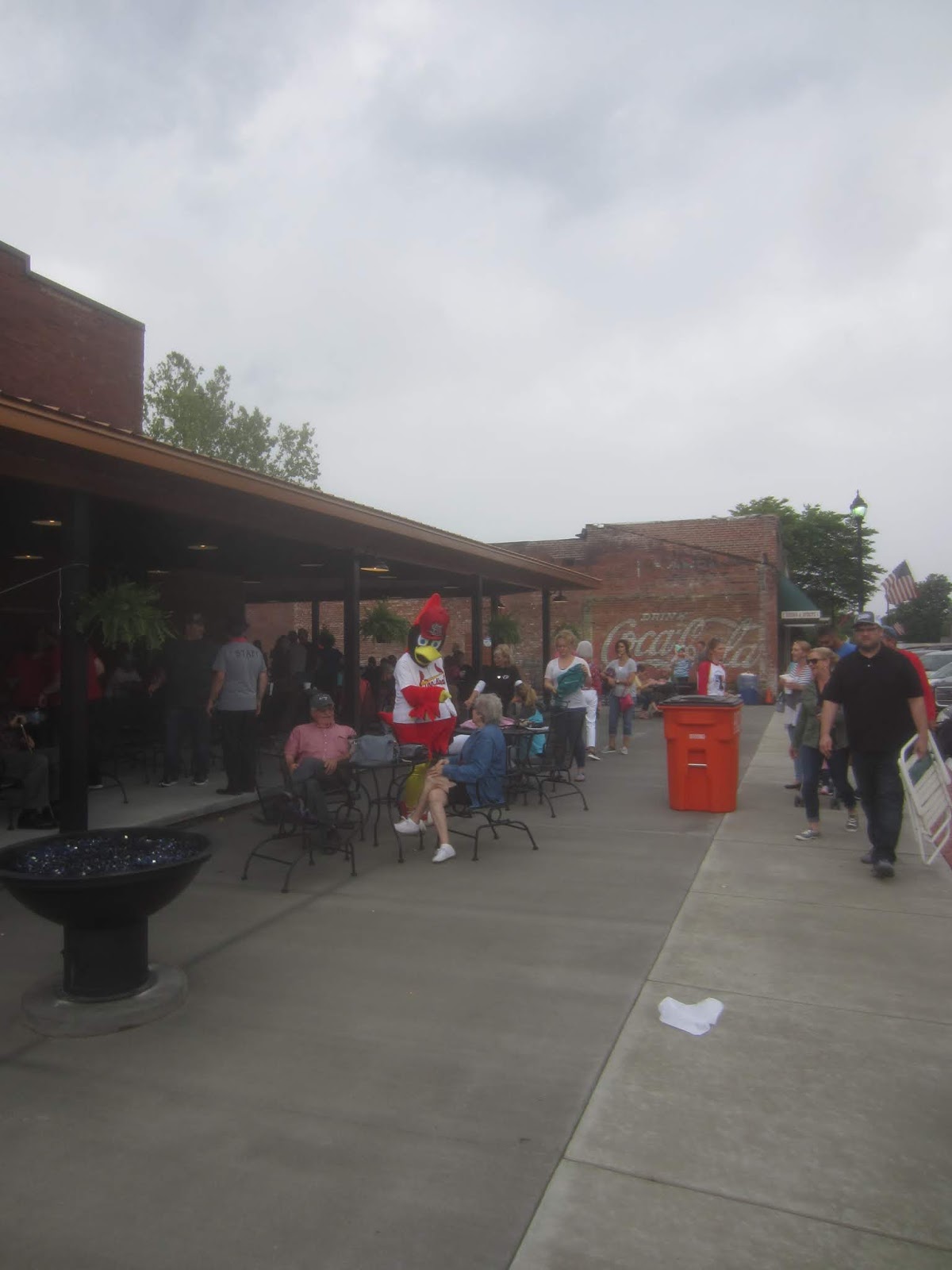
Fredbird, the St. Louis Cardinals mascot


Then, the crowd gathered a block west on Gallatin where there was a photo shoot, and remarks from people like Vandalia Mayor Ricky Gottman.

Once that finished, I went inside Lya’s and Friends, a boutique store, to eat some birthday cake, in the photo directly below, and then buy a commemorative souvenir tote bag to conclude my time at the Vandalia Bicentennial festivities, along with taking a few more photos in the downtown area.

Outside a display across Gallatin Street from the Old Statehouse Site

Looking eastward towards the grounds of the Old Statehouse Site

Sign celebrating Vandalia, beside the grounds of the Old Statehouse

Flag for the Vandalia Bicentennial celebration on a post beside the Old Statehouse Site grounds


Model of the Old Statehouse at Gallatin and 5th, a block west of the Old Statehouse

Also while there, I went to see the sites of the first two capitol buildings in Vandalia that were used before the third, which is preserved as a historical site.

The site of second state capitol building of Illinois (#31) is at 5th Street right at the intersection of Johnson Street, the location of The Leader-Union building, Vandalia's local newspaper.
Above is a plaque on the wall of The Leader-Union building, and below is a view of the front of the building.


The site of Illinois's third state capitol building (#32) is directly across 4th Street from the Old Statehouse Site.
Above is a display for the 3rd Illinois state capitol building on the wall outside the building currently on the site, a commercial property, the front of which is in the photo below.


I have to say, it was a really nice commemorative celebration, probably the best I can ever recall attending.  They had plenty of activities, presentation, displays, and a really nice parade that incorporated so much history, especially in the way of costumed characters.

It was also great to continue celebrating Illinois by engaging with its history, learning more about what has made Illinois what it is.

And everyone made the best of rainy conditions to have a great celebration.  While I was uncertain about what I could do, I ended up having a fantastic time inside the statehouse with the various presentations.

Indeed, it was a sight to behold when I was sitting in the Old House of Representatives room, where Illinois State Representatives did the work of governing that shaped Illinois years ago, and to see history come alive there in the celebration that took place when I visited on June 15.

That's truly the power of telling the stories of history as we take the time to be present to it again, and then join with it as we continue shaping history while doing the work of our lives in the present.


US Representative John Shimkus, R-IL District 15, took this photo of me posing with Abraham Lincoln.

Tuesday, July 2, 2019

Patriotic Greetings 2019: the Idea of the United States

Patriotic Greetings!

These High Patriot Days marking the annual commemoration of the independence of the United States signal a fitting time to ponder the idea of the United States.  This idea contains many individual components, and in each of them, in their own way, we recognize the United States.  And these patriotic days are based in the story of US independence that is one expression of this idea.

Following the conclusion of war between Britain and France in 1763, tensions grew between Britain and the 13 British North American colonies.  After more than a decade, American and British soldiers clashed at the Battles of Lexington and Concord in Massachusetts, sparking the American Revolution, which gave increased momentum toward the independence of the colonies.

On Friday, June 7, 1776, in a session of the Continental Congress meeting in Philadelphia, Virginia delegate Richard Henry Lee offered the following resolution: "Resolved, That these United Colonies are, and of right ought to be, free and independent states, that they are absolved from all allegiance to the British Crown, and that all political connection between them and the State of Great Britain is, and ought to be, totally dissolved."


About three weeks later, the Congress took up debate on the resolution on July 1.  On Tuesday, July 2, 1776, the independence resolution passed unanimously, with a "yea" from each voting colony.  Congress then turned its attention to the draft of a document that Thomas Jefferson composed that explained the reasoning for independence.  The Congress adopted the Declaration of Independence on Thursday, July 4.  (Note that these days fell on the same day of the week in 1776 as they do in this year 2019, which for me, brings me more in tune with the events of those momentous and historic days in 1776.)

The American Revolutionary War continued until a decisive American victory at Yorktown, Virginia, led to peace negotiations.  The war concluded with Britain's recognition of US independence with the Treaty of Paris 1783 on September 3 of that year.


One significant aspect of the independence story of the United States, and an important component of the idea of the US, is how this country came into existence based on a set of principles, distinguishing it among the other nations of the world when the Congress voted for independence and approved the Declaration of Independence.  And these principles have continued to shape and be shaped throughout our history and in our present civil discourse, continuing to give expression to the idea of the United States, which we hold in our land, and also present to the broader world.  Indeed, those principles have great power.

It's amazing to think of what this country has become in the years since 1776, and how our understanding of what this country is and what it means to be a US citizen has come to encompass so much, just as those founding principles have taken on expanded implications.  Certainly my celebration of Illinois's bicentennial in 2018 was a way to recognize what the United States has become since 1776, as new states, like Illinois, joined the original 13, and expanded the land and people the US includes, offering unique contributions.

Indeed, these patriotic days are a great time to think about what makes this country unique in and of itself, and furthermore, how it presents itself to the world at large.

I often think back to my World Youth Day pilgrimage last January in Panama, a 6-day trip that is the longest amount of time I've spent outside of the United States.  I figure that I had probably spent about 48 hours outside the US when my family was traveling through Ontario to the Niagara Falls area, and during our stay in the Niagara area, we bounced back and forth across the US-Canada border.  In traveling to Panama, I was thousands of miles from the United States.  Yet I could instantly recognize the presence of the United States while there, in the many expression of the USA I encountered.  While out and about for the various WYD festivities, I often encountered fellow pilgrims from the United States, with the US flag as one of the most common symbols identifying them, along with anything else they had on them that would suggest being from the US like a shirt for a group from a particular city or diocese, or even other flags like for states or the distinct red “N” University of Nebraska flag.

As I packed, I felt it appropriate while joining with fellow pilgrims from all over the world to bring tokens expressing who I am:  So I brought my own two small flags, one for the US and another for Illinois.  Flags often serve as a powerful symbol that expresses our national identity, especially in consideration of the flag's design.  I waved my two flags with great cheer as a way to express who I am while joining with pilgrims from all over the world who waved their national flags to express who they are, which is a major custom of WYD.  It was a wondrous scene to see us as US citizens join with people all over the world as many nations united in celebrating our one faith in God.
Here I am walking along Avenida Guillermo E. Quijano on the way to Metro Park, on January 26, 2019, with my two flags in hand.  Photo is courtesy of the Diocese of Gary.

Even my passport served as a strong expression of the presence of the United States, with so many scenes, images, and symbols that demonstrate the experience of the United States throughout history and in our present time.  The stamp I got upon passing through immigration at the Servicio Nacional de Migracion (National Migration Service) checkpoint at Tocumen International Airport was the first stamp ever in my passport.  As I admire that stamp, reflecting on the amazing experience it represents, I see that it was affixed right over an image of the top of the Declaration of Independence, which you can see in the photo below.  It's an amazing juxtaposition to see an important expression of the US present upon entering another country.


While ambling around in Panama, whenever I saw people from the US, I often would start spontaneously cheering, “USA! USA! USA! USA!” and there was such an electric energy as they joined in the chant and we celebrated the idea of the United States.  Even thousands of miles from the United States, I could recognize the presence of the US in my fellow citizens and instantly feel a sense of connection with them.  Even beyond our shared symbols, we share an experience of living in the same country, in all its vastness.  That is the power of the idea of the United States.

Having celebrated the idea of the United States in such ways while in Panama, it stirred something in me upon our arrival at O'Hare International Airport, especially when I saw a digital display sign mounted from the ceiling in the hallway leading to the immigration and customs checkpoint, which read, "Welcome to the United States" and embedded with a US flag image.  The scene makes the words come alive from Neil Diamond's "America" song, as we came "traveling far", "on the planes...coming to America".  It was special to return to my country with a renewed sense of patriotic pride from celebrating it while abroad.

(Similarly, as I was returning from my day trip to Vancouver, BC, Canada back in May 2017, it stirred me deep within to see the US flag upon crossing the border as the bus I rode on drove toward the stop for the immigration and customs checkpoint.  Seeing that flag powerfully spoke to me that I was back in my beloved country.)

Months following my trip to Panama’s national capital, Mom and went I on an extended weekend trip to Washington, D.C., my first visit to the national capital city of the United States, since going to Panama City, the first national capital city of another country I've visited.  It is such an inspiring city, in large part because the places, building, and institutions there give expression to the idea of the United States, while that city has done much to influence how the idea has been manifested throughout the country, and beyond.  And it was special to go there for the first time after traveling to Panama, to engage with what made the idea of the US worth celebrating while abroad.

The National Archives houses thousands of documents telling our history, most prominently the Charters of Freedom that speak to how the United States and its idea began.  The Smithsonian museums house so many artifacts and have exhibits that speak to our experience as Americans, our history, our culture, and our identity, even as it continues to be shaped by what we make of the past and present.  The Capitol, the White House, the Supreme Court, and other government buildings are places where the idea is acted out as the process of the people’s government continues, just like it is in polling places when people cast their ballots for government officials, as has happened a couple of times in the past year.

Being in Washington, D.C., stirs some sensations deep down in my soul, because being there makes me aware of who I am as a citizen of the United States.  It was like when my family went there during Spring Break 20 years ago in 1999.  One day, we visited the National Archives museum building, getting inside within half an hour of closing time, which gave us just enough time to see the Charters of Freedom.  I remember Dad hoisting me on his shoulders so I could gaze upon the documents.  I didn't know well the history of those documents as I do now, but even as an 8-year-old, I knew I was looking at something highly significant.

As I've learned the story of those documents, I've come to embrace the special experience of standing before them when I have visited the National Archives, doing so again and again as a sort of ritual experience during subsequent trips to Washington, D.C.
Mom took this photo of me in front of the National Archives building in Washington, D.C., during our visit to Washington, D.C., in May 2019.

And there's nothing like entering that city and being stirred by the sight of the monuments and other buildings.  What's most amazing is the realization that what's there is a reflection of who I am as a person, as I have a part in what those places represent, even as they have had some part in shaping how I live as a US citizen.

I also had these ideas on my mind when visiting Historic Colonial Williamsburg Virginia 10 years ago in July 2009, which was a true highlight of that summer for me.  Having read so much about the history expressed in that place, I was so delighted to finally have the chance to visit it, and see the history on display there.  Seeing it displayed helped provide context for me to understand that history further and its implications for what it means to be a US citizen today, and what we can make of being US citizens as we continue living out our citizenship, expressing the idea of the USA.

Indeed, places are an important expression of the USA.  So are artifacts and documents--even Thomas Jefferson said the Declaration of Independence is a "masterful expression of the American mind."

And that's what makes these days so powerful an expression of the idea of the USA, and, for me, so worth celebrating in grand style.  I celebrate not only because of these days, but because the history we celebrate is something that I am, and we all are, a part of, and can shape for the benefit of those living in this country, and to present something noble to the world at large.

So let us celebrate on these days, and continue the spirit of these celebrations as we give expression to the idea of the United States.

To the Spirit of God, under Whose Providence the United States was born, and the Spirit of the United States of America,

God Bless the United States of America,
Paul

P.S. This is my annual Patriotic Greetings note for 2019.

Here are links to view the versions of these notes that appear on my blog for 20132014201520162017, and 2018.

Like with any of my blog posts, please feel free to share this note with others.

While this note has been in electronic version since 2013, a paper copy is always available.  Please contact me if you would like one, and inform me where I should send it.