Sunday, February 9, 2014

Meteorology on My Mind

It was that time of year again, for the American Meteorological Society's Annual Meeting.  This year, the meeting was held during the first week of February, at the Georgia World Congress Center in Atlanta, GA.  Assembling for the meeting were hundreds of meteorology professionals to discuss the latest happenings in the science.  This meeting came in the week after snow and ice shut down the metropolitan Atlanta area, and other parts of the southern United States, making the discussions at the meeting all the more pertinent.

As a aside commentary on the wintry weather situation in Atlanta and the southern United States--remember it affected more than just Atlanta--it really goes to show how communicating weather information is just as crucial as the information itself.  As of late, we're starting to see how extreme weather can have a big impact on society, and part of the process of properly responding to it and mitigating its associated effects, is for us meteorologists to learn how to effectively communicate the information we assemble, and making sure the end users know how to receive it in a way that spurs them to take the right kind of action.  Dr. Marshall Shepherd, who you shall read about later in this post, offers some perspective on this whole situation in this piece.

Being a recent college meteorology graduate, I found it well worth my time to attend the Early Career Professionals Conference (ECPC) on the afternoon of Sunday, February 2, held as one of many conferences within the larger Annual Meeting.  It was also good to have the opportunity to meet with people in the field.

That started right away while I awaited the MARTA train to take me from the Five Points station to the Dome/GWCC/Phillips Arena/CNN Center station—what a laundry list for a name.  There were two people talking on the platform about weather, one of whom, Kevin, was headed to the meeting.  He was coming straight from the airport, still carrying his luggage, where he had flown in from Indianapolis, where he works with MeteoGroup.  I felt like adding my two cents to the conversation, so I readjusted my bag so that the AMS logo was clearly visible.  The other man took note and started talking with me about weather.  Then I started talking with Kevin as we rode the train one stop over, and then as we made the long walk out of the station, past the Phillips Arena, and then into the GWCC Buildings A and B, over to Building C, which was at least a five minute walk, because the GWCC is a massive and gigantic place.  Kevin and I talked about applications of meteorology in energy, and then some.

When I saw the sign pointing toward the registration desk, we parted ways.  After I picked up my materials, I dashed over to one of the exhibit halls to take a quick peek at WeatherFest, a family fun event always held the Sunday of the AMS Meeting week.  It looked like there were a lot of nice activities, and I was glad to see so many families with children in the GWCC headed to WeatherFest, to enjoy the fun of weather.

Shortly before 1 PM, I was in my seat in the meeting room that served as the main location for the ECPC.  After a few welcoming remarks, we numbered off 1-2-3, and then broke into three groups for small group interactive discussions.  The topics in the discussions focused on how to how to be a leader in one's job, how to keep the job, and diversity in the workplace.  The idea is that we learn technical skills in school, but school doesn't always emphasize leadership and diversity courses, so this conference is filling in that gap.  It’s one of the ways the AMS is seeking to continue supporting individuals after they leave school and while they are starting their careers in meteorology.  This particular conference was being held for the second time ever.

In the leadership discussion, we shared character qualities we recognize in leaders, and not necessarily people who have a “leader” title, which speaks to how we can be leaders, no matter our position in the workplace.  In the keeping one’s job discussion, we shared about things we can do in and out of the work place to show initiative in being involved.  And in the diversity discussion, we discussed diversity in society, and then did a case study, seeking to resolve divisiveness in a workplace situation based on diversity principles.  The two big take-away points were the laws regarding discrimination and how diversity is an asset in enhancing workplace productivity.

The overall take-away points from the discussions were that the things we do to engage meaningfully in the workplace are as simple as being open, collaborating well, and other life skills, and the key is to practice them to make them a reality.  That's the hard part, and why companies have to invest a lot in human resources division to help their employees work well together, and not fall into politicking.

Following a coffee break, which also included tea, the outgoing AMS President, Dr. Marshall Shepherd, a professor of atmospheric science at the University of Georgia in Athens, made a few remarks.  Then there were two panel discussions, with opportunity for the audience to ask lots of questions.  The first was with AMS leadership about opportunities available to us as early career professionals.  It included Ken Carey and Dr. Louis Uccellini, former AMS president and current NWS director.  The second panel discussion had early career professionals discuss their work, and how they are successful, as well as offering advice for us.

The conference concluded at 5 PM.  I then made my way to the exhibits.  Sunday evening featured student posters.  Four ValpU students had posters on display, and it was nice to see them and learn a little bit about what they've worked on, as well as catching up with some of the other ValpU students who came to the conference—a sizable group of 22.  I also went to a reception, with appetizers and a carving station that had my favorite, turkey.

Things were winding down around 7 PM, especially on account of a certain major sports event.  I stepped back to my hotel for a bit.  Then, I headed back to the OMNI Hotel at the CNN Center, next door to the (east side of the) GWCC, for the Early Career Professionals reception at 9 PM.  I made the rounds over the next couple of hours, talking with a number of people about what they’re doing in meteorology, mostly a lot of graduate students and their research work.  One professor I spoke with told me about his work helping a Native American tribal group deal with the effects of drought on their supplies of sacred plants.

I also had the chance to briefly chat with Dr. Shepherd in person.  It was quite something to have the opportunity to meet him in person after having seen him appear in the recent White House "We the Geeks" Google+ Hangout on the Polar Vortex and Climate Change, and the NOVA program "Killer Typhoon" on Supertyphoon Haiyan.  And I spoke with Ken Carey, an AMS fellow, and who I met at the NWA meeting back in October, and the AMS Executive Director, Keith Seitter.  I also enjoyed partaking of the spread of desserts, including cake, cookies, and fruit tarts.  And I won an AMS t-shirt in a raffle of business cards, of which I handed out plenty.

Being at the conference was a great opportunity to meet with people in the field, and engage in this field in which I hold great interest.  I go forth, remaining ever confident about the opportunities there are, and waiting to seize upon the right one, knowing it will be of great service to society at large.
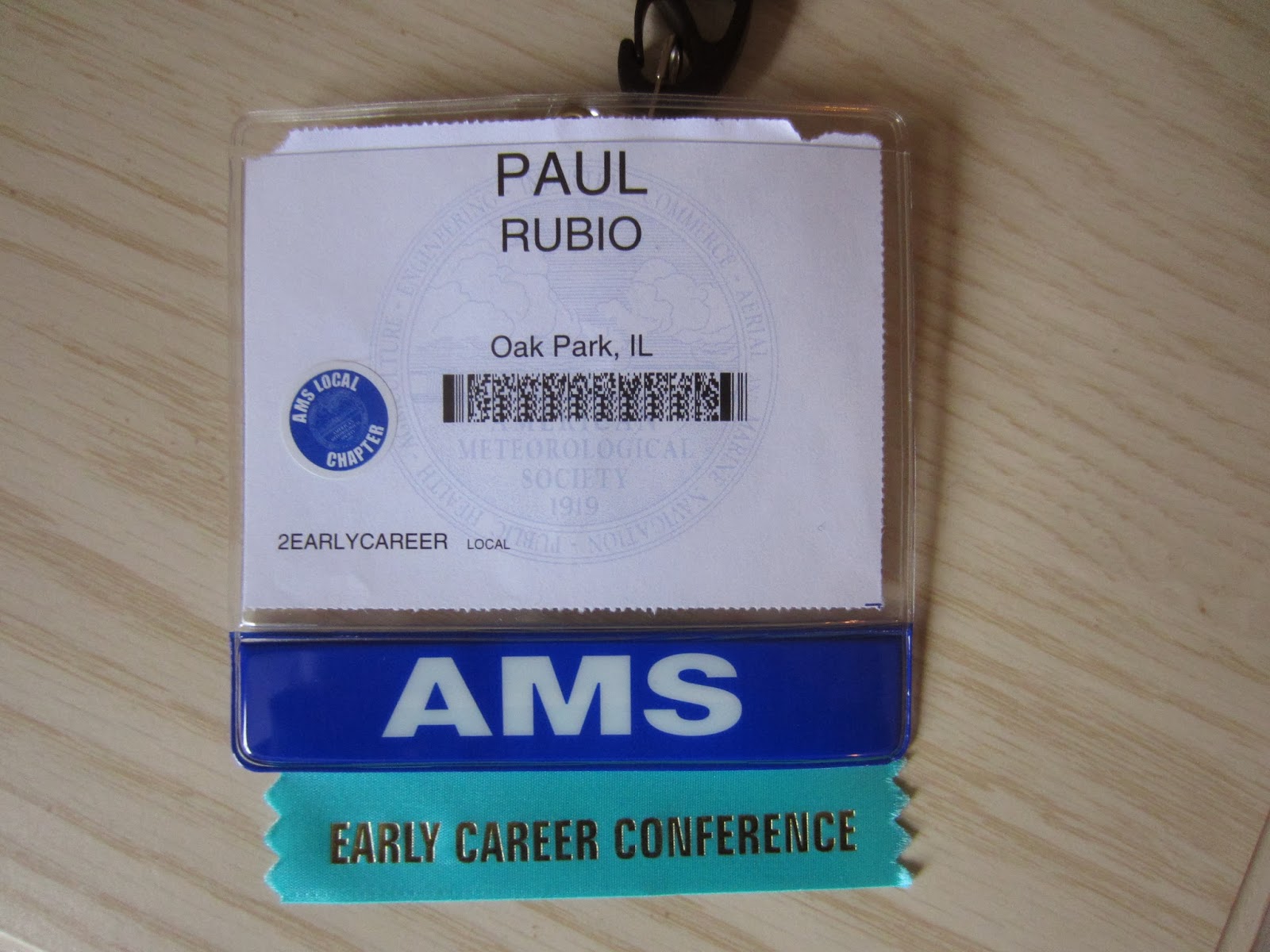

Here I am at the AMS Annual Meeting sign in the GWCC.  Below is a close-up of my conference badge.


An inside look at the GWCC, Building C, west side

Saturday, February 8, 2014

Spellbinding, Sochi-Style

I've never tried to make secret my general disinterest in sports.

The World Cup?  Only the vuvuzelas got my attention back in 2010.

Recent Blackhawks victories?  Good for them, but whatever.

Cubs or Sox fan?  I'm officially neither.

What was I doing while the SuperBowl was on February 2?  Avoiding it, which is my favorite annual custom, since I see American football as a lot of malarkey.  But I don't always go out of my way to avoid it.  This year it was easy because I was in Atlanta for a conference.  (However, I sometimes make a point to watch the US National Anthem, but that's it.)

But then there's one sporting event that I make it my business to watch.  In fact, in 2006 and 2010, it all started the Friday night after the SuperBowl.  You guessed it: the Olympic Games.

I perceive the Olympics as being more than just sports.  It seeks to draw out of people, namely the athletes, the highest character qualities, the richness of the host country's culture, and brings the world together like nothing else does.  There's a higher purpose being accomplished in the Olympic games, as it speaks to what it means to be human.

But my favorite part isn't necessarily the competitions themselves--it's the Opening Ceremony.  It's always so cool to see the artistic show the host country puts on to share before the world its history and culture in a stylish manner.  There's always some kind of epic quality to it.  (I sensed this especially in the music at the London Olympics Opening Ceremony.  And I'm still listening to the Isles of Wonder soundtrack on the CD I bought of it.)

So I was before my TV last night watching the ceremony, starting at that auspicious time of 20:14 locally there in Sochi, on the 7th of February, 2014.

The one thing that always gets me geared up is the opening montage at the beginning of NBC's coverage, which is certainly epic.  This one spoke about the vastness of Russia, bringing together East and West, in a mystifying, grand way.

I really liked the very first part of the Opening Ceremony, with the display of Russian things according to the Cyrillic alphabet.  Not having any familiarity with the system, or many of the things shown, I could appreciate it as something specially Russian.

And I couldn't help but be struck by the mystical, hauntingly beautiful music that came next, accompanying Lyubov, representing the Feminine Soul of Russia, as she lifted up in to the air and passed dreamily among the islands.  I only wish I knew what the name of that music was that was playing.  I'm so drawn by it, I almost want it stuck in my head.

The National Anthem of Russia was a piece that reflected well a strong sense of nationalism, which I sensed in both the tune and glancing over the lyrics, which speak to Russian pride.  There was also a sort of hardiness to the sound of the men's choir singing the song.  I noticed that same kind of hardiness in the Russian announcer's voice, befitting of a people who had to have a sense of toughness to survive in such a land as big, cold, and faraway as Russia.  But when Liza Temnikova, playing Lyubov, sang, she had such a beautiful, gentle touch to her voice.

At first, I was surprised that the ceremony jumped right into the Parade of Nations.  But then I realized it would give the athletes a chance to view the show that came later on, instead of putting most of the show right away, as tends to happen.

I liked the cool effect of the map of each country displayed on the stadium floor as each athletic delegation came out.  But it did seem like there could be some coordination issues as one country marched toward the end of the ramp, while another one emerged.  I also enjoyed the music, which was kind of retro--well maybe not, but music isn't my expertise, so I just think of it as "retro".

I enjoyed the artistic display of Russian history, through the Medieval, Imperial, and Communist Eras.  It was especially effective for the Communist Era, as symbols seem to work better to represent that time, rather representing something more physical.  I couldn't help but notice how Peter the Great had on what looked like some very Western European-style clothes.  And what could be more Russian than that ballet number?

And as the two athletes ran out of the stadium to light the cauldron, I took note of the music playing as something I had heard before.  After first thinking of "Pines of Rome", I realized it was another piece featured in Disney's Fantasia 2000: the "Firebird Suite", a classically Russian piece by Igor Stravinsky, sounding a triumphal tune as the fire traveled to the top.  (And hearing that fast-paced dance from The Nutcracker got me all jazzed up, too.)

Beyond the actual program, some of the commercials were good. I especially liked the Coca-Cola one, in which the lyrics of "America, the Beautiful" were in a variety of languages.  Except for one brief part that seemed a bit lewd, it was a wonderful commercial.  (When I found it on YouTube, I discovered it was a Super Bowl commercial as well.)  And I liked the voiceover audio of Amelia Earhart in the VISA commercial.

While it's true that all of this could be construed as just a show, it's something I find enjoyable, and epic.

So here's to Sochi and Russia for putting on a fabulous show to open the 22nd Winter Olympic Games, and all the best to the athletes as they engage in spirited competition that truly speaks to the human experience.

Friday, February 7, 2014

Special Appearance

So it was with delight that I learned my uncle and his organization were featured in a report on Art Norman's Chicago Making a Difference on the NBC 5 News just recently.

Check out this video of the report: http://www.nbcchicago.com/video/#!/blogs/making-a-difference/Making-A-Difference--Chicago-Voyagers/244043951

My uncle makes his appearance toward the end.

This organization is Chicago Voyagers, and my uncle, Bernie Rupe, is the executive director.  One of their main goals is to give inner-city youths, who often don't live in the best situations, character-empowering experiences by taking them on trips out in nature.  They go camping, hiking, canoeing, and, as featured in this report, skiing.

My Uncle Bernie has been involved in a lot of this type of work for many years.  It fills me with joy to see him so involved in this work to help youths by taking them out in nature, which is one of his big penchants.  He truly has a caring heart that spurs him into real action to do good for others.  I am glad to have him as my godfather and Confirmation sponsor.  He is truly a saintly figure in our own time.

Friday, January 31, 2014

Observations on the State of the State Adress

On Wednesday, January 29, one day after President Obama delivered the State of the Union Address, Illinois Governor Pat Quinn delivered the State of the State Address.  This speech occurred five years to the same day when Governor Quinn was first sworn into office, after the Illinois State Senate unanimously voted to remove Rod Blagojevich from.

Governor Quinn started off the speech recognizing those involved in recent emergency situations in Illinois.

He then painted a bleak picture of the state of Illinois five years ago when he took office, so that he could emphasize how improved the state's condition is now, owing to actions he has taken and lead the way on.

The address focused on how to create jobs in Illinois (ever an important topic) and how to foster an environment that allows the people of Illinois to get good jobs, including financial-related moves and job training, as well as raising the minimum wage to $10/hour.  Then there was talk on education, emphasizing resources and services to enhance early childhood education from birth until age 5.

I was struck by how Governor Quinn said that during his time in office, difficult moves were taken to resolve problems.  I can't say I'm convinced enough bold, difficult moves have really been taken.  And while I have little expertise in matters surrounding pension reform, it's hard to say if the deal that was struck is really substantial enough, especially given how much time it took to finalize it.

Critics argue that the state of Illinois isn't really in such a rosy condition as Governor Quinn put it in his speech.  There are more problems that will have to be sorted through to bring prosperity back to Illinois, with good leadership in state government as an important part.  And as an election year, 2014 is a pivotal time for the voters to do their part to ensure that.

Thursday, January 30, 2014

SOTU Thoughts

Tuesday night, President Obama delivered the 5th State of the Union (SOTU) Address of his administration.  It focused heavily on domestic issues, especially the economy, how to create jobs, and how to help the middle class.  Most internationally-related issues were given less mention, as it seems President Obama has had a lot of trouble dealing with domestic issues over the past year.

I took note when Barack Obama spoke of the activities of common-day Americans at the very start of his speech, (mentioning specifically teacher, entrepreneur, autoworker, and farmer) to emphasize that "you", we, the American people, are the State of the Union.

Throughout his speech, President Obama talked about how the United States is a place where people work hard and succeed by seizing opportunities, such as when he said, "Opportunity is who we are."

It was a little bit after he said that when I noticed Vice President Biden made some kind of gesturing toward someone sitting out in the crowd that gave me pause (see number 1 on this webpage).

Then there was his remarks about climate change: "...the debate is settled.  Climate change is a fact."  I often hear something like this said by people who believe climate change (caused by human activity) is real and is leading to doomsday scenario, and want to take drastic action.  Certainly evidence out there suggests that something is going on.  But I think it should lead to more discussion in healthy tone, rather than these "putting one's foot down to stamp out dissent" kind of remarks, while we work to care for our environment in meaningful ways.

Immigration reform is definitely an important issue that needs addressing sooner rather than later in a substantial way.  I was a little surprised that President Obama didn't spend more time discussing this.  The transcript of the speech only has one paragraph on it, and then he moved right away onto discussing more about creating jobs.

Then I was in for a bit of a surprise when President Obama told the story of Misty Demars.  The television displayed her name at the bottom of the screen, and then her hometown: Oak Park, IL.  Apparently, I had missed the story in The Wednesday Journal that said she would be a featured guest at the speech in regards to his call to Congress to extend unemployment insurance.  While that is certainly a good way to help people out of a job, I think it would ultimately do better to foster an economy that can give people good-paying jobs so they can support their families and livelihoods.

President Obama then told the story of John Soranno, the owner of Punch Pizza in the Minneapolis area, and his employee Nick Chute--nice pun on "dough", by the way.  John had raised the wages of his employees to $10.  Quite frankly, that's the way business should be in this country.  Business owners should be able to grow business by serving people in good ways, and then be able to reap profits whereby they can pay their workers more, not being forced by government law to raise them if it doesn't make sense for their own business.

Subsequently, President Obama then moved on to the major issues of healthcare reform, singling out Republicans for not being supportive of it, and looking down on their efforts to repeal it without creating a different plan.  It's unfortunate this situation exists, that Republican members of Congress recognize flaws in the plan, and are desperate to stop it, and then demonized for it.  President Obama and the Democrats shoved the ACA through Congress back in 2009/2010, instead of bringing people from both sides of the aisle together to sort through the fine details of how to effectively reform healthcare so everyone can have good insurance coverage, especially without causing others to lose theirs.  Yes, the Republicans are trying to stop it because they feel like they're being pushed aside while it steams ahead, but they definitely have to start working on a better plan, if only President Obama would create a more open environment.

Next up was foreign policy.  I found it curious that President Obama said of Israel, "America will always be at their side", because the chapter on President Obama's relationship with Jews in the book The Amateur, by Edward Klein, made it clear that the President has not done a very good job fostering good relations with Israel.

Before moving on to discussing Iran, President Obama used that phrase "Let me be clear", that it seems we have to watch out for.

President Obama doesn't want Congress to issue new sanctions against Iran to derail peace talks, but this made me think back to something Charlie Dyer said on the Moody program The Land and the Book during the "in the news" portion of the program: it's important to take a strong stance against Iran now before they gain too much strength in developing nuclear weaponry.

There was some inspirational points at the end.  It was something to hear a chant of "USA, USA!" break out in the chamber when President Obama mentioned the athletes representing the United States in the upcoming Winter Olympiad in Sochi.

And then there was Cory Remsburg.  His story truly embodies the struggle we undertake to achieve great things, with determined endurance no matter the obstacles.  His efforts to live life are something to spur all of us on in our endeavors.  He certainly deserved the lengthy standing ovation, he and all those who have lived life so bravely after so courageously serving our country.

All in all, President Obama certainly said a lot of things in his speech that sounded good.  But his tone seemed to suggest that everyone should make American great according to his plans, in the way he urged Congress to take action, and then said he would take action on his own to achieve what he wants to do.  There was no sense that he really wants to engage in healthy dialogue leading to decent initiatives.  (This opinion piece in the Chicago Tribune offers some good arguments in this regard.)

Following the SOTU Address was the Republican response by Representative Cathy McMorris Rodgers (R-WA).  She addressed some of the concerns I had about the SOTU speech.  She said that the President made a lot of promises that sound good, but won't make any one's lives better, especially in hindering policies that the President has proposed.  Her remarks were all about the people empowering themselves to achieve their potential, not about the government taking action to shape people's lives.  I liked how she had a very measured, kindly-looking demeanor throughout her remarks.

Honestly, there were a lot of issues brought up in this speech that I'm not really sure how they are to be best addressed.  And given my lack of expertise regarding the intricacies of them, I can't really comment on them too much.  Of course, there are those who would say that politics, as expressed in the SOTU and its Republican response, is all talk, which is true in many ways.  The real substance is manifested in the action that people in the United States take to live their lives meaningfully--that's where the real State of the Union lies, as Representative McMorris Rodgers, and President Obama, put it so well.  It's the people of this country that make all the difference.  That's what our governmental system is founded on: "government of the people, by the people, for the people".  So in spite of all the difficult circumstances our country is in right now, I'm confident that will see great days ahead as the people take charge of this country, not just one self-centered person like in countries with dictatorships.

And through it all, I recall to mind the words that appear above the Speaker's platform in the House chamber, where President Obama spoke Tuesday night, the words of our national motto: "In God We Trust".  And I join with the prayer Representative McMorris Rodgers offered: "A prayer...for our larger American family.  That, with the guidance of God, we may prove worthy of His blessings of life...liberty...and the pursuit of happiness.  For when we embrace these gifts, we are each doing our part to form a more perfect union."  Abiding in Him, we achieve true greatness.

Monday, January 27, 2014

In the Spirit of a Broken Record...

Over the past couple of weeks, the word "clipper" has appeared in the forecasts in Chicagoland constantly.

While you may not know what a clipper is, you no doubt have experienced the effects of a string of them.  One day, it gets cloudy, then there's some snow, and then next day it gets clear and much colder.  And this has happened numerous times, like with the snow events on January 14, 16, 21, and 24, with other occurrences as well.

Basically, a clipper is a type of low pressure system that moves relatively quickly.  They usually occur in winter, and bring light snow and then much colder air.  They are also known as "Alberta Clippers", because they travel southeast from the Canadian province of Alberta.

As with any low pressure system, there is a convergence of warmer air with colder air.  The warmer air is located southeast of the low pressure center, and the cold air wraps around the low's other three quadrants.

These low pressure clippers haven't put down too much snow as the cold temperatures in the area have limited the amount of moisture available for accumulating snow.

They've been coming one after another because the upper-level air pattern has remained stagnant, high up in the troposphere (the layer of the atmosphere starting at the surface and going 60 miles up).  As I referred to in my post about the extreme cold, this pattern is manifested best in the upper levels as a belt of strong winds moving from west to east in the Northern Hemisphere.  This belt of winds, known as the jet stream, is buckling in such a way so that warmer air is surging north toward Alaska, forming a ridge.  In compensation to that movement, the jet stream is dipping south across North America, forming a trough, keeping conditions cold in our area throughout much of this month.  There hasn't been anything on a broad scale to move along this pattern of ridging near Alaska, troughing over the US.  Therefore, these clippers have generally been riding the air flow that is diving south into the Coterminous United States.

(As an aside, the WGN midday news broadcast today, Tom Skilling remarked that the ridging up into Alaska may be the result of unusually warm ocean waters in the Pacific, which is pushing warmer air further north.  It's an interesting explanation for what's going on.)

So that's a word on clippers.

By the way, if you're interested and you have the time, check out this video on the White House's website, from one of their "We the Geeks" Hangouts.  It features a panel of people in the field of meteorology discussing the polar vortex and the associated extreme cold outbreak that occurred earlier this month, as well as other things related to climate change.  It's about 45 minutes long, and they all engage in some really good discussion, presenting great insights.  Pay attention especially to what Stephanie Abrams says about weather being an effort to restore balance, and doing good for the environment just for the sake of doing good.

Here's the main page for "We the Geeks": http://www.whitehouse.gov/we-the-geeks

The video should be on that page, after you scroll down a little.  If not, try this YouTube link: http://www.youtube.com/watch?v=AWZA85GUsi0

Friday, January 24, 2014

For What it Really is...

This week, thousands of pro-life people gathered to stand for life on the anniversary of the Roe vs. Wade decision that unleashed the murder of unborn babies via abortion, estimated currently to be at 56 million.  At the same time, pro-abortion advocates were celebrating the achievements made in advancing women's health rights.  One such gathering locally was an event to benefit Planned Parenthood at the Bottom Lounge restaurant on Chicago's Near West Side.

And Pro-Life Action League protesters were out to take a stand for life, right at the location of this Planned Parenthood celebration, on the evening of Thursday, January 23, including me.

But this was more than just a protest of Planned Parenthood, which makes big money exploiting women by aborting their pregnancies.  One of the special guests at this event was Senator Dick Durbin (D-IL), who was given an award from Planned Parenthood for supporting women's healthcare.  And he used to be pro-life.  So that added to the meaning of this protest.  We braved cold and the uneasiness of the restaurant employees and owners who sought to move us away from the building, even though we were legitimately in our right to stand on public sidewalk.  It's hard to say if we caught much attention as the attendees walked in the restaurant.  Many of them seemed to ignore our signs.  And it appears that Senator Durbin was taken in through a side door.  One woman came outside a couple of times to get pictures, which makes me wonder how they'll be used in recapping their event.

It sure was cold out that evening, but it was only fitting to take this stand for people murdered in cold blood under the guise of women's healthcare rights.  In some ways, I feel sorry for people who think that abortion is perfectly acceptable.  The truth about those unborn human lives is distorted to their purposes, and it's almost as if they're incapable of seeing abortion for what it really is.  It brings me face to face with the fallen state of humanity, even as it is manifested within myself.  But I know that God has restored me to righteousness in Jesus Christ, and in that I take my stand, even standing out in single digits for an hour.  God is for my life, and so I am for life, too.

P.S. Going back to the event I attended on Sunday, Pro-Life Action League posted a nice summary of the March for Life Chicago on its website.  Check it out.  And thanks to my brother Eric for linking my post of my experience at the March to a post on his blog.

As of the writing of this post, there was nothing posted on PLAL's website recapping yesterday's protest, but I imagine something will be going up soon, so please feel free to keep an eye on its website in the coming days.