Sunday, October 18, 2015

Weathering through the Months

We're well underway with autumn 2015, which is proving consistent with the pattern of swings in the weather patterns that have characterized much of this calendar year.

I think back to the winter, with cold and snowy conditions reminiscent of the 2013-2014 winter.  I still hold to the idea that the 2013-2014 winter really wasn't all that bad.  Yet this winter of 2014-2015 wasn't really all that much of an improvement over that of 2013-14.  It did start out with more temperate conditions throughout December.  Then, similar to the winter before, there was a big snowstorm on Epiphany Sunday, the first Sunday of the new year, followed by a plummet in temperatures to bitterly cold levels, prompting cancellation of school sessions as the bitter cold persisted that week.  The rest of January wasn't too extreme.

But then came that big blizzard at the tail end of January and start of February.  The weather experts say that blizzard established a significantly-sized snowpack that maintained very cold air persistently throughout the month of February.

March was generally dry, and brought swings in temperature, with very cold temperatures at the beginning and toward the end, and milder conditions at times in the middle of the month.  Notably, March 16, my birthday, experienced very mild temperatures, with a high temperature into the 70s, which has happened very few times in Chicago weather records dating back to the late 19th Century.

As spring got going, there was a noticeable lack of severe weather, up to and even beyond the day the WGN/Fermilab Severe Weather Seminar was held.  (Nevertheless, there was much to discuss at that seminar, even the devastating effect tornadoes have on those who experience them, which was enough to make Tom Skilling cry.)  Then came April 9, which brought devastating a tornadic event to northern Illinois.

There were some more tornadic events, especially as summer got started.  Severe storms were constantly triggered by disturbances in the atmosphere owing to pockets of rising air, as well as an upper-air pattern that persisted from the northwest, often a trigger of severe weather in the Midwest.  On June 15, after a very heavy rain at the midday hour, a significant severe storm cell formed in the late afternoon.  While moving toward central Cook County, it exhibited rotation indicative of a tornado, prompting a tornado warning for the area, including Oak Park--so that I took cover in the basement--and even the United Center, where spectators were waiting to get inside for the game that led to the Chicago Blackhawks' Stanley Cup victory.

It was very interesting how June started on the cool side, and at the beginning of the second week, brought some very warm temperatures.  But after a warm start, temperatures cooled by Friday--a pattern that happened every week in June, usually after a significant rain event.

July was mostly dry, with some cooler temperatures at times, too.  Then came some warmer temperatures in August, with dry conditions--a pattern that persisted into the start of September.  Fall has brought mostly temperature conditions so far, with some cooler days, and even now, frost conditions in the past few days.

With all this talk about the weather for the past few months, perhaps some of you reading wonder what this winter will bring.  Well, from checking the latest information from the Climate Prediction Center, the indications are that a strong El NiƱo pattern is taking hold, with warmer than usual temperatures in the eastern Equatorial Pacific Ocean--a pattern that has ramifications across the globe.  For the Midwestern United States, that means above average temperatures and below average precipitation during the winter.  So there's reason to believe--unlike the busted long-range forecast for the 2013-14 winter--that this winter won't be so cold, and there won't be so much snowfall--a definite change from the past two winters.

Check out this video that explains the NOAA Winter Weather Outlook.

Thursday, October 15, 2015

The Decade in the Spirit's Seal

I experienced an especially important occasion in my life 10 years ago this day:  It was at approximately 6 PM, on the evening of Saturday, October 15, 2005, when I stood before Bishop Kane, who conferred on me the sacrament of Confirmation, sealing me in the Holy Spirit with the sacred Chrism oil, before the altar under the dome at Ascension Church.

It is a day and a moment that I have celebrated every year since, like it’s my own birthday.  I’ve sensed its importance since that time because it was a crossroads moment in my life, when the foundation of faith laid in the childhood years before met the years of when I went forth living out my faith in whole new bold way from the seal I placed upon me.

My parents were devoted to Christian faith, and handed that on to me throughout my childhood.  They definitely fulfilled well their duty that they pledged themselves to when they brought me to the baptismal font at St. Cornelius Parish, where I died to myself and started my journey of life in Christ—an occasion which I’ve started celebrating with more prominence in recent years.  We’d read from the Bible and Keys for Kids, a kids-focused devotional booklet all, the time, from which came conversations about what faith means.  I went to classes in which I learned about faith, Catechesis of the Good Shepherd, and even AWANA and VBS at the evangelical free Calvary Memorial Church (CMC).  We attended Church regularly.  As a child, I sometimes had trouble appreciating the experience of Mass, my earliest memories of which were at the gym of St. Giles School, where the St. Giles Family Mass was held.  But there were other moments when something sparked in me, especially in the process of preparing for my first communion, held in that gym, as well as in CCD.

When I reached 5th grade, something sparked in me that made me start appreciating my faith even more, owning it for myself, though I can’t exactly pinpoint what it was.  I know for sure that it accelerated noticeably when I started at Julian Middle School, where my faith life really flourished, as I mentioned in my reflection of my10-year anniversary of 8th grade graduation.  And it all started thanks to the Jewish people, who I met in large numbers, seemingly as I turned every corner.  Hearing them talk so openly about being Jewish helped me not only learn about Judaism, but also caused me turn and think more about my own religious practices, and what they mean for my personally, especially as Judaism enriched my sense of faith.  I furthermore grew in understanding my faith when seeking to engage in meaningful dialogue with those outside of Christianity.

Then, in 8th grade, I started the nearly year-long preparation process for Confirmation, which seemed a natural step, given the faith-filled environment in my family.  Yet the seriousness of this step, having to apply myself in this preparation, strongly dawned on me at the meeting held before the enrollment Mass on November 20, 2004.  But I knew I could do it, based on what my parents wrote on the form signing me up for Confirmation preparation, as they spoke to how I had a yearning to learn about faith, which signaled how I was embracing it for myself, and so was ready to be sealed in it.  While this could have been seen as something that probably happens more often than we like to think it does, that parents sign their children up just because it’s something they’re supposed to do, I sense that I had something more going for me.

It was also as I started the process that I made what I consider one of the best decisions of my life: choosing my Uncle Bernie to be my Confirmation sponsor.  When considering others beyond my parents to fulfill this role, I thought of Uncle Bernie at some point.  At that time in my life, I didn’t think I knew him all that well, and wasn’t sure if that should be a deterrent.  But Dad suggested that selecting Uncle Bernie would give me opportunity to get to know him better.  And that certainly has happened in the past decade.  He and I have formed a special, deep relationship, and I’m very grateful for his presence in my life, sharing my joys, and providing a good listening ear as I faced struggles, too.

As I wrote in a narrative I composed for an assignment in my high school freshmen literature class a few months after my Confirmation, the process was mostly about learning about Roman Catholicism, building the head knowledge, through the learning at the preparation sessions, as well as the reflection worksheets I did on the Sunday and Holy Day readings.  But there were more practical elements involved, like completing a minimum of 15 service hours.  I fulfilled some of them by helping stuff bulletins during Lent with special inserts, cutting Campbell’s soup labels, and even making PADS lunches once.  And from our learning about the Gifts of the Spirit came one meeting when we had four different speakers share with us about how the Gifts of the Spirit have been manifest in their lives.  I had similar conversations with various members of my family as I compiled a Gifts scrapbook.

I didn’t really begin to sense the power of Confirmation, working in my heart, and not just my head, until the Confirmation retreat.  At this point in the process, three weeks before the ceremony, the focus shifted to what it means to live out Confirmation.  The speaker during the morning part of the retreat, Mr. Johnson, very eloquently talked about what it means to live out love toward another person:  He shared a clip from the CBS program 60 Minutes about a Scottish doctor who helped a Peruvian boy get the surgeries needed to correct facial disfigurements.  Mr. Johnson also shared about how his older brother showed him love in something that happened on Halloween night when they were growing up, and how that meant so much for him, even years later when he watched that same older brother die of cancer.  He summed up his talk by saying Confirmation is a public confession that I will love others in the name of Jesus and in the communion of saints.  When later in the retreat we wrote letters to our future selves, I wrote that insight, and it still speaks to me today.

Then came the day of the Confirmation Mass itself, and I deeply felt the momentous nature of the occasion, right to the moment when I walked up to the altar and stood before Bishop Francis Kane with Uncle Bernie at my side.  He asked me why I had chosen my Confirmation name, George.  Well, honestly, I cheated when I did so:  In 2005, the United States presidency was book-ended by two men named George, who both had strong character qualities I admired, a sense of patriotism to serve country, and a sense of faith to live for God.  Those were qualities I wanted to emulate in my own life going forth from my Confirmation.  Of course, with a name like George, I could hide my intentions more easily than if I had picked a name outside the Roman Catholic tradition of saints.  Bishop Kane was a little surprised when I shared with him my reasoning for George, and then told me to think of St. George.  He then sealed me with the sacred Chrism oil in the Name of the Father, Son, and Holy Spirit, to which I responded, “Amen.”  And in response to his offer of peace, and I shook his hand and responded with the now-defunct “And also with you.”  (As an aside, St. George is fitting because he’s the patron saint of England, which is the country that founded the original 13 colonies that became the original United States in the 1780s.)

With that, I was now an officially Confirmed Roman Catholic Christian.  It was almost too much to take in, even as Uncle Bernie whispered “Congrats” in my ear as we walked back to our designated pew.  11 months of preparation, and all the foundation of faith that came before it, flowed to this one culmination moment, and from it would flow a new life sealed in the Holy Spirit.

Indeed, there was much I would have to figure out.  There wasn’t any kind of reunion in the weeks after Confirmation, so there was no opportunity to meet up again with those in my class to process what had happened.  I also had aged out of Religious Education at Ascension, so there wasn’t any more formal faith formation I had to experience at Ascension for the time being.  I ended up attending a high school youth group regularly at CMC, where I had also attended a group during 7th and 8th grade.  I had some good experiences learning about what faith means, especially in junior high school level as we learned about all the books of the Bible, and then in high school, with topics like purity, the book of James, prayer, and even a great study during my junior year called the Truth Project, created by Focus on the Family.  

I also continued practicing as a Roman Catholic, attending Mass on a consistent weekly basis.  I even got involved regularly as a lector, first with the monthly Youth Masses, and then in the standard lector pool.  There were aspects of both denominational experiences I valued, and so I stuck with both, even when circumstances challenged me to do otherwise.  But that wasn’t the only challenge in faith I had during my high school years.  It was at this time that I left behind the atmosphere at Julian that, while secular, had encouraged the flourishing of my faith life.  And I entered the more hostile atmosphere in high school that didn’t encourage it, but tested it more, as I faced the reality of friends, teachers, and others who didn’t share my beliefs, and with whom I often found myself at odds in matters of faith, religion, and spirituality.

I was facing many struggles in the years of high school and transitioning toward college.  I couldn’t have known it, but college would bring me a renewed sense of Confirmation, and it started right away.  When I attended the new student orientation at Valparaiso University, Dad, accompanying me, got me connected with St. Teresa of Avila, the Roman Catholic Student Center at ValpU, knowing this would be a perfect way for me to continue in Roman Catholic practice.  (Notably, St. Teresa of Avila's Feast Day is October 15, the same as my Confirmation.)  My initial hesitation gave way to a willingness to try it out.

So on the morning of Sunday, August 23, 2009, I headed downstairs from my accommodations in Lankenau Hall to the lobby to meet people wearing t-shirts that read “Follow Mii to St. Teresa’s”, as did a few other new freshmen students.  They escorted us to St. Teresa’s for our first Mass there.  The day before had brought much sadness as I bid farewell to home, the only home I had ever really known in life, and my parents, to start a new phase in life at ValpU.  If those events, a culmination of all the chaos I had been experiencing in my life during high school, especially the preceding few months, could be regarded as a Crucifixion, what happened at 11 AM on this Sunday morning was like a Resurrection experience.  I was welcomed into a vibrant community of people who truly love God, and proclaim the Gospel, most especially by a ministry of caring for us students, and supporting us in our lives at college. 

The readings from the lectionary that Sunday speak about people making a commitment to God, in both Joshua, and in the Gospel of St. John.  Father Kevin, in his homily, compelled us to commit ourselves anew to God at the start of this new school year, in the same spirit of the response that the people of Israel gave to Joshua, and St. Peter to Jesus, that they would follow the One True God.

This first Mass at St. Teresa’s was for me like a secondhand Confirmation, because it confirmed that even in a new environment, away from my home, family, and all I hold familiar, I would still actively seek the God who promises to always be with us.  I made a commitment to live for God, which was put to the test in an open setting the very next day.  It was also a Confirmation that faith was an important part of my life, and I wouldn’t ever think of not attending Mass each weekend, as I regularly did so every weekend.  

And this first Mass at St. Teresa’s started me on a path in which I would renew my zeal for being Roman Catholic, shedding any shame I felt from circumstances in the preceding few years.  It wasn’t a quick process, though, because I still had to sort through baggage.  However, I was able to see, through the example of the community of St. Teresa’s, that the Roman Catholic Church is a positive force for good in the world, serving people in God’s love.  I was also able to get some faith formation, learning more about some of those practices I had been told were “questionable” and “wrongful”, hearing explanations for them that made a lot of sense.  Over time, these things helped me develop a new appreciation for practicing faith as a Roman Catholic.  All this happened in an environment in which my faith flourished anew.  Much of it happened as I engaged in dialogue with people of varying spiritual backgrounds.  I had many significant conversations, especially with Colleen, who was the InterVarsity Christian Fellowship staff person at ValpU at the time.  That conversation really helped me get a good sense of faith.

It all culminated when I participated in a mission/service trip to St. Augustine Mission in Winnebago, NE, a sister parish of St. Teresa’s.  After having hesitated to participate in other similar service trips before, I knew just the opportunity had come, and jumped at the chance to go.  There, just like at St. Teresa’s, I was able to experience how a group of Roman Catholics could go out and do good in the world, even in the face of such dire circumstances on the reservations.  That weeklong trip is the one experience I can point to when I gladly call myself Roman Catholic, and I would delightedly spend the rest of my days doing so. 

In the spirit of Confirmation and the Holy Spirit, it was so fitting that the weekend I graduated from college coincided with Pentecost weekend.  On the Saturday evening of that weekend, a special evening Mass was held at St. Teresa’s at 7 PM, which both my parents and Uncle Bernie attended.  It was so fitting to cap off my four years at ValpU by celebrating how God had worked in my life, not only in my studies, but in renewing me in my fervor for Roman Catholicism.  It was like I was once dead, and now was made so alive by God’s Spirit working in me through the process that occurred over those four years to make me Roman Catholic anew.  Upon the occasion of my college graduation, I ceremoniously added the name “Cornelius”, the name of the parish where I was baptized, to celebrate my renewed appreciation for being Roman Catholic.

There’s no doubt that I was riding a wave as I exited my college experience, thriving spiritually.  My vibrant spiritual life provided me so much satisfaction, even as I faced the struggle of securing meaningful employment, which certainly could have made those months fresh out of college a time of great pessimism.  While on the wave, I felt compelled to put my faith into action, which I did by increasing my involvement in liturgical ministry at Mass, and most especially in volunteering with Religious Education (RE), both as a teacher of RE--and now I'm in my third year--and then also a mentor at Confirmation preparation meetings for the class of 2014, and subsequently for the class of 2015, soon to have their Confirmation.  Both opportunities in RE were great ways for me to put my faith in dialogue with those developing their own understanding of faith.  For RE class, planning lessons is a chance for me to look at material, think about it, and put in a form to help young people grow in relationship with God, and something similar happened as I headed into each Confirmation preparation meeting.

Walking along side these young people preparing for this sacrament was something amazing, to think I was part of shaping the future of the church.  I remember how emotional it was to see them right at the time of the Confirmation Mass making this commitment to faith, as it stirred deep in my soul the powerful experience I had back at my own Confirmation.

Furthermore, just like my involvement at St. Teresa’s, being part of Religious Education and Confirmation preparation demonstrates that my own Confirmation was not just another ritual, or the end of formal religious education for me.  Rather, it was the beginning of a marvelous work God did, and still is doing, in me to bring me alive in faith, as I took advantage of opportunities to make use of my faith, which Father Larry affirmed so well when I met up with him and Bishop Kane following the Mass for the Confirmation class of 2014--read about it in this blog post .  The way I practice my faith, and even the reason I go to RE class each week goes all the way back to October 15, 2005, when I made that commitment.  I wasn’t sure how it would all turn out, but I stepped out, and God has truly done amazing things.

I pray that as I stand at this 10-year anniversary, I will, from the heart, renew my commitment to grow in relationship with God, responding by faith to the God who has shown me so much love, awaiting the awesome works God will do in the years ahead, as He compels me to work out my faith.  All the while, I will thank God that I am Roman Catholic.  And I will praise God for loving me, saving me, and sanctifying me, through the working out of the Paschal Mystery in me, in the Father, the Son, and the Holy Spirit.

Here I am, center, at the reception following the Mass at which I was confirmed.  To the right is Bishop Francis J. Kane.  To the left is Uncle Bernie.

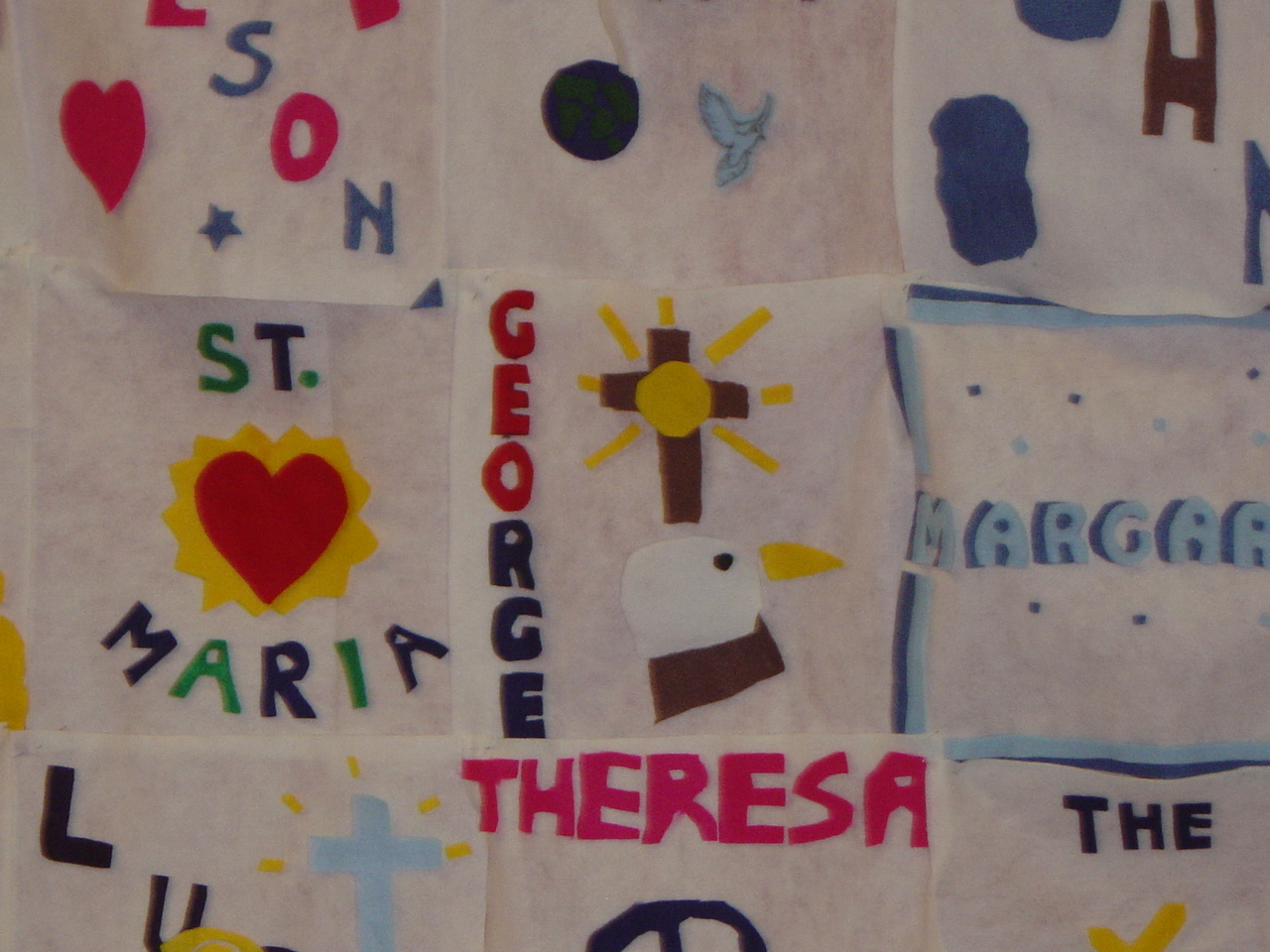
Here, in the center, is my piece in my class's Confirmation banner, with my Confirmation name, George.

P.S. If you would like a copy of the narrative I wrote for my high school literature class a few months after my Confirmation in 2005, please contact me.  You may also contact me to read an unabridged version of this reflection, with some extra details.

Tuesday, October 6, 2015

God's Shepherd and the Gathering of People

Here's a little history tidbit to start: It was on this day, October 6, 1979, that now-Saint Pope John Paul II became the first Pope to visit the White House.

I take note of this historical event because of the recent Apostolic Visit of Pope Francis to the United States, "Love is our Mission".

Pope Francis has a demeanor that definitely appeals to people--so much, in fact, that I've only heard two people I personally know express criticism of him.  His appeal made his visit garner attention and hype as if he were some big-shot celebrity.

For me, the exciting aspect of his visit was to have the leader chosen by God to be shepherd of the Roman Catholic Church, in the succession of the Apostles, come to present to the people of the United States, sharing his insights with all, even to those beyond the Roman Catholic Church.

I had toyed with the idea of traveling to the East Coast for weeks to be present for parts of his visit.  While they ultimately didn't materialize, I watched two events live:  his speech before Congress, and the concluding Mass of the World Meeting of Families, as I made it my business to arrange my schedule so I could do so.  And I followed his visit all six days, taking in the coverage on NBC Nightly News, which afforded me the opportunity to watch live his arrival at St. Patrick's Cathedral in New York City on Thursday, September 24.  I also looked over the text of some of the other speeches he gave.  Throughout them all, his shepherd's touch was present, as he spoke to us about how to live out the truth of God and the principles of faith.

In his speech before Congress, in addition to having that shepherd's touch, he also spoke to the United States experience.  He even acclaimed, at the start of the speech, how privileged he was to speak in "the land of the free and the home of the brave", which floored me.  He appealed to our highest values and ideals, as demonstrated in four individuals: Abraham Lincoln; Martin Luther King, Jr.; Dorothy Day, and Thomas Merton, speaking on liberty, justice, the Golden Rule, respect for life, collaborating, and working together in difficult situations.  He truly spoke the wisdom of God that adds so much meaning to life.

It was amazing to hear these gracious words come from his mouth, and to think of the historic nature of the occasion.  Pius VI was Pope in 1789 when the first session of the US Congress was held, and here now, 16 pontiffs later, was the first Pope to address this body.  And how beautiful it was when he stepped out onto the balcony of the US Capitol, and in his remarks, spoke words of blessing upon the children, another touch of God's shepherd.  (It was also very notable to watch him pause at the statue of Padre Junipero Serra in the Capitol on his way to the balcony, a man he had canonized a day earlier.)

His shepherd's touch was present as he mourned and honored the victims of 9-11 during an interreligious service at the Ground Zero Memorial, as he also spoke of the resolve that this tragedy can bring us, the living, together to work for and live in hope for peace.

He spoke again to the American experience in his speech at Independence Mall in Philadelphia, especially the American value of religious freedom, that people of different beliefs can come together for the good of society, as each religion has principles that speak to doing good and focusing on the higher purposes in life.

Then there was the concluding Mass for the World Meeting of Families on Sunday the 27th.  It was amazing to see the thousands upon thousands gathered for Mass in Philadelphia along Benjamin Franklin Parkway.  Pope Francis truly demonstrated his role as Pope by calling for us to lay aside that which divides us and be united as God's people.  He furthermore stated how important this is to start in the family, the smallest unit of Church, which nurtures the faith that allows us to shine in the world, even in the small things, like a nice, warm supper, or a loving hug from a loved one, especially after a rough day.

Indeed, the Pope's role is to be a sign of the Church's unity, and that was further symbolized by how people came together upon the occasion of his visit to the United States.  This visit was memorable in how the people came and the Pope spoke to his flock, drawing from the principles of faith and the teachings of the Church, even as he embraced the opportunity to visit the people in the US with much gratitude, sentiments he so beautifully stated in remarks shortly before his departure on Sunday the 27th.  Now we go forth, like Saint Junipero Serra did, boldly proclaiming the Gospel and testifying to the power of God's reign in our world as we live out the principles of faith in which we have been instructed by God's shepherd on Earth.

Thank you, Holy Father, for coming and encouraging us here in the United States.  And as you, as a good and decent shepherd of the Lord, in the succession of St. Peter, humbly asked for our prayers, we shall certainly pray for you as you continue your work, even as you continue to pray for and shepherd us, that we may walk before God, unto Eternal Life.

P.S. To find the text of the speeches and homilies Pope Francis gave, as well as other resources for his visit, please visit this page on the website of the United States Conference of Catholic Bishops.

Tuesday, September 29, 2015

Rethinking Banned Books Week

This week marks Banned Books Week, an effort sponsored by the American Library Association's Office for Intellectual Freedom.  It brings awareness to the many books that have been challenged in, and removed from, libraries.  The ALA is a major advocate of people's freedom to read, view, and access whatever materials they please, and considers any removal of books a matter of censorship that violates citizens' 1st Amendment rights.

I think there's validity to the principles advocated by the American Library Association (ALA).  Libraries have removed books because one person objects to even so much as a small detail in the book, like a dictionary that can allow a child to look up an expletive.  And if such actions are taken unchecked, things could get out of control, as one's persons objections could remove all manner of materials, even something like a book that contains images of the Sistine Chapel.

But I strongly feel the ALA should rethink its whole approach to book challenges.

The reality is that librarian professionals are not supposed to cast judgment on material people want to access based on its content.  Yet the ALA gets uptight when someone wants to challenge a book based on what is sometimes a legitimate concern.  For example, it's clear that pornography affects the mind of the person viewing it.  Some people, like in the ALA, would claim such a statement is just someone's opinion, and is not sufficient reason to remove a pornographic item from the library, and a similar line of reasoning is used to advocate against barring access to pornography on public library computers, even for children.  Furthermore, library policies on book challenges are set up in such a way so that a challenge would never be accepted, but pretty much always denied.

Librarians are also not supposed to judge patrons' reference questions.  Even a seemingly silly question usually has a legitimate purpose behind it, like in this tutorial video when a woman asks if birds can fly because she wants to take her pet bird with her on a commercial airplane flight.  A good librarian is supposed to take the time to discern that purpose through a reference interview.

I feel the community of librarian professionals should approach objections to books in the same way.  Instead of having a hands-off approach, they should take the time to communicate with the person making the objection, and understand what's behind it.  Challenges to library material could then be turned into a great opportunity to open up a community forum to discuss how best to address difficult issues, like how to limit pornography's devastating effects in society, or how to teach children to avoid using inappropriate language in a society where it has become more commonplace.

So while it may not be in the best interests of libraries to remove books on a whim because of one objection, the idea of belittling people's objections through something like Banned Book Week is not any more acceptable in my mind.  It's unfortunate that both sides on this issue are taking past each other, rather than dialoging about the larger issues at stake.

I feel Banned Book Week would be more meaningful if it aimed to foster healthy dialogue about making our society a better place.

Thursday, September 3, 2015

In Celebration of 1783

It's once again that momentous day, September 3, which was the day when the Treaty of Paris 1783 was officially signed, formally ending the American Revolution, by which Great Britain recognized the independence of the United States of America.

On this high patriotic occasion, I offer some thoughts, as I think back to the July 4 ceremony I attended at the Chicago History Museum a couple of months ago.

The keynote speaker was Ron Gidwitz, who is active in Republican politics in Illinois, and ran for the Republican gubernatorial nomination back in 2006, and is a frequent attendee of this event.  He said that so many people sacrificed for the good of this country, even making the ultimate sacrifice.  We owe to them to be involved in the process of our government.  It all starts with voting.  He rebutted the idea that "my vote doesn't matter", noting that in the recent Chicago municipal elections, one of the aldermanic races was won by less than 100 votes.  He further noted that the turnout was less than 50% of the population of that ward, so that a relatively small number of people selected the alderman.

Personally, while I recognize special interests dominate the political process, that's no excuse to not vote.  Not voting doesn't change anything.  The only hope we have for changing anything is to vote.

Mr. Gidwitz then said we should be involved by communicating with our elected officials.  Our form of government is about their being accountable to us, and dialoging with us.  So we should speak up, and let our officials know what's on our minds.

 I hold dear in my heart these actions and the principles behind them.  We are fortunate to have this form of democratic republican government in this country, even if it's not perfect, which no government is.  We should make good of it by being involved in the process.

So on this day celebrating our country, I urge you to get out and be involved.

Saturday, August 29, 2015

Points for Considering a Vulnerable Population

August means its recess time for the members of the United States Congress, when they leave Washington, DC, and spend time in their home districts.  Many hold town halls for constituents.

My Representative, Danny K. Davis (D-IL-7) held a town hall at Oak Park Village Hall back on the evening of Thursday, August 6.  When it concluded, I approached him, and said I had a burning question to ask him, which he agreed to field.  In this blog post, I relate, to the best of my memory, what happened during the course of our conversation.  It started in the Village Board Council Chambers, and proceeded through the hallways of Village Hall out into the parking lot--so we were talking as we walked along, over the course of 5 minutes or so.

I have contacted Representative Davis several times on defending one of the most vulnerable populations in our society, the unborn.  Once, when I called his office regarding legislation before Congress addressing abortion, the staff person who picked up the phone told me that Representative Davis "supports a woman's right to choose".  So when I was talking with Representative Davis himself this evening, I told repeated this sentiment, and he acknowledged that is indeed his stance on the issue of abortion.

Then I told him that I believe when a human embryo is conceived in the womb, it has its own unique DNA, and thereby is a human person with human rights, deserving protection.  I then told Representative Davis that it would appear that he would not agree that human rights begin at the moment of conception.  So then I pressed the question:  If human right don't start at the moment of conception, when do they begin?

Representative Davis responded, "I really don't know", and then continuing his answer so as to suggest that there needs to be more discussion to arrive at an answer to the question of when human rights begin.  He then reiterated his opinion in supporting a woman's right to choose what to do with her body.  He mentioned something about how he was raised to adhere to the principles of the Bible, in which God created people, and somehow, though I don't remember exactly, that led to his reiteration of his stance on abortion.  I then asked, "Does that include an unborn woman's right to choose?"  He started his reply saying that he's not really sure if there is such a thing as an unborn woman.

As we neared the door leading out to the parking lot, I then pressed the matter further, saying that the Declaration of Independence speaks of the inalienable rights of life, liberty, and the pursuit of happiness.  If a human person is aborted, his/her life is taken away, and is thereby denied the right to life, as well as being denied the rights of liberty and the pursuit of happiness.  Representative Davis said that there would need to be more discussion to sort out the issues of when and where one person's rights stop, and where another person's rights begin.

There's a lot to consider in Representative Davis's responses.  For starters, let's go back to his response to my initial question, that if human rights don't begin at the moment of conception, when do they begin?  As I told Representative Davis, at the moment of conception, the embryo has a unique DNA, distinct from that of the mother and father, and so it's only logical to say at that moment, the embryo is a human person, and so the protection of human rights begins at the moment of conception.  If it doesn't begin at the moment of conception, there's really no other logical moment at which human rights would start.  It doesn't make sense to say human rights begin at birth, because the fetus shows signs of being a human person even before birth, signs which are staggered throughout the pregnancy.  So Representative Davis, in a way, aptly states that he doesn't know when human rights begin if not at the moment of conception, because there's no other logical moment to fix as the starting point for the protections of human rights if not at conception.

(Representative Davis's answer reminds me of the answer then-US Senator Barack Obama gave at a forum during the 2008 presidential campaign moderated by Pastor Rick Warren.  When posed with the question of when a baby has human rights, Mr. Obama said that it was a matter "above his pay grade".  In my mind, that reflects how there's no other reasonable answer to give if not at the moment of conception, as Senator McCain straightforwardly stated in his answer to that same question.)

And then there are the comments Representative Davis offered toward the end of our conversation, when, in pressing the matter, I evoked the idea of the inalienable rights of life, liberty, and the pursuit of happiness.  The advances of modern medicine have unleashed the horrors of abortion:  The scariest part of it is that an abortion is done in the name of the rights of a woman, so as to relinquish any rights the unborn person has.

Throughout history, people have asserted power in such a way that quashes the rights of others.  In the past, people were denied rights and other opportunities based on characteristics like the color of skin, ethnicity, or religion.  And although our society has progressed to allow people the greater realization of their God-given rights, the medical ability to perform abortions has opened Pandora's box, allowing for a denial of the rights of people simply because they aren't yet born, even the basic right to live.  Abortion, therefore, is like a step backward in the progress of fuller realization of our God-given rights.  While I have many reasons to oppose abortion, this idea of the denial of a basic right is an important one, the starting point that addresses the big picture for why I am pro-life, and believe the sanctity of human life commences at the moment of conception.

If you disagree with me, I encourage you to consider the points I have mentioned in this blog post based on how Representative Davis responded to my pressing the issue of abortion on him.  If you agree with me, I hope the points I give in this blog post help you in seeing the big picture of why we believe in the sanctity of human life.

Friday, August 28, 2015

Master of My Destiny: Installment 4

This post is part of my "Master of my Destiny" series of blog posts in which I share about my happenings in graduate school.

After having a focus during my first term on the fundamental matters of library and information science, this summer term, my second semester in the program, was an opportunity to take the next steps by delving into more specifics and do more practical work. 

Library User Instruction class was notable for its educational focus, tailored to those studying library and information science.  There were some lectures, and the content touched upon topics like learning theories, student behaviors, and human mentality, topics that undoubtedly are the focus of entire courses for those studying education, but were covered in just a few minutes in this class.  (During one lecture on human mentality and perceptions people have, I did something very dangerous that I wouldn't normally do:  I openly told others how I honestly feel about President Barack Obama, without even feeling out their political views first.  Fortunately, within the context of this part of the lecture, my strong feelings stayed contained without opening a can of worms.)

The main focus of this class was engaging in actual instruction, in the form of presentations. For the first two, which were individual, we taught how to use a tool.  The third one was a group presentation in which we taught a concept, and then, in our groups, we transferred the content of the presentation into an electronic learning object.  Not only did we have to explain the ideas, but we had to work on effectively conveying the information, and engaging the audience, involving them in the learning process, as well as assessing their understanding.

I had an adjunct professor for this class.  His regular job is working as a librarian at Moraine Valley Community College.  He was able to bring good insights from his work in instruction to enhance what we were learning in this class.

Another class I had was Collection Management.  The collection is the core part of a library, and the big take away from this class was the importance of a plan to guide the library in knowing what to include, and then how to discard items that are no longer useful in the collection, all to serve the needs of the users.  (If you're interested, here is an example of a collection policy, that of the Oak Park Public Library: http://oppl.org/about/policies/collection-strategy-statement)

In learning about managing library collections, we looked at library collection policies and discussed them in class.  We also did practical exercises to get a feel for how to manage a collection:  Our first big assignment was to create a seed collection for a library in a specific geographical area.  The second big assignment was the weeding assignment, which involved examining the books on two different sections of shelf in the Dominican University Rebecca Crown Library to determine if each was worth keeping, or should be removed from the collection.  The final big assignment was working in pairs to create a library user survey, which is a process that isn't as easy as it might seem.  It’s difficult to use just the right wording for the survey questions to get at the information needed, as well as keeping it concise to ensure high response rate.

For this class, I also had an adjunct professor, who is the director of the Berkeley Public Library, a suburb at the west edge of Cook County, just to the east of Elmhurst.  (I visited her library, and though it's quite small in comparison to what I'm used to about Oak Park's library, they have a lot available there in the items, programs, and amenities.)  All the time in class, she drew from her many job experiences, past and present, in sharing insights about library work, never afraid to share her opinions about the good, the bad, and the ugly of libraries.

I was fortunate to have another class with this same professor this semester: Government Information Resources, which met once in person, and then the rest of the work was online.  She showed much enthusiasm for the material, having once been a government documents librarian.  The focus of this class was learning about the resources produced by the US government, which is the largest producer of information in the world.  We focused mostly on resources from federal agencies, although there were some resources we looked at from state governments and even international governmental organizations.  The first resource we looked at was the US Government Manual, a 600-page book that details all the agencies of the US government.

From there, we looked at different types of resources, like law codes, and those pertaining to the environment, health, and business.  For each type, we completed exercises, searching for specific items, like President Theodore Roosevelt's personal correspondence, wild burro adoption schedules in Wyoming, recreation areas in Illinois, information on doing business in foreign markets, the president's daily schedule, information on lyme disease, and government regulations.  It could be tricky to find certain things, but in general, I enjoyed the opportunity to look around government websites, which I enjoy doing anyway on my own for fun.

In both of my in-person classes, we had many opportunities to critique each other’s work, and I welcomed the chance to have such discussions in a respectful, collaborative environment.  It was certainly helpful for the second presentation in Library User Instruction for the feedback I received and offered, and it got pretty involved when discussing the user surveys in Collection Management.

Indeed, I kept active during these summer months, delving into specifics of library and information science, and having a good dose of fun along the way.  And now, I am halfway through obtaining my degree--kind of like getting the "M" and "L" of my MLIS.  There's much I've been enjoying about this program, and it's great that I enhance it now that I've started an actual library job.

I’ve also been able to see how my participation in LIS connects with the higher purposes of life.  Nothing could have better underscored this than the discussions in the first session of Library User Instruction class.  Instruction is a process, especially in how we constantly work to improve our abilities, a major take-away from the entire class.  Part of this process is assessing where we are in the liminal space moving from where we are to our ultimate goal.  In the midst of this process, there are Kairos moments, a sense of time when something critical happens--different from the sense of chronological time.

The ideas my professor was talking about during the first session made me think about my own experiences teaching Religious Education at my home parish.  I knew this summer class would be valuable not just for my possible career goals, but also to enhance my ability to teach in that capacity, too, as teaching is part of many aspects of life.  So I felt challenged to really work at enhancing my abilities, while I also also felt excited at the opportunity to do so.

Indeed, through such lofty insights, I can see how this degree program is driving me toward a career that fits in with the larger picture of my life’s overall vocation, which I feel I have been led to by the One Who is really the Master of my Destiny.