Sunday, October 12, 2014

A Landmark Status and a Landmark Figure

It's official, and there's a plaque now to show it.

A piece of the legacy of one of the most prominent political figures from a notable family with strong ties to Illinois is now a National Historic Landmark.  The man was Adlai Stevenson II, and the landmark is his home in Mettawa, in Lake County, IL, which was designated a landmark last April, and the official plaque presentation ceremony was October 12.

I'm always on the look out for the kinds of sites that are not as well noted, but tell significant stories.  And that's what piqued my interest when I saw a story on Chicago Tonight that Mr. Stevenson's home attained landmark status.

Looking for an opportunity to go on an outing somewhere, and seeing this as something of note, it was back on August 24 last that my Dad and I headed up from Oak Park to see it.  It was a lovely drive up the Des Plaines River corridor, following Des Plaines River Road, into central Lake County, passing through suburbs such as Des Plaines, Wheeling, and Buffalo Grove.  Upon reaching Townline Road/IL Route 60, we headed east, and then south into country land, where we finally reached the road to the home.

It is a sizable estate--Mr. Stevenson had 70 acres there.  The Lake County Forest Preserve District now administers the property, which is 40 acres containing the house and the stables.  Upon parking, we were directed into the stables where the tour began with some words about the property, and a brief video about Mr. Stevenson.  (His maternal great-grandfather, Jesse Fell, was a friend of Abraham Lincoln.  His grandfather, Adlai Stevenson I, was Vice President of the United States.)

Then, we went to the house.
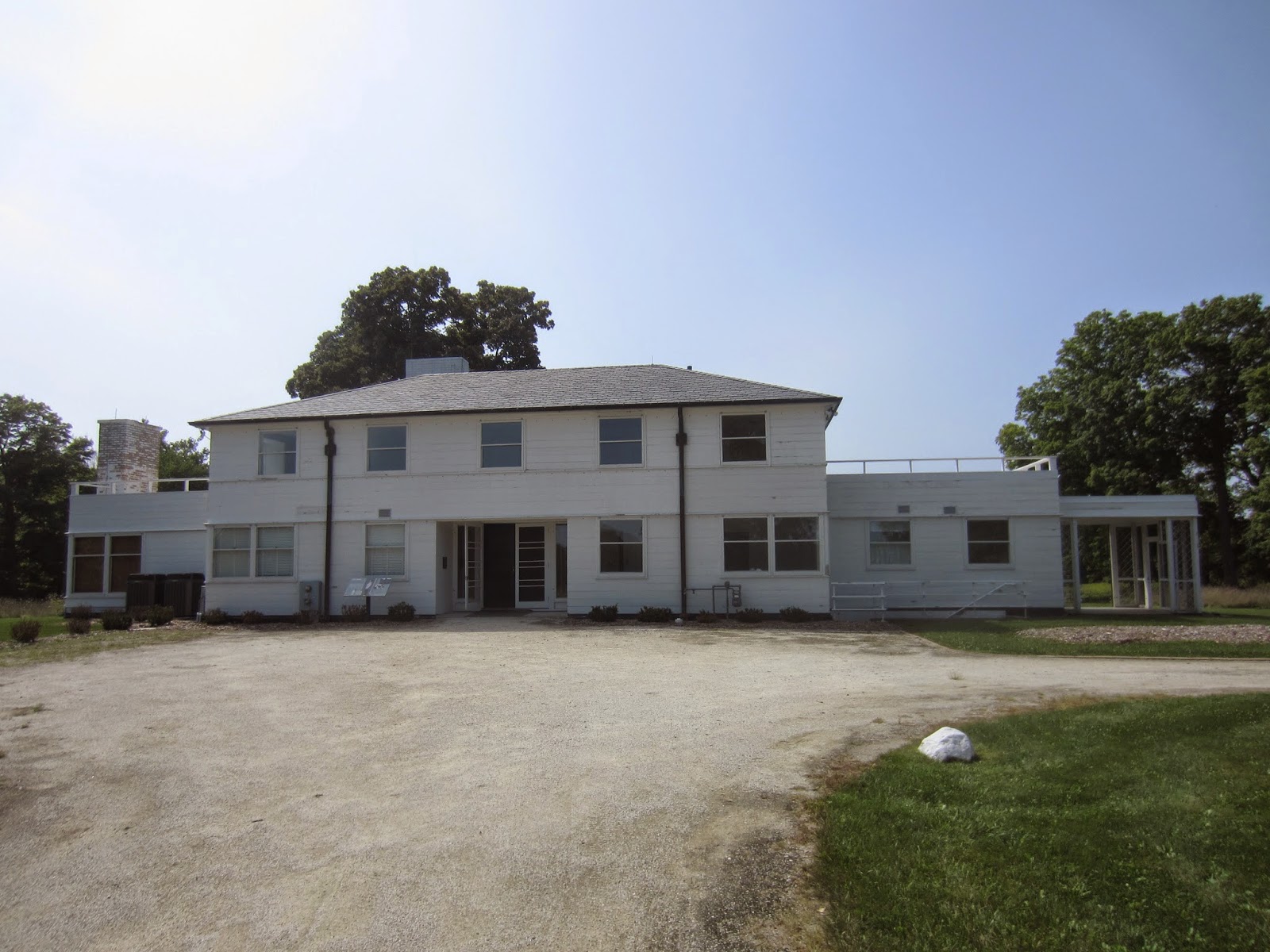
Despite being in such a sizable piece of land, the house is on the small side and with a plain exterior look.  As it turns out, while the Stevenson family was moving in, some rags spontaneously combusted in the basement because they came in contact with some chemicals, and set the house on fire.  The walls were made of a material that was supposed to protect it from fires that could break out in the nearby natural areas, but helped the house function as an oven in the case of the spontaneous combustion.  The present house on the site was built after that fire.

After a few words about the house outside by the front door, upon entering, we went straight to the study (see pictures below).  It was made to look like it did when Mr. Stevenson used it, with many of the objects in it having been there during his lifetime.

Some of the books on the shelves were in the house where he grew up in Bloomington, IL.  The items I found most notable are a key given to him during a trip to Alaska during the 1950's (just to the left of the white Illinois flag draped near the window), a silver cigarette box (given as a gift from his cabinet members when his term as Illinois governor ended, which is just to the left of the key), and a register, like a roll-a-dex (at the opposite end of the desk from the cigarette box).  (Katherine Hamilton-Smith, Director of Cultural Resources, says that the chair was the one he used when he served in the Presidential Cabinet as Ambassador to the United Nations.  And while I seem to remember the tour guide saying the key was that of the City of Anchorage, Ms. Hamilton-Smith can't seem to verify that, even upon having contacted Adlai Stevenson III.  The only thing known for sure is that the key was part of an effort to get Mr. Stevenson's endorsement of Alaska statehood.)

Many famous dignitaries came to visit Mr. Stevenson II at this house, including Richard J. Daley, Eleanor Roosevelt, and John F. Kennedy, who sought Mr. Stevenson's enorsement for the Democratic nomination for president in 196.  Mr. Stevenson wasn't willing to endorse him, because, it seems, Mr. Kennedy was too young and unready.  The lack of an endorsement appears to be the reason why, upon entering office, President Kennedy appointed Mr. Stevenson to the role of Ambassador to the UN, rather than Secretary of State, for which he was more qualified.

We then looked around in the other rooms of the house, including the dining room, the servant areas, and the upstairs bedrooms, which were pretty much empty of any furnishings.  The windows in the house provided great views out on the huge field to the west.  Of note in the master bathroom upstairs were marks in the floor, which the tour guide pointed out were from Mrs. Stevenson's high heels.  There was a deck (see second picture below) right off the master bedroom (see directly below), with great views of the huge lawn stretching from the house to the nearby woods along the Des Plaines River.


We finished up the tour back in the stables (see directly below).

Upon ending, we looked around at the exhibits, with panels featuring some of his quotes, which I felt had spoke eloquent ideas:


From reading these quotes, I could tell that Adlai Stevenson II was a man of principles, and used his capacity as a public servant to make them known as part of his efforts to make the world a better place, where people conduct themselves honorably, decently, and respectfully.  I think that's why President Johnson said he would be remembered for his ideas rather than the positions he held (see the quote on the picture of this panel below):

Unlike the people in my grandparents' generation, I never experienced Adlai Stevenson II while he was in the prime of his public service career.  So I was glad to have this opportunity to visit his home and learn more about this important figure.  And it's good that this site has been preserved and now been given a significant recognition for its part in the narrative of United States history.

(And it was to my grandma right off I-94 whom we paid a very nice visit while on the way back home.)

P.S. If you weren't aware, this is the 100th post on this blog.

Wednesday, October 8, 2014

Fiery Idea

So the one story being talked about these past few days in Chicago is the bust of a show that was supposed to be a Spectacle of Fire on the Chicago River as part of the Great Chicago Fire Festival.

While it was disappointing for many of the 30000 spectators that the houses didn't go ablaze as intended, as one of those spectators, the more disappointing part for me was having so much trouble just finding a suitable spot to see what was going on.

I showed up at the Chicago River around 8:15, and it seemed it was just starting, perhaps running a bit behind schedule, as the announcer, who sounded to me like NBC 5 Chicago news anchor Rob Elgas, was speaking about the cauldrons being lit by the dignitaries.  (By the way, the sound system for the show worked well, and it was all set to wonderful music.)

The crowds lined every inch of space along the river, the stairs leading down to the river walk, and the Michigan Avenue bridge--which was so thickly lined with people even standing on a ledge at the edge of the sidewalk of the bridge that I couldn't cross to the other side.  (Areas where the crowds weren't present were blocked off, like the lower level of the Michigan Avenue bridge.)

Eventually, I went down a stairwell by the Hyatt Regency, and made my way across Lower Wacker to a spot where I could at least see more of the action on the river, which, by the time I got there, including the boats carrying flames of fire, including the steamship, which I thought was a train at first, with its "choo-choo" sound.

As time passed, people began leaving, including my next door neighbors who I encountered right before they went home to get their children to bed.  I made it down to the path right by the river level, and then eventually all the way up to the fence along the river as even more people left.

Indeed, I had been so focused on getting a good spot that it really didn't occur to me that the show was malfunctioning when the houses weren't burning up completely (see directly below).  (At first, I thought when the fire started, it was on the other side of the houses which I couldn't see and would make its way around to where I could see it.)

So, despite the letdown, I'm still glad I went.  I certainly like the idea behind the show and the festival.  From what I gathered, the festival celebrates the grit, resilience, and determination of a city that was once devastated by fire, and rose again to become the great, bustling city that it is today, where I am proud to have been born.  Furthermore, people from all parts of the city come together, contributing in their own unique ways, to make Chicago the great place that it is.  Indeed, there was quite a collaborative effort in putting the fire spectacle together.  The cauldrons were made by participants in the After School Matters program, and images of people involved in the making were displayed on screens mounted on boats that floated down the river at the show's conclusion.

I look forward to seeing how this great idea manifests itself in the show and festival in years to come.  For now, I can at least say that the fireworks part of the spectacle was pretty amazing, and somehow, not being highly skilled at photography, I managed to get this shot (see right below).  Even a woman standing behind me who saw me get it immediately told me it was a great shot.


And an encore picture for the finale...
I guess it's all a matter of bust and boom.

Tuesday, September 30, 2014

A Summary of Summer 2014

With the Autumnal Equinox having occurred last week, the summer season is over as the heavenly bodies dictate.

Looking back on the summer, I recall to mind periods with abundant moisture, storms, and temperatures on the cool side.

After some fits and starts throughout March, April, and May, it finally felt like summer come mid-June.  The upper-air patterns shifted from their positions they had been in for months, and opened the pathway for moisture to be transported from the Gulf of Mexico right into our area.  This made for a wet, stormy string of days.  I remember a notable line of storms that crossed the area of Saturday, June 21, and, for a time, rained out an outdoor graduation party I attended for some of my cousins.  The abundant moisture also created a string of days with dense fog.

Then there was Monday, June 30, which brought two different derecho events.  A derecho is basically a severe thunderstorm event that lasts for several hours, travels over several hundred miles, and causes damage mainly because of high winds.  One derecho came through in the evening hours, and another much later at night.

Following these storms, the weather cooled off heading into July.  And there were some noticeably cool days in July.  Pieces of the air pattern circulation stationed near the Arctic, the Polar Vortex, broke off and brought cooler air to the Great Lakes region.  The air was also quite dry, with long stretches of time with dewpoints in the 40s, which is more typical of the northern United States autumn weather.

After another warm-up at the end of July and start of August, there was another string of cooler days in the middle of the month.  At one point, cool temperatures combined with a significant amount of moisture created very low cloud ceilings, the level of the base of clouds covering 60% of the sky or more, which caused cancellations of the airplane acrobatics at the Chicago Air and Water Show.

Overall, this summer season wasn't overly warm, but wasn't too cool.  It was a run of the mill kind of summer regarding temperatures, with a good dose of precipitation here and there.

Thursday, September 25, 2014

In a Show of Dignity

We are at the start of the annual observance of the 40 Days of Life.  This comes days after an annual occasion in which we remember why we stand up for the unborn.

September 13, 2014, marked the annual National Day of Remembrance for Aborted Children.

To mark the occasion, I joined a prayer service at Queen of Heaven Cemetery in Hillside, IL, at the gravesite of two thousand aborted children.  Over 20 years ago, pro-lifers rescued their remains from garbage containers.

The prayer service featured a number of speakers, including Joe and Ann Scheidler, the founders of the Pro-Life Action League; Cardinal George; John Morales, who created the film 40; and Mary Griffith, founder of Woman's Choice Services.

There was the sharing of personal experiences, including the process of rescuing the remains of aborted children from garbage containers to receive the dignity of burial, and both John and Meredith shared about overcoming a past scarred by being personally involved in having an abortion.  I sensed powerful emotions in me as I heard these stories of those who faced the evils of abortion.

It was touching to see Cardinal George there.  He remarked that he has been running with a heavy schedule, and dealing with heavy traffic, which was why he showed up late and left early, all this while not in the best state of health.  But it meant a lot for him to be at this prayer service, and just his presence was inspiring given his health and his frailty, evident in the manner he walked.  He offered some great words speaking to the injustice of abortion that has arisen because of the decline of moral values in government and society.  And he advocated for the continued work of caring for and protecting all life, starting from conception.  (And how notable to have seen him a week before his successor's appointment was announced.)

Indeed, all the words spoken at the prayer service were inspiring, uniting us together in mourning for the victims of abortion, both the unborn children and their parents, and urging us on to continue the work of caring for the vulnerable, precious lives of the unborn, until the day when abortion is regarded as a scar on the past.

As a moving gesture at the end of the prayer service, with flowers in hand that had been distributed at the beginning of the service, while the choir sang, we came to the grave marker of the aborted children and laid the flowers down.  It was a sign that we are moved by the agony of the circumstances in which they died, and firm in our commitment to make sure no more must die this way.

The Pro-Life Action League blog has a wonderful post about this prayer service, including pictures, and you can view it here: http://prolifeaction.org/hotline/2014/hillside2014/


Sunday, September 14, 2014

Our Star-Spangled Symbol

It's the 200th Anniversary of the composition of "The Star-Spangled Banner".  Francis Scott Key, a Georgetown lawyer, wrote it in ecstasy at seeing the Stars and Stripes flying above Fort McHenry in the early morning light of September 14, 1814, as the British abandoned an assault on Baltimore, MD.  He was being held aboard a British ship at that moment after successfully negotiating the release of a prisoner, Dr. Beanes a few days earlier.

We in general are familiar with the first verse of the song, which is the verse usually sung when it's performed.  But I always feel that singing the first verse only cuts off the narrative that all four verses tell together about "Defense of Fort McHenry", which was the title first given to the poem when it was first printed.  The lyrics tell about the triumph that comes in a bleak time in the War of 1812, just weeks after the British burned Washington, D.C.

The song speaks of the US flag as the illustrious symbol of our country.  There was much joy to be had when Mr. Key saw the flag still flying above Fort McHenry, sensing the triumph of the nation against its enemy.  It is a triumph that continues in each generation of Americans as we strive against and overcome the evils within and beyond us so that what is noble and right prevails proudly above as does the flag flying high.

Here's to our Star-Spangled Symbol...


Here I am with my Mom in the National Museum of American History in Washington, D.C.  In the background is an artistic representation of the American flag, at the entrance to a special gallery displaying the original Star-Spangled Banner that Francis Scott Key saw that morning 200 years ago.  It's quite a thing to see.  (Just outside the gallery, an interpreter portrayed Mary Pickersgill, the woman who helped make the flag.)

Wednesday, September 3, 2014

Some Thoughts on the United States

September 3 was the day in 1783 when the Treaty of Paris 1783 was signed, marking the end of the American Revolution, and making official the independence of the United States.  It's a day that I feel is as important as July 2 and July 4, 1776.

So I wish to hearken back to those July days to offer some thoughts on this day.

For all but two of the past 12 years (including this one), I have gone to the annual July 4 ceremony at the Chicago History Museum (formerly the Chicago Historical Society).  There's patriotic and American music, a reading of the Declaration of Independence, remarks by a public official or other significant community figure, and the firing of muskets by reenactors of a British regiment.

The past couple of years have featured some great speakers, and I wish to share some of their thoughts for my blog audience's ponderings on this occasion.

In 2012, Alderwoman Michele Smith, who represents the ward that includes the museum, spoke about the American idea of government being important in the local sense.  The local level is most in tune with the interests of the people, being based in their communities and neighborhoods.  It's important for us to get involved in our local governments as an essential part of our experience as citizens, as local governments most affect what happens around us.

In 2013, Carlos Tortolero, president of the National Museum of Mexican Art in Chicago's Pilsen neighborhood, spoke about his experiences as an immigrant to the US from Mexico.  His family made the journey in a "junky" car, but he then acclaimed that America is not a "junky" place.  Indeed, it is a place that has a special regard for the highest ideals of freedom and liberty, creating a society of substantially good quality, which draws people from all over.

This year, 2014, the speaker was Randall Dunn, the Head of the Latin School of Chicago, right across North Avenue from the history museum.  He noted that the US is unique in listing "the pursuit of happiness" among the three most important rights of the nation.  He shared about how we can pursue happiness: by being curious, sharing happiness with others, and living with a purpose.  Indeed, as part of our American experience, we are driven to attain those high ideals.  So happiness is not merely about feeling good, but seeking a greater good.

Every year, Gary Johnson, the President of the Chicago History Museum, shares some thoughts about some line that stood out to him from the Declaration of Independence, which is something different every year.  He shared some thoughts about the political ties that connect us.  He noted that we all share the common experience of being Americans, regardless of our opinions or perspectives.  He urged us to move beyond our disagreement and unite around the experience of being Americans.  Those are great words of wisdom, especially at a time when politics can get divisive in a heated and nasty way.  It's important for us to remember we're all Americans, and we have it in our power to collaborate in the midst of our differences for he betterment of our beloved country.

May these thoughts renew us Americans in the spirit of what our country is about, and urge us on to make it a righteous nation, this day, and every day. 

Thursday, July 31, 2014

A Matter of Rights

When the Supreme Court announced its much-anticipated decision on the Hobby Lobby abortifacient contraceptives case back at the end of June, I thought back to the end of my first semester of senior year at ValpU.  I was to write an essay, worth 50% of my grade, analyzing some issue pertaining to themes in my Justice seminar class in Christ College.

On my mind as a particularly good topic for this essay was the hot-button news item of the numerous lawsuits filed against the Department of Health and Human Services on account of the HHS mandate requiring faith-based employers to cover contraceptives in the healthcare plans for their employees, particularly those contraceptives that cause abortions.

As I thought over how I would present my arguments regarding this case, I remembered something I once read in The Governor, the book Rod Blagojevich wrote as his defense in the months-long period between his arrest/removal from the Illinois governor's office, and his first trial for corruption charges.  He writes that healthcare really is a matter of life and death, because if a person can't get coverage for healthcare procedures for conditions, especially serious ones, it could mean death.  That was why he advocated so strongly for increased healthcare coverage for Illinoisans during his tenure as governor.

That statement really gave me pause when I read it.  It wasn't so much that I agreed with it per se, but it was a striking way to frame the idea of healthcare coverage.

It's true that there are many people who lack access to healthcare coverage, and can't get the treatments they need for all kinds of conditions, even serious ones.  So it's undeniably clear we need a way to help those who can't get coverage for treatment, which can be a matter of life and death.

But the Affordable Care Act has proven itself to be an unsuitable solution to this grave problem, and the HHS mandate is one example of how problematic the healthcare law is in regards to the government's control over providing coverage.

In an effort to make available abortion-inducing contraceptive coverage, the government is forcing people of Christian faith to go against their principles of faith, which makes abortion an act of murder, thereby making the coverage of these contraceptives complicit with inducing the death of an unborn human person.

So at stake here is the rights of healthcare versus religious freedom, the latter of which is steeped into our existence as the United States.

Way back at the start of this country, the Founding Fathers were aware of the problems caused when government meddled with religion.  The government would officially recognize one religion, and could require attendance at officially-sanctioned churches, or citizens could face fines.  Other religious groups that were not of the official state church could have their activities banned or strictly monitored.  This is why the Foudning Fathers wanted there to be a separation of church and state, so that religion could be a matter left to the conscience of individuals, not something that government dictated for them.

Unfortunately, many misinterpret this idea of the separation of church and state to mean that people in government can't make any religious expressions, and even furthermore, that people can't make religious expressions out in public at all.

And now, the government is encroaching on religious liberty to enforce this mandate.  People are no longer allowed to abide by their deeply-held beliefs as they are being forced to acknowledge the right to have healthcare, and in this case, the right to contraceptives and abortions.

Quite frankly, the idea of reproductive health rights is really nothing more than a fabrication designed to promote the left-leaning agenda of people who want totally unrestricted abortions to suit their own desires.  So really, a newly-fabricated rights are bullying long-held religious freedom.  The author the Chicago Catholic Examiner column, William Leubscher, puts it well in this column he wrote about the decision.  His words toward the end about contraceptives are well put, because they are ultimately not about treating health conditions, but more involved in one's personal lifestyle choices, thereby making the government's actions regarding them preposterous.

And there's still more action that must be taken to preserve religious freedom.  The thing about this decision is that it's based more on a technicality, that the government can go through other means to provide coverage for abortifacient contraceptives.  So the preservation of the religious liberty of those who are against abortion and abortion-causing agents is still going to need further protection.  The fight still goes on, and we pray that religious liberty prevails in the court cases that remain and in the battle in society at large.

P.S. Here are some other good articles offering commentary on the decision:

This one critiques the reactions on the left: http://liveactionnews.org/disappointment-or-deceit-analyzing-reactions-to-the-hobby-lobby-decision/

In regards to this article, when I watched the NBC Nightly News report on the decision at the top of the broadcast the day it was announced, I was intrigued by the use of the phrase "controversial ruling".  Last year, when the Supreme Court made a ruling on provisions in DOMA, the word "controversial" was not used, even though many opposed it--opposition which didn't get much airtime in the reporting.  Perhaps "controversial" refers to how the people in the liberal mainstream media didn't like the outcome in the Hobby Lobby decision.

This one further addresses the matter of reproductive health rights: http://liveactionnews.org/theres-no-right-to-sex-in-the-constitution/