Saturday, June 29, 2019

The Place of Our Values

Several years ago, I was in the Rayburn House Office Building, sitting in the office of US Representative Danny K. Davis, who serves the 7th Illinois Congressional District, which includes the vast majority of Oak Park along with other western suburbs and portions of Chicago.  We had just gone on a tour of the US capitol, led by members of his staff, and we were visiting with him briefly after our tour concluded.

I remarked to Representative Davis that it is inspiring to be in Washington, D.C.

Indeed, each time I'm there reinforces why it is such an inspiring place.  The institutions and other sights in that city speak immensely to who we are as people of the United States.

I was certainly aware of the grandeur of this city 20 years ago when my family took a trip there during Spring Break in 1999.  We covered a lot of ground during our stay there, seeing Smithsonian museums, monuments, and other buildings like the Capitol and the White House.  Even though I couldn't fully conceive it at that time, I knew there was something important about the places I was seeing during our time there.

Onboard Amtrak's Capitol Limited train, most likely on the way to Washington, D.C. during our family Spring 1999 trip.  This photo was likely taken by Mom or Dad.

From left to right are my brother Eric, my Mom, and me, in front of the Gettysburg Address at the Lincoln Memorial.  This photo was likely taken by Dad.

From left to right are me, Dad, and Eric, in front of the US Capitol in this photo likely taken by my Mom.

I am to the right of Eric on the steps of the National Archives museum building.  Probably Mom or Dad took this picture.

Here I am in the National Mall.  Mom or Dad likely took this picture, or Eric possibly, for that matter.


That trip 20 years ago was the first of many visits I've made to Washington, D.C.  In the years since 2011, I had made several brief, hourslong visits that fell during layovers between different Amtrak trains I was riding, and for which Washington, D.C., Union Station was a transfer location.

In the middle of May 2019, I had the opportunity to make Washington, D.C., a destination during an extended weekend excursion with my Mom.

To give our trip a special touch, we rode Amtrak's Capitol Limited train there, like we did the first time our family foursome traveled to Washington, D.C., and that anniversary certainly made it all the more meaningful to travel there again 20 years later.  On this 2019 trip, for the first time for both Mom and me, we rode in Amtrak Sleeper Class accommodations.

It added its special touch to our trip from the very start on Thursday, May 16, at the moment Dad pulled over on Canal Street by Union Station to drop us off and we saw an open door leading into the Metropolitan Lounge.  As sleeper class passengers, use of that lounge was included in our trainfare.

We bid farewell to Dad and went inside.  A woman stopped Mom to ascertain if she had privileges to be there.  I produced our travel ticket document on a sheet of paper, and the woman looked at it, and then marked it.  She then told us we were on the second level, which was designated the quiet zone, and there was another waiting lounge in the level below.  We headed downstairs.  There was a table with complimentary food of fresh fruit, banana chips, Chex mix, and candy.  There was a beverage fountain nearby with unlimited soft drinks available, along with hot beverages.  The lounge also had a bar serving alcoholic beverages.  With this swanky lounge and all its amenities, I knew we were in for something grand.
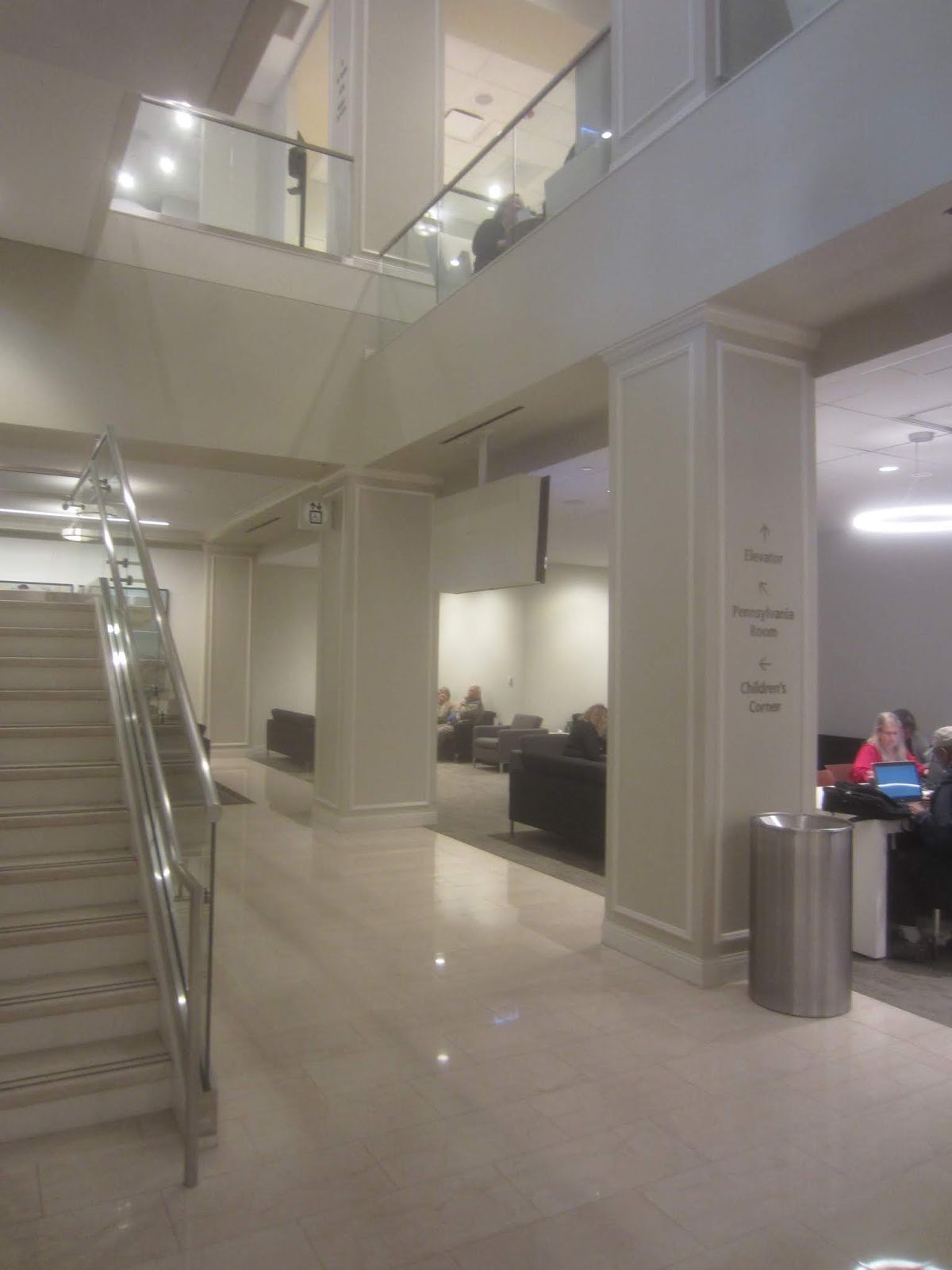
Above is the food selections in the Metropolitan Lounge, which is shown in the photo directly below.  All pictures in this post from here onward were taken by me, unless I appear in them, in which case my Mom took them, except where noted.


Here I am relaxing in the swanky digs of the Metropolitan Lounge.

We waited there about half an hour until the boarding call for our train.

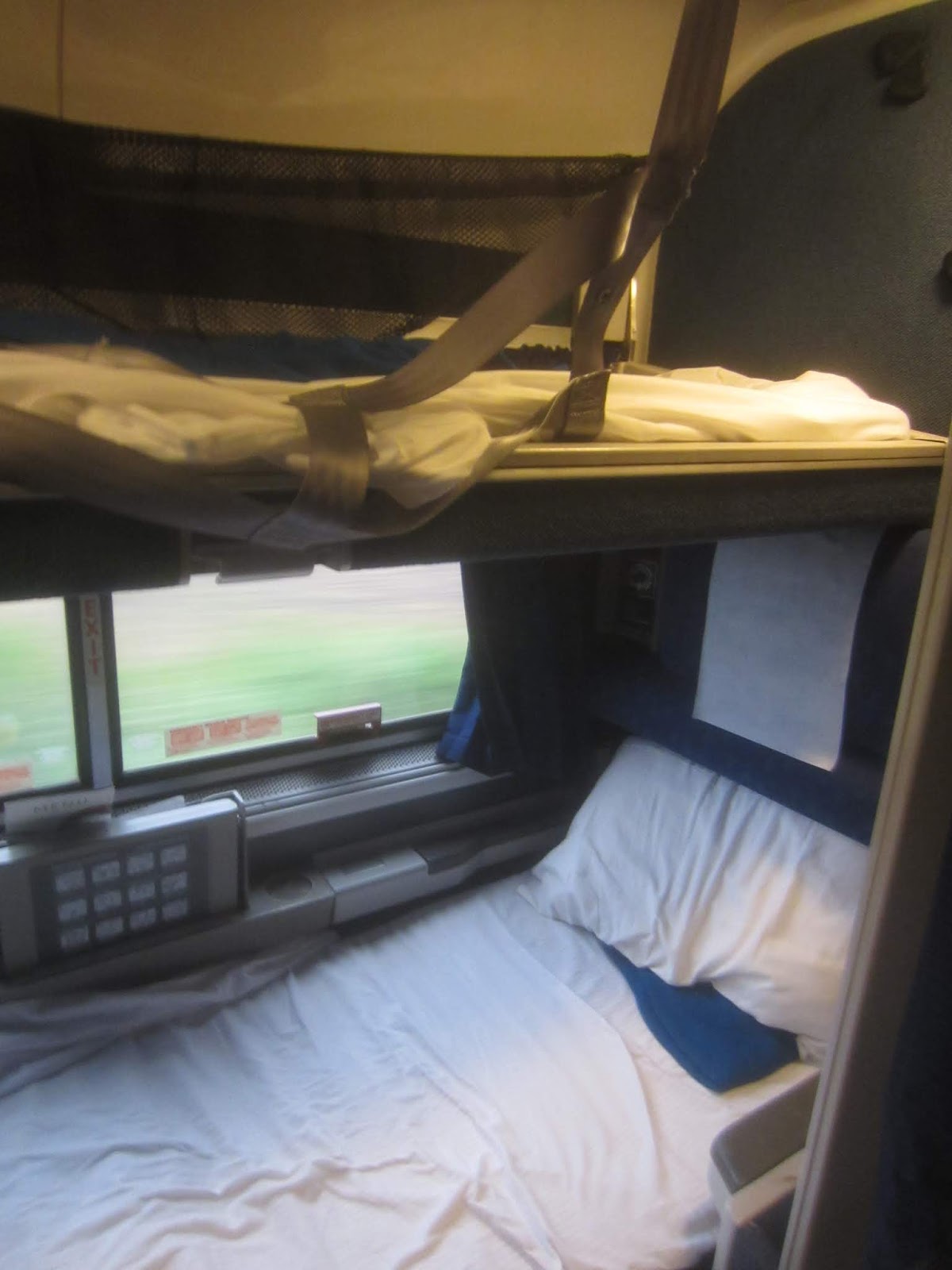
We headed out to the south concourse and then onto the platform for our train.  As soon as I had booked our trainfare back in December, we were assigned a car number and a room number.  We settled into our roommette, which wasn't overly spacious, but gave us sufficient room in seats across from each other, as you can see in the photo below.


Right about 6:40 PM CDT, we felt a lurch, the movement that indicates our train had officially departed and we were on our way.  (Please note that unless otherwise noted, all times in this post are in Eastern Daylight Time (EDT), since the vast majority of this trip was spent in the Eastern Time Zone.  The only times in Central pertain to our Chicago departure and arrival.)

As we traveled through the south and southeast sides of Chicago, our wonderful sleeper car attendant Jamal came by to take our dinner orders and ask if we needed further assistance.  He offered us wonderful service throughout our journey.
The view of the Chicago Skyway Bridge over the Calumet River from our roomette as we travel on the train tracks parallel to the Skyway.

After we entered into northwest Indiana, we went to the dining car for our dinner, which also functioned as the sleeper class lounge.  Our dinners weren't quite ready yet, so we waited with other passengers until we were called by room number.  Unlike most other Amtrak routes that have sit-down restaurant-style meals, our dinner was already packaged and warmed, then handed to us in a cloth tote bag by the dining car attendant.  And while it lacked the same charm as the dining service on other trains, it was still a nice meal.

Mom and I both got a beef dish with mashed potatoes and gravy.  It also came with a small salad, a roll, a dessert bar, and a drink.  I enjoyed taking full advantage of complimentary nonalcoholic beverages throughout both train trips.

Around 10 PM, Jamal arrived to get our berths into place for sleeping.
Above and below are photos of the berths when in position for sleeping.  These photos were taken on the journey westward in the morning before our arrival back into Chicago.


Before going to bed, I lingered in the sightseer lounge car, talking with a couple other passengers.  As the train traveled into northeast Indiana, we entered a thunderstorm, with pelting rain and frequent lightning.

I finally went to sleep around midnight after stepping off the train to stretch my legs at the stop in Toledo.

I slept solidly in my berth, since I was able to lie flat, rather than having to sleep in a reclining chair in coach class.

I was up a little after 7 AM on Friday, May 17.  After the train stopped in Connellsville, Mom and I went to the diner car for breakfast, which was a continental style breakfast buffet including cereals, breakfast bars, fruit, and some hot items.  As we traveled through the scenic Appalachian highlands, I lingered in the diner lounge car for a while.

The signs of the Washington, D.C., Metro Area started to build upon reaching Martinsburg, the western terminus of a MARC Commuter Rail line.  After stopping at Harper's Ferry, which is a particularly scenic spot, we crossed over the Potomac into Maryland--below is a photo of the Potomac, with the train tracks in the foreground and Maryland on the opposite shore.

We passed by commuter rail stations for many suburbs.  Then we reached Rockville, and passed by the terminus of the Metro Red Line at the Shady Grove station.

As we headed toward Union Station following the stop at Rockville, passing through suburbs like Silver Spring and then into the northeast side of Washington, D.C., there were spectacular views of the Basilica of the National Shrine of the Immaculate Conception.  Around 1:45 PM, we had arrived at Union Station.

Once we were off the train and into the station, we ate lunch from Roti.

Next, it was onto the Metro train, riding the Red Line and then Yellow Line to Alexandria, where we had Wyndham hotel accommodations very near the King Street station.  Once we checked in to our suite and settled in, we got back on the Metro and headed back into DC to visit the US Holocaust Memorial Museum.  We viewed an exhibit on the US response to the Holocaust, which did a good job going in-depth about attitudes in the United States in the 1930s, which complicated how the US responded, and actions by brave individuals who did what they could to save Jews.  We also viewed Daniel's Story, giving a child's story perspective of the Holocaust.  We also saw an exhibit that included footage recorded by US soldiers who liberated Nazi camps.
Above is the main hall of the Holocaust museum.  A sign on the wall has an Elie Wiesel quotation: "This museum is not an answer.  It is a question."  The content of the exhibits definitely poses questions to give us much to ponder.  Below is a display of the flags of the US army units that liberated Nazi camps toward the close of World War II.


We had finished there by 6:30, and made our return to Alexandria.
Here's a view of the sky scene by the Washington Monument, from Independence Avenue, near the USDA building.  Below is a view from the Yellow Line as we crossed the Potomac River.


When we transferred from the Blue/Orange/Silver Line corridor to the Yellow Line at L'Enfant Plaza, we saw huge numbers of fans boarding the Green Line to Nationals Stadium, where they were scheduled to play the Cubs.  Throughout the weekend, we saw people here and there wearing Cubs paraphernalia.

Once back in Alexandria, we shopped for groceries at Whole Foods, and then had dinner in our room suite.

I walked around outside in the neighborhood for a while before going to bed.

The next day, Saturday, May 18, came something we had been anticipating for a while: a visit to the Smithsonian's National Museum of African-American History and Culture--the exterior is in the photo below.  We were fortunate that Mom was able to secure advance tickets for us to visit.

We got to the Smithsonian Metro Station well ahead of our timed entry, so we walked around for a bit, and by 11 AM, we were inside.

First, we headed to the history galleries.
Hallway outside the entrance to the history galleries


Display at the entrance to the history galleries

We got in line, and then went in a group to an elevator, which took us down three floors and back to the year 1400, where we got historical context for the continent of Africa and also Europe in at just about the time when the Trans-Atlantic slave trade started.
At the beginning of the lowest level of the history galleries.

A woman standing in that area of the exhibit said she was going to lead a tour through the galleries on the lowest level, which was open to anyone who wanted to join.  Mom and I agreed to participate.

It was immediately clear that this museum, like the others in the Smithsonian, is chock full of content, and it would take a nearly inordinate amount of time to view it all.  Having a tour guide was a good way to take in various highlights.

The lowest level took us from the origins of the Transatlantic Slave Trade to slavery in the British North American colonies, and then to the American Revolution, and then up through the end of Reconstruction.  The exhibit included an actual slave cabin that was disassembled and then reassembled in the museum.  Other items on display included Harriet Tubman's shawl, Nat Turner's Bible, and the freedom papers of an individual.  Free African-Americans had to carry these papers with them to assert their status, and being found without them could mean being sent into slavery.  The museum didn't have much time to amass such a large collection of items, and so they relied heavily on donations from private individuals, and it's incredible to behold what they amassed in a span of just a few years before the museum's opening in 2016.
Freedom papers from the 19th Century

Nat Turner's Bible

Harriet Tubman's shawl is to the left and her hymnal to the right

South Carolina slave cabin

Once the tour finished, we went to the next level, which covered the years 1876 to 1968.  The focus was on the Jim Crow Era, and how African Americans banded together and started their own social organizations to provide for themselves in the midst of segregation, up until the Civil Rights Movement.  In this exhibit was a train car, arranged to show the segregated African-American and Caucasian areas.  There was also a dress Rosa Parks created, and Thurgood Marshall's glasses and watch.
Thurgood Marshall's glasses and watch appear mounted in the display case.

Rosa Parks dress

Above is the interior of a 20th Century train car, and below is the exterior.


Above is the Civil Rights Act of 1964, with a pen President John used to sign it, and below is the Voting Rights Act of 1965, also accompanied by a pen President Johnson used to sign it.


The uppermost level in the exhibit focused on the years 1968 to the present, which included content on African-American in popular culture and recent racial tensions.  I was particularly taken by a video showing images from the years 2001 to the present, with the song "Glory" playing in the background, which was featured in the movie Selma.

The following 4 photos contain thought-provocative quotations, which underscore how the museum's exhibits help visitors ponder the implications of the history therein presented.


It was after 1 PM by the time we finished viewing the historical galleries, and we decided to have lunch at the museum's Swee Home Cafe, despite the long line to get in.  There were different serving areas with regionally-focused foods.  We passed over the Southern foods like fried chicken, with the longest line, to get pulled pork sandwiches in the Western-themed area.  Directly below is a photo of the food on display there.

The dining area of the Sweet Home Cafe

Following lunch, we viewed a temporary exhibit on Oprah Winfrey.
Included in this case are a dress Oprah wore on a show and the effects from the show when she gave away a free car to all the audience members, like the big red bow on the car and the box with the key, which I believe is the small silver box.

Then we went to the exhibits on the upper floors of the museum, which focused on various aspects of African-American culture, including musicians, sports, military service, and artists.  Included in these galleries were Gabby Douglas's Olympics credentials badge, and Dr. Ben Carson's lab coat.  There were also statues of renowned African-American athletes.

For the 54th Massachusetts Regiment

Display for Dr. Ben Carson

Gabby Douglas's Olympics credentials badge

Jesse Owens statue

Michael Jordan dispaly, including his jersey and a Wheaties box bearing his image

Piano and bench from Pilgrim Baptist Church in Chicago

Above is the view of the Washington Monument from inside the museum, and below is the view of the monument by the museum outside.


It was after 4 PM by the time we left the museum.  We walked to see the Martin Luther King, Jr., Memorial.  Then we walked back to the Smithsonian Metro Station for our return to Alexandria.  When we transferred at L'Enfant Plaza, there were again huge crowds headed to the Nationals Stadium for another Nationals vs. Cubs game, which you can see in the photo below.

The next morning, after we had breakfast, we walked about a mile to St. Joseph Parish for 8:30 Mass.  While attending World Youth Day in Panama back in January, I met a few St. Joseph parishioners at the farewell reception at the Miraflores Locks Visitor Center, and when I heard they were from a parish in Alexandria, I set my sights on attending Mass at their Church.
Above is the exterior of St. Joseph, and below is the interior.


We quickly encountered a welcoming community.  The priest invited guests to stand, and then he brought a microphone to the guests so we could introduce ourselves.  Father gave a homily in the spirit of a true teaching homily, going through each reading thoroughly and drawing from it insights for our life of faith.  There was fine music and a lively crowd in a filled church.  Following Mass, a few people approached us to welcome us personally.

Afterward, I learned about some of the history of St. Joseph.  Because African-Americans faced discrimination at St. Mary's Parish in Alexandria, they sought to create their own parish.  They got a large amount of money from St. Katherine Drexel, who donated money from her enormous inheritance to found churches for African American and aboriginal Americans.  Being familiarly connected with St. Augustine Mission, which she founded in Nebraska, I was particularly pleased to discover that historical anecdote about St. Joseph.  Following Mass, we went to the church basement, where there was a display about the parish's history, including a document bearing the signature of St. Katherine Drexel.
St. Katharine Drexel statue near the back of the sanctuary

Display case of St. Joseph history, with a document bearing St. Katharine Drexel's signature on it in the center of the photo.  Below is a close-up of her signature, which she spelled with a "C".


We left St. Joseph and headed due west to the Braddock Road Station to board the Yellow Line.  We rode it to Gallery Place-Chinatown, which was right by the National Portrait Gallery, which I soon learned is the same building with the National Museum of American Art.
Here is a piece of art that spells out, phonetically, the entire preamble to the US Constitution.

We went on a guided tour with Elizabeth.  She did a fabulous job highlighting certain works in the gallery, and taking time to help us be aware of certain artistic details in paintings, of subjects like Elizabeth I and presidential portraits, especially George Washington and Barack Obama.  Her approach helped me notice details I wouldn't have considered otherwise, like a rainbow in the famous Gilbert Sullivan portrait of George Washington.  (The National Portrait Gallery has a complete collection of presidential portraits, with the White House having another.)

A portrait featuring inventors of the 19th Century

George Washington's portrait

Here I am posing by James Madison's portrait, whose birthday I share.

Here I am posing by President George H.W. Bush's portrait, who was president when I was born.

She also pointed out historical details of the building, like the spot where the original engrossed copy of the Declaration of Independence was on display during the time when the building was the Patent office--I am posing by that spot in the photo directly below.
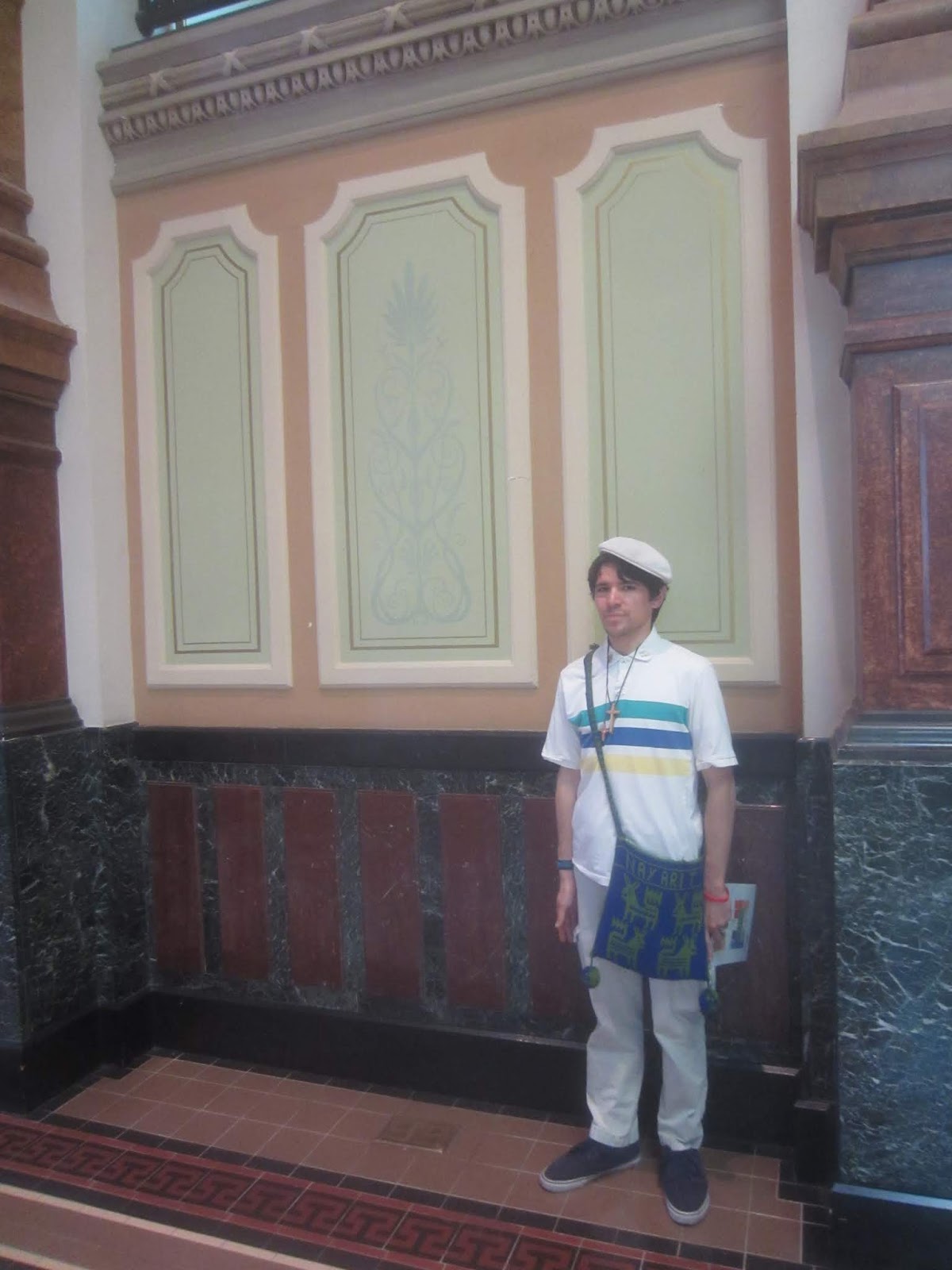
She also noted that President Lincoln held an inauguration reception in the building, and noted the staircase where he walked, which is in this photo:

One other resplendent part of the building was the indoor Kogod Courtyard, with a glass ceiling letting in all the sunlight but climate-controlled to make it a comfortable space to pass the time.  (Alas, I didn't take a photo, but you can go to that link to see a picture of it.)

By 1 PM, we got on the Red Line and went to the Brookland-CUA stop and then walked across Catholic University of America's campus to the Basilica of the National Shrine of the Immaculate Conception--I am posing in front of it in the photo below.

We had lunch in the cafeteria and then did some shopping.  I always find it meaningful to visit the Shrine when in Washington, D.C. as a deeply spiritual, prayerful place, especially with all the side chapels dedicated to various Mary personages, and awe-inspiring interior design.

Above, a view looking up into the new Trinity dome, and below is a close-up of detail in the Trinity dome.


Then we walked north to the National Shrine of Pope St. John Paul II, listening to the Basilica's carillon as we walked.
Above is the entrance to the shrine on Harewood Road, and below is a view of the front of the building from Harewood Road.


We got to the other shrine in time for the 3 PM praying of the Divine Mercy Chaplet followed by Eucharistic adoration.  The Redemptor Hominis Chapel was so light-filled with all its bright coloring, a truly beautiful and prayerful place.


The Luminous Mysteries Chapel had a vial of John Paul II's blood, a first-class relic.
Above is the vial of his blood, which is embedded in the altar.  Below is a picture of the altar in the Luminous Mysteries Chapel.


Right before leaving, I signed a Knights of Columbus guest register, and then the person at the desk offered me some gifts.  The Knights contributed significantly to its construction, and so are specially recognized there.

In a city known for monuments and buildings that evoke a grand sense of earthly power and prestige, places like these two shrines have made Washington, D.C., as a notable spiritual destination for me, with sites bearing the names of saints that help draw us toward God, the Creator and Ruler of Heaven and Earth.  Indeed, among institutions that speak to our shared values as a nation are these special spiritual places that speak to our faith and our shared experience of it, especially as people of the Church in the United States, which touches something deep down inside of me.

Above is a statue of Pope St. John Paul II in the lower level, and below is me, posing by a statue of him outside the shrine.


We walked back about a mile to the Brookland-CUA station and made our way back to Alexandria.  After dinner, because the warm day put me in the mood for something cool and sweet to eat, we walked down King Street to a gelato place Mom found, La Casa Rosada, whose entrance is in the photo below, certainly evocative of the distinct Italian immigrant community in Argentina, of which Pope Francis's family was part.  I got mango sorbet, which I enjoyed.

Above is King Street in Old Town Alexandria, and below is a view of King Street near our hotel, lit up at night.


The view of the front of our Wyndham Hotel


I walked back down King Street the next morning to visit the Basilica of St. Mary's Parish, in the photo directly below, and spend some time in prayer there before going onward with the day.


We had checked out by 10 AM, and made our way to Union Station to store our luggage in the Club Acela.
The view of Alexandria from the platform of the King Street Metro Station

Here's the view after the Yellow Line train crossed the Potomac, but before going underground.  Two prominent landmarks are the Lincoln Memorial (near the center) and the Washington National Cathedral, near the right.  Below is a view of the Washington Monument and the very top of the Jefferson Memorial dome.


Then we walked to the National Archives Museum building to see the Charters of Freedom, a true highlight of any visit to Washington, D.C., to behold those documents that are at the heart of what the United States is.  Or, as I heard a student visiting with a school group say, these documents are the history of America's founding.  We were in company with many school groups there, just like at the Holocaust Museum.  It heartens me greatly that schools still go through so much effort to take students on trips to Washington, D.C., because it's so important that young people see what's there, and and become more strongly rooted in who they are as US citizens.  Indeed, it's wonderful to see our heritage passed on to the next generation.
Here I am, outside the National Archives building after our visit.

We then went back to Union Station via the Metro and then walked to the West Lawn of the US Capitol to see the set-up for the forthcoming National Memorial Day Concert, an important custom of mine on Memorial Day Weekend.  It was special to see the setting in person as context for seeing it days later.
In the center of this photo, you can see the topmost part of the stage set-up.

We returned to Union Station and got Chinese-style food for lunch.  Then we went to Club Acela to wait for boarding our train.  This lounge was much smaller than the Metropolitan Lounge.
A man sitting across us got this picture of Mom and me.  He was traveling with his wife out west from South Carolina.

The info board for our train.

We were on the train a few minutes before 4 PM, and the same car attendant crew that was on duty during our trip there was on the same train going back, though we had a different attendant, and I believe his name was Phil.  The train departed right about on time at 4:05 PM.  I took in the great views of Washington, D.C., and then the nearby suburbs and then the Appalachian highlands as we headed toward Chicago.  We had dinner at 6:30 PM, eating the same menu choice as on our way east.
The view from the station stop at Rockville, MD.

Harper's Ferry, WV

A view of a field as we travel along, likely somewhere in western Maryland

Just west of the station at Cumberland, MD

view of the Appalachian highlands west of Cumberland, MD


I stepped off the train at Cumberland to stretch my legs.  I was in bed around the time we stopped at Connellsville.

The next morning, we had breakfast around 7:30 AM, which was around the time the train stopped in Elkhart.  We took in the fine views of northern Indiana fields and towns as we headed west, and then the views of northwest Indiana and Chicago as we neared the end of our train journey.
Downtown LaPorte, IN, the hometown a very good friend of mine

View of Lake Michigan as we travel through the furthest extent of Northwest Indiana, shortly before entering Illinois and Chicago

Skyline of Chicago as the train crosses over the I-90/94 Dan Ryan Freeway near 63rd Street


We arrived at Chicago Union Station shortly after 9 AM.  We proceeded straight to Lou Mitchell's, in the photo below, for breakfast before going home.


Washington, D.C., is indeed such an inspiring place because there are so many sites there that speak to our values of the United States that comprise our US heritage.  It is a place where I can ponder more deeply what it means to be an American, and the implications of being an American.  We get a sense of the values upon which this country is founded, and have served as the basis for everything in our experience since.  It is certainly so breathtaking to gaze upon the monuments in Washington, D.C., not only for the illustrious individuals of history but also monuments like the World War II Memorial that are about the thousands of common individuals who had a significant part in shaping our history.

We realize that part of our experience in the United States is grappling and struggling to advance those values so they are more fully realized by all people in our society.  Certainly the African-American History and Culture Museum has many exhibits that help visitors ponder the path the African-Americans have trodden thus far, and where we as a society must head next for there to be true equality.  Even the Holocaust Museum gives visitors so much to ponder about how to make a better world that respects the dignity of all people.

The other museums in Washington, D.C. have such a treasure trove of items that reveal the vastness of who we are and who we have been as people of the United States.  It is truly amazing to see all that is contained in those museums.

I have to say how much I appreciate the tour guides who led tours in museums, helping us take a different pace to really savor certain parts of everything in these museums.  It's amazing to think of what they helped us uncover.

Indeed, it's amazing to see how one place speaks so much to the entire United States, but it's just as amazing to realize that the entire United States has influenced one place as it reflects the country as a whole.

It was fitting to travel by train to Washington, D.C., to travel at a different pace to really see the country I'm passing through, the country reflected in that city and that is part of that city.  This trip helped me embrace train travel even more as a way to go at a different pace and be mindful of what is there in this country.

It was nice traveling in sleeping class accommodations, to experience the enhanced amenities.  We also had good service from our car attendants.

I was glad to share this experience with my Mom, as train travel is something that I embrace deep down.  And I was glad to share the sightseeing in Washington, D.C., since there's so much there we could both appreciate equally.

Indeed, this trip in so many ways touched what is deep down inside of me, as I shared the experience with Mom, embraced the different pace of travel to really see the country onboard the train, and become deeply in tune with the values of the United States which make Washington, D.C., what it is, even as that one place has made the United States what it is.

The US flag flies high above the plaza outside the main entrance of Union Station in Washington, D.C., the terminus for a trip to a city that inspires me to take a different pace in life and ponder what it means to be an American.

Wednesday, May 22, 2019

The Paschal Mystery in 2019

Looking recently through papers I've kept from when I was preparing for Confirmation, the section for the Easter Season says that it is the most important liturgical season.

I sense how important the Easter Season is, because throughout these 50 days, we celebrate the newness of Life we have in Christ, which we live all through the year, and is ours because of the Resurrection of Christ.

And the utmost importance of the Resurrection connects with the events celebrated during the other days of the Sacred Paschal Triduum.

Given how the momentous significance of the Triduum liturgies, it makes sense that Lent has such an intense spiritual focus.  I sought to use the Lenten Season 2019 as a time of purification, for a particularly noteworthy reason:  On Wednesday, March 6, 2013, I participated in an aboriginal American Sweat Lodge Ceremony while spending a week for a time of service in northeast Nebraska.  The purpose of the ceremony serves as a kind of purifying rite.

March 6 fell on a Wednesday again this year in 2019:  Recalling the day I was in the Sweat Lodge added deep meaning to Ash Wednesday, a day we begin Lent, a time of purification so that we can die to ourselves and focus more deeply on growing in relationship with God, which was made possible through the Paschal Mystery.

Upon the arrival of Holy week, aware of the importance of the Paschal Mystery, I once again this year sought to enter as fully as I could into celebrating these mysteries that are at the heart of Christian faith.

Attending Mass on Palm Sunday of the Lord's Passion really helped set the tone well for Holy Week, even if the weather outside that day was more fitting of the final Sunday of Advent, rather than the final Sunday of Lent.  I had already been primed for Palm Sunday Mass by attending a performance of St. Matthew's Passion two weeks prior.  So I was ready to experience the intense, long, and deep story of Christ's Passion, which speaks so much to our state of humanity, much as it speaks to the depths of Who God is that Christ would suffer as He would for us.

The next day, Holy Monday, my coworker returned from lunch with the shocking news that the Cathedral of Notre Dame in Paris was on fire.  While I had never been there, the news deeply moved me to see such a beautiful church, a place that draws us toward God, in flames, after having survived so much turmoil throughout the nearly 8 centuries of its existence.

Yet I feel the fire also speaks to the Paschal Mystery:  As devastating as circumstances get in our world, Christ, by His dying and rising, has triumphed and overcome all sin and evil.  We, His people join with Him in His triumph.  So we live in hope, and we join together as one people, who give meaning to the beautiful churches we build.  No matter what troubles we face, we have hope, just as many are determined to rebuild the Cathedral because of its historical and ecclesiastical significance.

These emotions were in the back of my mind while I was teaching my RE class the following day on Holy Tuesday evening.  Toward the end of class, I sought to convey the sense of hope we have in the midst of despair as represented by the profound song "Endless Night" from The Lion King musical.  I then talked about the Cathedral of Notre Dame fire, and drew from it a spontaneous monologue that stirred me to my core.  I spoke about how Christ gives us hope, because of the Paschal Mystery, which we celebrate each week at Mass, and in a more intense way during the Triduum.  I then told my students that my best piece of advice for them is that they should attend Mass every weekend and not miss without a serious reason, because it's so important for us to keep encountering the Hope Christ gives us by His dying and rising.

Then came the start of the Triduum on Maundy Thursday, with the opening song for that Mass, "We Should Glory" always setting the tone so well for what we commemorate beginning on this evening.

Father Hurlbert started off his homily by describing meals consumed by infamous convicts before their executions.  I immediately sensed a connection to our commemoration of the Last Supper at Maundy Thursday Mass.  This was a meal in which Christ fed others, and served a larger purpose, which is ritualized in the foot-washing rite.  Christ offered Himself for us, which serves as a model for how we should live our lives.  Partaking of the Body and Blood of Christ goes hand in hand with taking up the pitcher and bowl, as well as what it symbolizes, namely, serving one another in fulfillment of the command of Christ to love one another.  Like Father Hurlbert said in his homily, if we get the Eucharist right, we get everything else right, because worship is meant to transform us so that we demonstrate God's love in action.

Serving as a Eucharistic minister was meaningful on this Maundy Thursday since I marked 5 years in this ministry last November.

The solemn Transfer of the Eucharist at the conclusion of Mass had deeper meaning for me this year, because it took me back to World Youth Day in Panama City back in January.  During our time of Eucharistic Adoration at the Overnight Vigil, we prayed by singing the Latin lyrics of the final two verses of "Pange Lingua".  It is a powerful moment hearing those words, reminding me of how Christ sacrificed Himself for us, and is so worthy and deserving of our total adoration, and those lyrics really capture that sense of total adoration.  Back in January, the first lyrics of that verse "Tantum ergo" triggered deep emotions in me.  Hearing this song at Maundy Thursday Mass was definitely a powerful moment.

I lingered after Mass to spend time in quiet adoration before the Blessed Sacrament on such a sacred night.

The next day, Cross Friday, I wanted to do what I could to set the tone for the day, despite being at work.  Before work, I stopped at Our Lady of Woods Parish in Orland Park to briefly pray at the Stations of the Cross in their sanctuary.  It was quiet, still, and subdued in the sanctuary.

At the evening liturgy, I noticed during the proclamation of the Passion in the Gospel according to St. John how Jesus demonstrates Himself to be fully in control, even as He headed toward death.  He came to fulfill the purpose of God in dying, which was a theme Father Bob addressed in his homily.  These are important ideas to bear in mind in the midst of a somber day as we remember the Crucifixion of Christ.

There was something very rhythmic about the solemn intercessions as they were offered.  And it is a powerful moment when the Cross is venerated, for we recognize it as the means of our salvation.  I walked home in the light of the full moon, which establishes the date for Resurrection Sunday and also signaled the start of the Jewish celebration of Passover, a holiday that lends much meaning to the Triduum.

The following morning, on Holy Saturday, I was back at Church for Morning Prayer, which included an opportunity to offer a blessing for Zander, who would be baptized that night.  Following prayer, I helped get the Church decorated beautifully for the great celebration to come.

As the sun was setting, I was headed to Church for the Holy Saturday Easter Vigil Mass, my favorite of the whole year, with so much richness, from the very start.  It was special to be in a large gathering outside to light the Paschal candle, while cars passed by on the street, a way for us to proclaim the great mystery that makes us God's people.

Throughout the liturgy of the word, I noticed that all the Scripture passages proclaimed how God was at work to save His people, even while His people waited for the Messiah.  In the darkened Church, even as we waited for the proclamation of the Resurrection Gospel, there was so much richness in the passages proclaimed, much as God was marvelously at work in the time before the Messiah came.

A phrase from the passage from Romans that stood out to me was "newness of Life":  We live in newness of Life because of Christ's Resurrection, and that's a phrase I have kept returning to throughout these Easter Season days.

Finally, the grand moment came for the Alleluia to be sung once again for the first time since the "40 Days of Lent" began, proclaimed with even greater richness as we remember the central event of our faith, the Resurrection.  Notably, Father Bob, who proclaimed the Gospel, processed around Church with the Gospels book open to the page of Resurrection story, a wondrous gesture reflecting our call as His people to openly proclaim the Resurrection, especially by our lives.

After Zander was baptized, and it was time to head up to the font to renew our own baptismal promises, my mind returned to the Sweat Lodge ceremony.  At the end of it, our exit from the sweat lodge was supposed to symbolize emerging from the womb and being born, and we uttered the phrase, "All my relations", which speaks to our connectedness with everything.  Lent was a time of purification, like being in the sweat lodge.  Lent led us to the Triduum, when we celebrate being born again into newness of Life with Christ, which begins for all Roman Catholics with baptism.

As I processed up to the font, I recognized that in this gesture, I was acknowledging how baptism brings me alive.  So when I dipped my hand into the font to bless myself with the holy water, I uttered the words, "All my relations", to celebrate the newness of Life I have in Christ through baptism, which draws me into relationship with God and His body, the Church.

A spirit of jubilation pervaded the rest of the Easter Vigil Mass, and carried over into the following morning on Resurrection Sunday.  The immensely pleasant spring-like warmth and sunshine added to the exuberance of the day's occasion.

It was a packed church at 11 AM Mass, with over 1000 people, but I couldn't help but think of the contrast with the huge crowd of 700,000 people at the World Youth Day Closing Mass, and certainly a contrast to last summer when I attended the celebration of Mass with Father Mark in the St. Augustine rectory chapel, and it was just the two of us.  I carried my WYD pilgrim badge in the pocket of my suit as a reminder of that impactful experience on this most important and joyful day of the year.

There were two selections for the 2nd reading, and I was supposed to ask the celebrant which one to proclaim.  Father Hurlbert gave the choice to me.  They were both great selections, but after asking the opinion of some people, I chose the selection from 1 Corinthians, which speaks to the great feast we celebrate because Christ has been sacrificed, and we now are called to remove malice and wickedness, living anew in sincerity and truth.

I had that passage in mind later when I offered a prayer before our family's meal.  It was a wonderful time being together as a family, especially since my brother, who recently moved to Miami, came into town for this weekend, the first time I had seen him since the extremely cold January day when I saw him off at O'Hare Airport.  Sitting at dinner with him stirred something deep within me, a sense of togetherness that brought me Heavenly joy.  And I sensed that joy throughout the day on Resurrection Sunday And this joy is ours because of the Resurrection of Christ, which means everything for us.

Indeed, in his homily for Holy Saturday/Resurrection Sunday, Father Hurlbert said that if Christ didn't rise from the dead, He might have many nice offerings for us, but nothing to compel us.  But if Christ did indeed rise from the dead, all His promises and commandments have weight.

Truly, everything about our faith finds meaning and motivation in the Resurrection, by which Christ constantly breathes new Life into us.  We live in the victory of His Resurrection, and at each Mass during this Easter Season, we see the Paschal Candle lit as a reminder of that victory, and our share in that victory through our baptism, when we received a candle lit from the Paschal Candle.  It was these thoughts in mind that gave me a sense of exuberance a week later when celebrating the anniversary of my baptism. 

Throughout this Easter Season, I have continued returning to that idea of the "newness of Life" we have in Christ, a phrase used in the Epistle reading from Romans 6 during the Holy Saturday Easter Vigil Mass.  Christ's Resurrection gives us the reason for living in newness of Life, and also the ability, as we are freed from sin by joining ourselves to dying with Christ and then rising into new Life.  That truth is so much cause for celebration in the 50 Days of Easter Season and beyond as we continue our journey of faith in this life, bound for the glory of Eternal Life in Heaven with God, won for us by the Paschal Mystery.  Yet we already experience a foretaste of Eternal Life, for Christ is Risen and He lives forever to constantly grant us newness of Life that is ours even now day by day as we live anew in Him, embracing His mission to make the world anew, bringing forth the Life, Light, and Hope He gives by the victory of His Resurrection.

Above is the scene of the Ascension Parish Green after 11 AM Mass on Palm Sunday, April 14.  Below is the scene of the Parish Green after 11 AM Mass on Resurrection Sunday, April 21.


During the Holy Saturday Easter Vigil Mass, Father Bob processes with the Gospel book open to the page of the Resurrection story.

The Paschal Candle lit for Resurrection Sunday Mass, a sign of the victory of Christ we celebrate.


P.S. You can read my previous Triduum reflections for 2014, 2015, 2016, 2017, and 2018.  The 2014 reflection has a list of my favorite moments during the Triduum liturgies.

You may have also noticed I've made a slight change in the title of this post from the previous years, as a way to note that the Paschal Mystery is timeless and how we celebrate during the Triduum in this particular year.

Sunday, May 19, 2019

Post-College: 6 Years

Today marks the 6th anniversary of the event that inspired the launch of this blog, my graduation from Valparaiso University.

Like in 2013, May 19 this year falls on a Sunday, and the alignment of the days of the week in both years helps bring me more in tune with that momentous day in my life.

And not only was that day, but all the memorable experiences leading up to it, especially in the first few months of 2013, including my trips to Austin and St. Augustine, and then those days leading immediately up to graduation, with lots of celebration and pageantry, like being inducted into the Spanish honor society Sigma Delta Pi, and the prestigious scholastic honorary society Phi Beta Kappa.  I also ate lots of good food at many meals, particularly with various groups, like the meteorology majors and InterVarsity Christian Fellowship.

Being in tune with those days upon the occasion of this anniversary gives me much to reflect on, especially as I consider the continued connection and impact of my ValpU days, even 6 years later.

I have close relationships that have persisted through all that time.  I regularly get together over the phone with some of my closest friends, and we're able to keep up with what's going on in our lives, thanks to Roy, who is always eager to keep together, a sign of the deep friendship we've shared in our group.

I've also had reason to be back in Valparaiso thanks to my continuing friendship with the Ruggabers, which hasn't let up in the 6 years.  I was very blessed to be at their Golden Wedding Anniversary celebration last summer together with their family and close friends.

And going to World Youth Day with a group from the Diocese of Gary helped me feel a sense of connectedness with ValpU:  One person in the group was someone I knew during my freshman year, and there were a few people in the group who attend St. Teresa's, including a current ValpU student.  It was especially nice getting to know her because all the people I knew as students during my time there have since graduated, and it's good to connect with current students whenever I can.

My time at ValpU was extraordinary for many reasons.  And in the years since, I keep having more extraordinary experiences that build on top of one another.  One experience tops another, and they keep coming, especially as I think about my faith life.

I feel that my time at ValpU helped open me up to be poised for great experiences to come, especially as I glory in how God continues working marvels in my life, as I reflect on the great resurgence of faith I experienced during my time at ValpU.  Our faith teaches us to be always open to how God is at work.  Even if we don't fully understand His ways, we can live in breathless wonder that something amazing is bound to happen when we open ourselves up to Him.

I came back from World Youth Day regarding it as the best experience yet of my life, and I emphasize "yet" because I'm sure God will do something even more amazing, and there's no way I can really even fully conceptualize what that might be.  It was really something to reflect on that when I went on a trip over an extended weekend this past March to visit St. Augustine.  It's incredible to think how that place, hundreds of miles to the west of Chicagoland, added so profoundly to my ValpU experience as a whole.  (It's also notable that while there back in March, I visited with a ValpU friend who works there as a TV meteorologist.)

Usually, we associate a sense of wonder with the typical child, who constantly asks questions as while wondering about everything.  Yet even at my age, I still find myself with a sense of wonder, and I find myself easily stimulated to learn more about something, as happened all throughout this weekend while visiting museums in Washington, D.C.  Certainly, having spent time studying meteorology has allowed me to continue a sense of wonder about the weather, enhanced by a greater understanding of what happens in the atmosphere above us.

But I get easily fascinated and started wondering about a variety of subjects, which I feel makes the library and information science field a good fit for me, because it was going to the Maze Library that kickstarted my penchant for learning about various subjects.

Aligning with the same principles of my work as a librarian, it has also been such a good fit to teach Religious Education.  Although I didn't go into it with much professional teacher training, I have become so good at it, and I revel so greatly in the opportunity to teach and hand on the faith, coming back year after year.

Indeed, I was so greatly inspired in faith during my college years, especially in the time I spent at St. Teresa's.  Father Kevin McCarthy certainly had a profound influence on my life, and many others.  One thing he taught us at St. Teresa's is how to Party Hard with Jesus Christ, a routine that is a rub-off of his days as a cheerleading coach.

That "party" routine speaks to the sense of how I came to embrace faith as something to celebrate, and it has driven me to do my part to inspire my students in Religious Education class.  I teach them how to Party Hard with Jesus Christ.  But beyond just getting them excited in class, I hope that in my work of handing on the faith to them, they will embrace it and, most of all, live it out.

I think back to how the remarks made at the Baccalaureate Service and the Graduation Ceremony on Sunday, May 19, 2013, had a common theme of inspiring us to go forth with what we gained from our time at ValpU to do good in the world.

On this 6-year anniversary, I have much to celebrate as I reflect on the opportunities that have come my way, greater than the one before, and how I've been able to accomplish so much, inspired by my experiences at ValpU to pass it on in service to others.

 Above and below are pictures of me speaking to my students during my final Tuesday RE class of the 2018-2019 year.  Being a catechist teaching RE class has been a significant part of the continuing legacy and impact of my ValpU experience.  Photos are courtesy of Laurie Berggren.

Here are links to read the blog posts on my graduation, and my reflections for One YearTwo YearsThree Years, Four Yearsand Five Years.

Friday, May 10, 2019

A Golden Sesquicentennial

As a big-time train enthusiast, I am particularly excited about today's occasion marking the 150th Anniversary of the Golden Spike ceremony on May 10, 1869, and the official completion of the first United States transcontinental railroad.

It was quite an engineering feat to lay railroad tracks through the vast wilderness areas of the western United States, and in the case of the Central Pacific Railroad being built east, building over and through mountains.  Those hardy workers, many of them immigrants, deserve much credit for their part in this monumental achievement.

I think it's good an occasion like this, in our very interconnected modern world, to think back to life in 1869 when transportation, especially over long distances, was not as feasible, and thus, people couldn't experience that connection as easily.

With this railroad complete, there would be an immense transformation in US society, as people and goods could more easily move across the country from coast to coast in much less time than before, bringing the country together more closely, which had already been alluded to by the construction of a transcontinental telegraph system, helping expedite communications across the country.

I tuned in to live coverage of the Golden Spike ceremony reenactment on KSL's website, a ceremony that was held at the Golden Spike National Historical Park in northern Utah.  I watched the coverage for about 15 minutes, when the reenactment was happening.  There were multiple different ceremonial spikes that were driven in to the rail ties that joined the tracks of the Union Pacific and Central Pacific Railroads.  Different people made different presentations of the significance of their spikes, which were of different metals like gold and silver.

When the final spike was driven in, it triggered a communication signal sent via the telegraph that would cause several things to happen hundreds of miles away, like a giant ball to drop in the US Capitol in Washington, D.C., and the Liberty Bell to start ringing.

As I watched the coverage, I was amazed to see these different, far-flung parts of the country coverging together in one historic ceremony.  The United States would be brought together in a whole new way, and we could become more connected and engage with one another more closely.  Certainly my experiences in traveling across the United States, especially onboard an Amtrak train, is something that evokes breathless wonder in me as I behold the vast variety of people and places in the Unites States, and the amazing realization that all of it is part of one great nation.

As noted by one of the commentators present on the live coverage, it was a simple tap by a tool driving down the spike that brought together a nation--kind of like a small step by a person 100 years later would mark a giant leap for humankind in reaching the moon.

One other aspect of the reenactment that struck me was a prayer offered by the Reverend Dr. John Todd, who traveled all the way to Utah from Pittsfield, MA.  He praises God for granting to humankind the capacity to make attain great achievements, and petitions God that the railroad may continue to serve as a reminder of our ability to do good works and that peace and strength may continue to prevail throughout the United States.

It is a wonder that God gives us humans the ability to achieve greatly.  In a fallen world, though, these achievements have been used for malevolent purposes.  Yet by the power of God's salvific work that redeems the world, we can turn our sights on using our capacity to innovate and invent to work wonders for our world, and serve our fellow people.  We can join together more closely in using our wondrous feats to make a better world.  In light of the Easter Season, we can rejoice in the new achievements we attain through the innovation of new ideas that make the amazing happen.

So in the spirit of commemorating 150 years since the Golden Spike completed the first US transcontinental railroad, let us rejoice at what we have attained that has enhanced our world, and what we can continue to do, through the gifts God has given us, to continue achieving a better world.

And let us recall the words on the Golden Spike that was nailed in: "May God continue the unity of our Country as this Railroad unites the two great Oceans of the world."

It took much strenuous effort to complete the first transcontinental railroad, and much of America's character was reflected in the effort that resulted in such an incredible achievement for its time, considering the diverse workforce of the project, and how all those workers labored with the determination that is so interwoven into American character.  What they did 150 years ago knit together more tightly the far-flung reaches of the United States, and made way for greater economic prosperity as people could travel more quickly than ever before.

In that spirit, may God continue to prosper the United States from the Atlantic Ocean to the Pacific Ocean as we strive toward great unity as a people, just as the first transcontinental railroad united us in a whole new way a century and a half ago.

Wednesday, May 8, 2019

Lifelong Learning: 3 Years

I mark 3 years since graduating with my MLIS degree on May 8, 2016.

What have I been learning since then, especially in this past year?

Regarding my career, I have had the chance to attend workshops with an organization called LACONI, which offers professional development for librarians.  I've gained tools to better engage with my work, especially related to technology and intricacies of cataloging.

Certainly going to school gave me a good base of knowledge, but ultimately, school finds its value in its equipping me with the tools I need to continue learning, since there's so much more out there--in other words, school is for learning information and especially learning how to learn.

That's something I try to incorporate into my RE classes, helping my students better understand the practices of the Church so they can continue growing in faith, even beyond our year together in class.

Just like at work, the learning I do beyond my time in school is about putting what I've gained into practice for good purposes.  At work, I use my skills to make materials accessible to patrons.  In RE class, I use my understanding of faith to come alongside those youths in my charge to help them understand faith, even drawing upon what I know to address their questions.

During my time in school, I sometimes yearned to break beyond the artificiality of classroom learning and make it more meaningful in a broader context out in the world.  Finding those opportunities makes the learning of my past become more meaningful by truly coming alive.

There were many opportunities during my recent trip to World Youth Day in Panama where I experienced the learning of my past come alive. 

I've studied my fair share of geography in classes and more so on my own.  Indeed, once I got interested in geography, I yearned to learn more, and went to the library to find books for reading and learning more.  Geography came alive in so many ways as I experienced another country and another culture while in Panama.  I also got to visit a rainforest, which brought me back to studies like our rainforest unit in 4th grade.

Most prominently, I was able to use the Spanish skills I amassed during years of school, stretching all the way back to Ms. Gullo's Kindergarten class at Irving School.  I could put my Spanish communication skills to use in a real-world setting in a predominantly Spanish-speaking country.  I went there with confidence in my ability to communicate sufficiently in Spanish when requesting something, conversing with fellow WYD pilgrims, or even translating for other people in my group.  And I was glad that all my efforts in studying over the years paid off in being able to succeed in communicating and also in making good use of those skills.

It's great to see learning come alive as I experience it, and it draws me to keep on learning as I engage with life as it comes my way.

Sunday, May 5, 2019

My First Time at the Table, 20 Years Since

Twenty years ago, on Sunday, May 2, 1999, I approached the Table of the Lord for the first time to partake of the Most Holy Body and Blood of Christ at my First Holy Communion.

In the weeks leading up to that day, in addition to my regular Catechesis of the Good Shepherd classes, I had gone to special sessions where I learned more about what it would mean to partake of communion.

At two of these sessions, we baked monk bread, which had a browned kind of taste to it.  I much preferred the pretzels that we baked at a session in between the two.

We also spent time creating a clay chalice that we used at our First Communion Mass.
Above is my First Communion chalice, and below is the bottom, with my name and date.


And there was a session when we reflected on Jesus's teaching on the vine and the branches in the Gospel according to St. John chapter 15, and the catechists used a plant with vines to illustrate the discussion of it.  While I can't remember what words I used, I made a profound remark about connectedness that earned me the commendation of the catechists.

Then came May 2.  It's notable that my earliest memories of attending Mass were not inside a church building, but inside the gym of the St. Giles Parish School, where my family attended the St. Giles Family Mass, and where I went for Mass on May 2.

I think there may have been about a dozen of us first communicants in that group that day.  We all wore white gowns.  We processed in to the gym to our seats in front of our families as they admired us delightedly, while musicians up near the altar played on xylophones.  Just before this day, we gathered in the gym to review logistical details, and a woman specifically told us not to wave at our families, but rather use gestures like winking or smiling as we processed in.

The Family Mass community used baked bread for the Body of Christ, rather than the wafers that are used elsewhere.  I hadn't had any idea what the wine would taste like, so when I drank it for the first time on that May 2, I thought it tasted strange.

The celebratory mood continued even after Mass.  All the first communicants gathered in the far side of the gym from the altar to have cake.  My Grandma Vel had a photo of me hanging up in her house for a long time, taken by a professional photographer photographing at the Mass.  This particular photo shows me at the cake table with my hands clasped together in a prayer position, with my elbows on the table.  My Grandma thought that in the photo, I was praying to Jesus, having just partaken of Him.  When she asked me about it, I said that in my pose, I was eagerly awaiting a piece of cake.  She chuckled when she heard that and then said she would think of me in a prayer pose in that photo anyway.

Having no memories of the day of my baptism, my First Communion Mass was the first time I celebrated a special sacramental milestone in my life that I could remember.  The mood at Mass certainly set the tone well for the joyous occasion.  The celebration continued at home, including another cake, which was specially decorated.

Taken together with what I experienced during the formation sessions, I knew something special had just happened to me, which I would come to appreciate even more as time passed.

I embraced faith more around the time I entered middle school, and began enjoying the experience of Mass more than when I was younger.  At a certain point in middle school or high school, I would use the Anima Christi prayer in the time between partaking of communion and the prayer after communion to gain a more profound sense of what communion is.  I was drawn to attend Mass, to experience the richness of the liturgy, which has persisted throughout the centuries and is made new each time we gather.  And there was a specific mood set to the Scripture readings for the Mass, and even the symbols and the liturgical season at hand in which I also found much meaning.

My appreciation for attending Mass grew even deeper when I went to college.  It was the first time in my life I experienced strongly the sense of connectedness in the Eucharist.  While away from home, I was hearing the same readings, and partaking of the same Body and Blood of Christ, just like those back home.  I began to appreciate this sense of connectedness even when I attended Mass at other churches when traveling elsewhere.

And I experienced a sense of connectedness today when I went back to attend St. Giles Family Mass to mark the 20th anniversary of my First Communion.  My memories of the St. Giles Parish School gym are framed by my childlike perceptions, so walking into the gym for the first time in over 15 years felt like I was walking into a child-sized play pen as person of mature adult size, and I had to get my bearings a little bit.

The gym where St. Giles Family Mass is celebrated

It just happened to be the First Communion Mass for three girls in the Family Mass community.  The worship aide mentioned the first communicants wore white to symbolize the baptismal gowns, a symbol of our Christian dignity, which we are called to carry unstained to the judgment seat of Christ, a task we are strengthened to fulfill by the nourishment we receive in the Body and Blood of Christ, which made me think back to the white gown I wore.

I kept an eye out for any one I might recognize, and after Mass, I got talking with a number of people I remember from years back, including some of my catechists.  It is wonderful that the time I spent attending the Family Mass and the connections I made while learning about faith in catechesis classes forged bonds that still persist even after all these years.

As I made my way home, I stopped at Ascension to congratulate the daughter of a woman I taught RE with a few years ago, who just made her first communion.  And I was immediately invited over to their house to join in celebrating her daughter's first communion, which was a lovely way to rejoice in what communion means, for her, and even for me on my anniversary.

Indeed, partaking of the nourishment of Christ connects us to Christ and His Body, the Church.

I experienced that sense of connectedness in a profound new way when attending World Youth Day in Panama City, as I could feel in union with Roman Catholics from all over the world who gathered there to celebrate being one in faith.

During communion at the WYD Closing Mass, we sang a song that I later found out was the theme song for the 1993 World Youth Day gathering in Denver.  The song truly speaks to what I have come to understand about the Eucharist:


I played this song for my students last week Tuesday as part of my farewell words of encouragement during our final time together for RE class.  It was so apt to celebrate the end of another year of RE with my students in such close proximity to to the anniversaries of my baptism, falling on a Sunday in 2019 just as it did in 1991, and my first holy communion, because RE has been a way I can make something of the faith that was kindled by those two sacramental events.

Just as I remain connected to those communities that helped nourish my faith, so I remain connected to all those in any faith community of which I have been a part.  These are communities where, in worship, we experience connection to Christ and the Church, which gives us life, and nourishes us so that we bring His Presence into the world, especially in serving those in need, all to His Glory, doing so in His love, which Father Carl in his homily at Mass today said is the one criteria God has for serving Him.

And we keep coming back to partake of Christ's Body and Blood, so that, just like branches on the True Vine, we can continually be nourished and strengthened for the work He has called us to accomplish as His people.