It was 27 years ago on Saturday, November 28, 1992, that my family moved to the Chicago suburb of Oak Park, IL, the occasion that truly marks me as an Oak Park resident.
As I celebrate this anniversary, I think about how all the Chicago suburbs in their own special way contribute to the amazing patchwork quilt that makes up Illinois.
One of Oak Park's famed residents was Edgar Rice Burroughs, author of the original Tarzan books, who is #144 on my second Illinois 200 list. A plaque sits outside the home on Augusta Blvd. where he lived.
Richard Sears (#145) moved to Oak Park after he moved his company, Sears*, to Chicago.
To the west of Oak Park is River Forest, and one of its notable residents was Nebraskan Edwin Perkins (#146), who invented Kool-Aid. He lived in River Forest after moving the production of Kool-Aid to Chicago.
Further south along the Des Plaines River corridor is the Village of Riverside (#147), one of the loveliest spots in Chicagoland. The village was laid out by Frederick Law Olmsted as a resort community. The long, winding streets mimic the curves of the Des Plaines River.
Running throughout the suburbs is Salt Creek (#148), from Palatine to near where it empties into the Des Plaines River at Riverside, providing lots of recreational opportunities, including a bike path that I enjoy riding.
Suburban Chicago other wonderful natural offerings, like the fabulous Chicago Botanic Gardens (#149) in Glencoe, at the very northern edge of Cook County.
Over in the western suburbs is the Morton Arboretum (#150) in Lisle.
In nearby Lombard is Lilacia Park (#151).
In Wheaton is Cantigny (#152), a park that was once the estate of Joseph Medill (#153) and his grandson Robert McCormick (#154), both publishers of the Chicago Tribune.
Nearby Lisle is Wheaton College (#155). One of its famed alumni is evangelist Billy Graham (#156). On campus is the Billy Graham Center (#157), which has a museum dedicated to him. One of its early presidents was Jonathan Blanchard (#158), a staunch abolitionist, and it is apt that the building on campus named for him, Blanchard Hall (#159), aptly served as a stop on the Underground Railroad.
Among other important religious institutions is Trinity Christian College (#160) in Palos Heights, where a group gathered for the creation of the New International Version of the Bible.
Lemont has St. James at Sag Bridge Roman Catholic Parish (#161), the oldest continually active Roman Catholic church in Illinois.
White Fence Farm (#162) in Romeoville offers a pretty good fried chicken meal, as does Dell Rhea's (#163) in Willowbrook. Both are along the iconic Historic US Route 66 corridor, astride the portions covered by I-55 and Joliet Road*.
Park Forest (#164) is a community that was laid out after World War II.
Naper Settlement (#165) is a historic area in Naperville that gives visitors a glimpse into life in bygone years, as does the Graue Mill and Museum (#166) in Oak Brook.
The Historic Downtown District of Long Grove (#167) has a collection of shops that retain a sense of old-fashioned charm.
In the northern suburbs is Ravinia (#168), home of a large summer music festival.
Science fiction author Ray Bradbury (#169) was born in Waukegan.
In the southwest suburbs is Argonne National Laboratory (#170), a research facility that was established in the 1970's near Darien.
Evanston has the prestigious Northwestern University (#171). Nearby in Wilmette is the Bahai House of Worship (#172), an amazing work of architecture.
Another stunning house of worship is Annunciation of the Mother of God Byzantine Catholic Church (#173) in Homer Glen. The pastor, Father Thomas Loya, was once a commercial artist, and he did the iconography inside the church sanctuary. On the grounds of the Church is a prairie landscape.
Also up in the northern suburbs is the University of St. Mary of the Lake/Mundelein Seminary (#175). The seminary and the town are named for George Cardinal Mundelein (#176), the 3rd Archbishop of the Archdiocese of Chicago (#177). One of the biggest events there was the Closing Mass for the 28th Eucharistic Congress in 1926 (#178).
In Des Plaines is the Shrine of Nuestra Senora de Guadalupe (#174), the largest outside Mexico. It draws thousands of pilgrims every year on December 12 for la Virgen's feast.
Noting all that is in the Chicago suburbs reinforces the amazing patchwork quilt that Chicagoland is, with plenty to offer those who live, work, and visit.
*There was an error with my second List of 200 Illinois Notables in the blog post "So Much to See Drawn from the Land" which repeated Abraham Lincoln's Home from the first List, so the Sears Company fills in to make up for the repeat. The blog post "Along the Mississippi" skipped #46, so Joliet Road fills in for that spot.
Saturday, November 30, 2019

Thursday, November 28, 2019
Thanksgiving Thoughts 2019
Thanksgiving Day is one of my favorite holidays, because this national celebration in the United States evokes so many themes that align with my sense of faith.
Indeed, this past Sunday, I attended the OPRF Community of Congregations Interfaith Thanksgiving Prayer Service, held at New Mount Pilgrim Missionary Baptist Church in the West Garfield Park neighborhood of Chicago. The choir got us started off with an exuberant song, "Enter His Gates", which nearly raised the roof, to mention our mood, based on Psalm 100, which calls us to enter the presence of God with thanksgiving and praise.
Indeed, I enter before God's presence this day with great thanksgiving. Certainly, I feel that once I get started with pondering all I'm grateful for, it's easy to compile a long list, as I'm sure others notice.
Yet on this particular Thanksgiving Day in 2019, I'm especially thankful for two main reasons:
It was 27 years ago this day that my family moved from the North Side of Chicago to Oak Park. Indeed, it was a memorable day that I became a resident of Oak Park, the place I have cherished as home.
And in the midst of all my celebrations of Illinois's Bicentennial, Oak Park has taken on added significance as the place where I've put down roots, so that I can call Illinois my home.
As I've mentioned before, it was great growing up in Oak Park and to have lived here for so long. I enjoy easy access to the amenities of Chicago, while being in a community with its own distinct identity. There's easy access to getting around Oak Park, and this village has much to offer.
Many experiences I've had in my home in Oak Park have shaped me in many profound ways, especially my middle school years at Julian. I also say this about my home parish, Ascension, on Oak Park's South side, which continues to have a profound impact on me to this day.
And the other noteworthy reason that gives me much reason to celebrate today is that 6 years ago on Thanksgiving Day, on November 28, 2013, I served as a Eucharistic minister at Mass for the first time. Having graduated from college a few months prior, I was riding a wave with a vibrant spiritual faith life, and I channeled my zeal by taking on additional opportunities of ministry at Church. and what a great setting to render this ministry service, that day 6 years ago, on a day of Thanksgiving, gathered together at Church to celebrate the Eucharist, which is from a Greek word for "Thanksgiving". It was all the more fitting to serve as Eucharistic minister once again today. (I also note that today is the birthday of my baptismal godmother, my Aunt Terri--yet another reason to celebrate.)
And the Eucharist experience we share as a church community speaks to the way of life God calls us to when we depart from the gathering at Mass, a life of thanks offering. Mass motivates us, as we plead God for His mercy, and then receive instruction from His Word and nourishment from His Body and Blood to live in a way that rightly responds to His goodness.
When we give thanks to God, we behold Who He is, especially as the Source of what we have in life. And our thanksgiving gives way to our response to God, as we live a life devoted to Him, constantly offering Him thanks for all we have by the way we live, sharing with others the goodness He bestows on us day by day.
The goodness I find in the life of faith is something I'm eager to share with my Religious Education students. I've had a great time teaching RE once again this year. I can't help but notice the ways I've connected with the students I have on Tuesday evenings, especially at the end of class when at least one student offers thanks to my co-catechist Nelson and me. While I may not know for certain the specific reasons we get thanks, I sense that the expression of thank you is born from the meaningful experience the students are having each time they are in RE class.
Indeed, it's amazing to behold how we encounter the goodness of God's presence throughout our lives. We encounter it especially in being together and sharing love with one another. It's like what Marcy tells Charlie Brown in A Charlie Brown Thanksgiving, about how this holiday is more than just eating, and is about thankfulness for being together. And what a gift it is to respond by offering our thanks and living in a way that shows it day by day.
We are truly connected in thanksgiving.
All my relations.
Thanks be to God.
Indeed, this past Sunday, I attended the OPRF Community of Congregations Interfaith Thanksgiving Prayer Service, held at New Mount Pilgrim Missionary Baptist Church in the West Garfield Park neighborhood of Chicago. The choir got us started off with an exuberant song, "Enter His Gates", which nearly raised the roof, to mention our mood, based on Psalm 100, which calls us to enter the presence of God with thanksgiving and praise.
Indeed, I enter before God's presence this day with great thanksgiving. Certainly, I feel that once I get started with pondering all I'm grateful for, it's easy to compile a long list, as I'm sure others notice.
Yet on this particular Thanksgiving Day in 2019, I'm especially thankful for two main reasons:
It was 27 years ago this day that my family moved from the North Side of Chicago to Oak Park. Indeed, it was a memorable day that I became a resident of Oak Park, the place I have cherished as home.
And in the midst of all my celebrations of Illinois's Bicentennial, Oak Park has taken on added significance as the place where I've put down roots, so that I can call Illinois my home.
As I've mentioned before, it was great growing up in Oak Park and to have lived here for so long. I enjoy easy access to the amenities of Chicago, while being in a community with its own distinct identity. There's easy access to getting around Oak Park, and this village has much to offer.
Many experiences I've had in my home in Oak Park have shaped me in many profound ways, especially my middle school years at Julian. I also say this about my home parish, Ascension, on Oak Park's South side, which continues to have a profound impact on me to this day.
And the other noteworthy reason that gives me much reason to celebrate today is that 6 years ago on Thanksgiving Day, on November 28, 2013, I served as a Eucharistic minister at Mass for the first time. Having graduated from college a few months prior, I was riding a wave with a vibrant spiritual faith life, and I channeled my zeal by taking on additional opportunities of ministry at Church. and what a great setting to render this ministry service, that day 6 years ago, on a day of Thanksgiving, gathered together at Church to celebrate the Eucharist, which is from a Greek word for "Thanksgiving". It was all the more fitting to serve as Eucharistic minister once again today. (I also note that today is the birthday of my baptismal godmother, my Aunt Terri--yet another reason to celebrate.)
And the Eucharist experience we share as a church community speaks to the way of life God calls us to when we depart from the gathering at Mass, a life of thanks offering. Mass motivates us, as we plead God for His mercy, and then receive instruction from His Word and nourishment from His Body and Blood to live in a way that rightly responds to His goodness.
When we give thanks to God, we behold Who He is, especially as the Source of what we have in life. And our thanksgiving gives way to our response to God, as we live a life devoted to Him, constantly offering Him thanks for all we have by the way we live, sharing with others the goodness He bestows on us day by day.
The goodness I find in the life of faith is something I'm eager to share with my Religious Education students. I've had a great time teaching RE once again this year. I can't help but notice the ways I've connected with the students I have on Tuesday evenings, especially at the end of class when at least one student offers thanks to my co-catechist Nelson and me. While I may not know for certain the specific reasons we get thanks, I sense that the expression of thank you is born from the meaningful experience the students are having each time they are in RE class.
Indeed, it's amazing to behold how we encounter the goodness of God's presence throughout our lives. We encounter it especially in being together and sharing love with one another. It's like what Marcy tells Charlie Brown in A Charlie Brown Thanksgiving, about how this holiday is more than just eating, and is about thankfulness for being together. And what a gift it is to respond by offering our thanks and living in a way that shows it day by day.
We are truly connected in thanksgiving.
All my relations.
Thanks be to God.
Wednesday, November 27, 2019
The Design of Chicago
A little more than a year ago, on Labor Day weekend 2018, the Chicago Architecture Foundation opened a new location beside the Main Branch of the Chicago River, which came with a new name for the organization: the Chicago Architecture Center.
During the opening weekend, I went to visit the new location. I entered a contest as part of opening weekend, and won prizes, including a free one-year membership and tickets for an architectural river cruise.
If there's one thing that's worth splurging on in Chicago, it would be a CAC architectural river cruise, which is #90 on my Illinois 200 list.
I had gone on an architectural river cruise before for a field trip shortly before I graduated from OPRF High School, while in Ms. North's History of Chicago class. From the dock at Michigan Avenue, we went west on the Main Branch of the Chicago River to Wolf Point (#91), the "Y" where the North and South Branches meet the Main Branch, and then went on the South Branch to a spot near Adams before turning around and heading back to the Main Branch. Then, we went through the Chicago Lock (#92), and out about 3/4 mile into Lake Michigan.
For my prize of two free tickets for a river cruise, my brother Eric accepted my offer to join me for a nighttime cruise (#93). We went down the South Branch to around Harrison Street, and up the North Branch to near Chicago Avenue, right by the Chicago Tribune Freedom Center, where the Chicago Tribune and other papers are printed. We also went east on the Main Branch to the harbor near Navy Pier. It was fabulous seeing the buildings lit up at night, including the Merchandise Mart (#94) with its new art display (#95) projected in lights on the river-facing side of the building. We also learned about the various efforts to create new developments along the river.
Throughout the past year, I also used my winnings to partake of the CAC's offerings, which include many architectural walking tours.
Soon after getting making my membership prize official, Mom and I went on a tour of the Chicago Board of Trade Building (#96), which included a visit to the vault.
About a week later, I went on a tour of Palmer House Hotel (#97), one of Chicago's most famous and fancy hotels.
Next up was a tour of the Chicago Pedway (#98), particularly the western portions. I've used the pedway many times as a convenient way to escape less favorable weather and the streets above the city as I get around the Loop. We started our tour in the James R. Thompson State of Illinois Center building (#99). Then we went into Chicago City Hall (#100), and went by Cook County Offices, right by the Daley Center (#101).
Next we passed through Block 37 (#102), a commercial establishment, which I remember many years ago was an empty lot with an ice skating rink. It is on the west side of State Street, across from the old Marshall Field's Store (#103).
Next up heading east is an interesting sight, with a swimming pool right off the pedway, connected with a health fitness club.
Then we reached the Chicago Cultural Center (#104), which was built as Chicago's first library. Next door is the Millennium Station (#105), with a sophisticated modernistic design to befit the name of Millennium Park (#106) above it.
We wound our way by the Prudential Building (#107) and ended up at the Aqua Hotel, with a spectacular lobby. I also went with a group that did a post-tour extension walk to the Illinois Center (#108) and the CAC.
It was a rather cold day I went on that tour, so it was great to go on it, since it spends so much time indoors, underground.
A couple days later, I went to see the sights open for Open House Chicago weekend (#109), which I think is one of the best events in Chicagoland, and is totally worth participating in, even for just an hour or two to see a couple of sites.
During my few hours out with Mom, we started at the old Chicago Post Office. Then we visited a number of buildings with great views from high up, some of them with rooftop terraces.
Later, in November, I went on a tour of Chicago Union Station. We had the chance to see some of the lounges located near the Great Hall, and look at the artistic designs throughout the Great Hall.
A few months later, with summer well underway, I went on the Historic Skyscrapers tour. We wound our way around the Loop to look at some of the examples of the earliest skyscrapers that were built in the latter portion of the 19th Century. They include the Auditorium Theater (#110), the Rookery (#111), and the Marquette Building (#112). While no longer present in the Loop, the Home Insurance Building's (#113) influence is still felt, as it was the first skyscraper built in Chicago, the head of the line in pioneers that sought to build onward and upward toward the sky. Buildings could reach greater heights by using a metal skeleton frame. The Home Insurance Building is one example of the work of William Le Baron Jenney (#114). One the site now sits the Field Building (#115), with a swanky Art Deco hallway.
Next up, I went on the North Side Elevated Art with Mom. It was fascinating to stop at various stations along the Brown Line corridor from the Loop up to Belmont to see the artwork in the stations (#116).
Later, on a very hot day in July, Mom and I went to the Chicago Riverwalk to hear talks from CAC docents about how the history of the Chicago River, including the engineering work done on the waterway, and the buildings that went up along it.
I went to tour the Merchandise Mart, which is along the Chicago River, later in July.
Then, in August, I went on the Millenium Park tour. Ever since the summer before I was in 8th grade, when it opened, I've been rather fascinated by the park. It has great amenities and very notable architecture, like the Pritzker Pavilion (#117), the BP Bridge (#118) going across Columbus Drive, the Lurie Garden (#119), the Crown Fountain (#120), Harris Theater (#121), and Cloud Gate (#122), also known as the Bean. Notably, there's a waterway in the Lurie Garden with walls that mimick the limestone wall design of the Illinois and Michigan Canal (#123).
Later in August, I went on the Loop Elevated Architecture tour. We stopped at various stations to look at the architectural elements of note, starting with one of the newest CTA stations, Washington/Wabash (#124). We got off by the Harold Washington Library (#125) to view the building and station there. Subsequently, we got off at Quincy to view the classy olden architecture of that station (#126). And our final stop was at Clinton, just outside the Loop, to view the sights around there.
I also took advantage of the Frank Lloyd Wright (#127) tour, in my own neck of the woods during Labor Day weekend 2019. Starting at his home and studio along Chicago Avenue (#128), we walked around the nearby neighborhood, mostly along Forest Avenue, to view houses he had designed, which represent the Prairie style of architecture that he developed (#129). A truly lovely spot in that area is the block along the short stretch of Elizabeth Court (#130). Also of note is a ticket booth from the 1893 World's Columbian Exposition in the yard of the Hills-DeCaro House next door to the Nathan G. Moore House, with Tudor architecture.
I had the chance to visit another lovely neighborhood, for the first time, when I joined the Beverly South architecture tour, in the South Side neighborhood of Beverly (#130). One landmark of note is the Glivins Castle (#131). There are also many fine homes, representing a great variety of architectural styles. There's even a Wright-designed American System-Built House (#132).
Later in September, my parents and I went on the Oakwoods Cemetery (#133) tour. Among the notable people buried there include athlete Jesse Owens (#134), Ebony magazine founder John J. Johnson (#135); Bishop Henry Louis Ford (#136), a Chicago religious leader whose name is on the Bishop Ford Expressway on I-94 south of 95th Street; activist Ida B. Well-Barnett (#137), and Harold Washington (#138), Chicago's first African-American mayor.
At the start of October, I went on the Chinatown (#139) tour. We walked up and down Wentworth Avenue to view the architecture of the buildings, many of which house businesses. We also stopped by St. Therese Church (#140), once built as a parish for Italian immigrants, and it still retains Italian architectural elements, even as it's outfitting with Chinese architectural touches and now serves Chinese-Americans. We also went inside the Chinatown Branch of the Chicago Public Library (#141), with a very distinct architectural design of a round building and glass all over. We ended our tour at Chinatown Plaza (#142), a newer commercial development along Archer Avenue.
Later in October, I enjoyed OHC again, with plenty more great rooftop views, particularly at the Prudential building overlooking Millenium Park, as well as 1 N. Dearborn, a commercial building at Dearborn and Madison, which contributed significantly to the thriving business activities in the Loop business district.
I have to give a lot of credit to the CAC for its many wonderful offerings that allow people to take in the sites of Chicago, and appreciate the architectural elements. It's a great way for people visiting Chicago to see what's here.
But I've enjoyed it as someone who lives in this area, because it's an opportunity for me to appreciate what's in my own neck of the woods by spending time visiting what's here.
And I have to hand it to the amazing group of CAC docents (#143), who, through a very involved training process, know so much about Chicago's architecture, and can help anyone who lives near or far away, embrace the architecture that's here and why it's significant.
During the opening weekend, I went to visit the new location. I entered a contest as part of opening weekend, and won prizes, including a free one-year membership and tickets for an architectural river cruise.
If there's one thing that's worth splurging on in Chicago, it would be a CAC architectural river cruise, which is #90 on my Illinois 200 list.
I had gone on an architectural river cruise before for a field trip shortly before I graduated from OPRF High School, while in Ms. North's History of Chicago class. From the dock at Michigan Avenue, we went west on the Main Branch of the Chicago River to Wolf Point (#91), the "Y" where the North and South Branches meet the Main Branch, and then went on the South Branch to a spot near Adams before turning around and heading back to the Main Branch. Then, we went through the Chicago Lock (#92), and out about 3/4 mile into Lake Michigan.
For my prize of two free tickets for a river cruise, my brother Eric accepted my offer to join me for a nighttime cruise (#93). We went down the South Branch to around Harrison Street, and up the North Branch to near Chicago Avenue, right by the Chicago Tribune Freedom Center, where the Chicago Tribune and other papers are printed. We also went east on the Main Branch to the harbor near Navy Pier. It was fabulous seeing the buildings lit up at night, including the Merchandise Mart (#94) with its new art display (#95) projected in lights on the river-facing side of the building. We also learned about the various efforts to create new developments along the river.
Throughout the past year, I also used my winnings to partake of the CAC's offerings, which include many architectural walking tours.
Soon after getting making my membership prize official, Mom and I went on a tour of the Chicago Board of Trade Building (#96), which included a visit to the vault.
About a week later, I went on a tour of Palmer House Hotel (#97), one of Chicago's most famous and fancy hotels.
Next up was a tour of the Chicago Pedway (#98), particularly the western portions. I've used the pedway many times as a convenient way to escape less favorable weather and the streets above the city as I get around the Loop. We started our tour in the James R. Thompson State of Illinois Center building (#99). Then we went into Chicago City Hall (#100), and went by Cook County Offices, right by the Daley Center (#101).
Next we passed through Block 37 (#102), a commercial establishment, which I remember many years ago was an empty lot with an ice skating rink. It is on the west side of State Street, across from the old Marshall Field's Store (#103).
Next up heading east is an interesting sight, with a swimming pool right off the pedway, connected with a health fitness club.
Then we reached the Chicago Cultural Center (#104), which was built as Chicago's first library. Next door is the Millennium Station (#105), with a sophisticated modernistic design to befit the name of Millennium Park (#106) above it.
We wound our way by the Prudential Building (#107) and ended up at the Aqua Hotel, with a spectacular lobby. I also went with a group that did a post-tour extension walk to the Illinois Center (#108) and the CAC.
It was a rather cold day I went on that tour, so it was great to go on it, since it spends so much time indoors, underground.
A couple days later, I went to see the sights open for Open House Chicago weekend (#109), which I think is one of the best events in Chicagoland, and is totally worth participating in, even for just an hour or two to see a couple of sites.
During my few hours out with Mom, we started at the old Chicago Post Office. Then we visited a number of buildings with great views from high up, some of them with rooftop terraces.
Later, in November, I went on a tour of Chicago Union Station. We had the chance to see some of the lounges located near the Great Hall, and look at the artistic designs throughout the Great Hall.
A few months later, with summer well underway, I went on the Historic Skyscrapers tour. We wound our way around the Loop to look at some of the examples of the earliest skyscrapers that were built in the latter portion of the 19th Century. They include the Auditorium Theater (#110), the Rookery (#111), and the Marquette Building (#112). While no longer present in the Loop, the Home Insurance Building's (#113) influence is still felt, as it was the first skyscraper built in Chicago, the head of the line in pioneers that sought to build onward and upward toward the sky. Buildings could reach greater heights by using a metal skeleton frame. The Home Insurance Building is one example of the work of William Le Baron Jenney (#114). One the site now sits the Field Building (#115), with a swanky Art Deco hallway.
Next up, I went on the North Side Elevated Art with Mom. It was fascinating to stop at various stations along the Brown Line corridor from the Loop up to Belmont to see the artwork in the stations (#116).
Later, on a very hot day in July, Mom and I went to the Chicago Riverwalk to hear talks from CAC docents about how the history of the Chicago River, including the engineering work done on the waterway, and the buildings that went up along it.
I went to tour the Merchandise Mart, which is along the Chicago River, later in July.
Then, in August, I went on the Millenium Park tour. Ever since the summer before I was in 8th grade, when it opened, I've been rather fascinated by the park. It has great amenities and very notable architecture, like the Pritzker Pavilion (#117), the BP Bridge (#118) going across Columbus Drive, the Lurie Garden (#119), the Crown Fountain (#120), Harris Theater (#121), and Cloud Gate (#122), also known as the Bean. Notably, there's a waterway in the Lurie Garden with walls that mimick the limestone wall design of the Illinois and Michigan Canal (#123).
Later in August, I went on the Loop Elevated Architecture tour. We stopped at various stations to look at the architectural elements of note, starting with one of the newest CTA stations, Washington/Wabash (#124). We got off by the Harold Washington Library (#125) to view the building and station there. Subsequently, we got off at Quincy to view the classy olden architecture of that station (#126). And our final stop was at Clinton, just outside the Loop, to view the sights around there.
I also took advantage of the Frank Lloyd Wright (#127) tour, in my own neck of the woods during Labor Day weekend 2019. Starting at his home and studio along Chicago Avenue (#128), we walked around the nearby neighborhood, mostly along Forest Avenue, to view houses he had designed, which represent the Prairie style of architecture that he developed (#129). A truly lovely spot in that area is the block along the short stretch of Elizabeth Court (#130). Also of note is a ticket booth from the 1893 World's Columbian Exposition in the yard of the Hills-DeCaro House next door to the Nathan G. Moore House, with Tudor architecture.
I had the chance to visit another lovely neighborhood, for the first time, when I joined the Beverly South architecture tour, in the South Side neighborhood of Beverly (#130). One landmark of note is the Glivins Castle (#131). There are also many fine homes, representing a great variety of architectural styles. There's even a Wright-designed American System-Built House (#132).
Later in September, my parents and I went on the Oakwoods Cemetery (#133) tour. Among the notable people buried there include athlete Jesse Owens (#134), Ebony magazine founder John J. Johnson (#135); Bishop Henry Louis Ford (#136), a Chicago religious leader whose name is on the Bishop Ford Expressway on I-94 south of 95th Street; activist Ida B. Well-Barnett (#137), and Harold Washington (#138), Chicago's first African-American mayor.
At the start of October, I went on the Chinatown (#139) tour. We walked up and down Wentworth Avenue to view the architecture of the buildings, many of which house businesses. We also stopped by St. Therese Church (#140), once built as a parish for Italian immigrants, and it still retains Italian architectural elements, even as it's outfitting with Chinese architectural touches and now serves Chinese-Americans. We also went inside the Chinatown Branch of the Chicago Public Library (#141), with a very distinct architectural design of a round building and glass all over. We ended our tour at Chinatown Plaza (#142), a newer commercial development along Archer Avenue.
Later in October, I enjoyed OHC again, with plenty more great rooftop views, particularly at the Prudential building overlooking Millenium Park, as well as 1 N. Dearborn, a commercial building at Dearborn and Madison, which contributed significantly to the thriving business activities in the Loop business district.
I have to give a lot of credit to the CAC for its many wonderful offerings that allow people to take in the sites of Chicago, and appreciate the architectural elements. It's a great way for people visiting Chicago to see what's here.
But I've enjoyed it as someone who lives in this area, because it's an opportunity for me to appreciate what's in my own neck of the woods by spending time visiting what's here.
And I have to hand it to the amazing group of CAC docents (#143), who, through a very involved training process, know so much about Chicago's architecture, and can help anyone who lives near or far away, embrace the architecture that's here and why it's significant.
Wednesday, October 30, 2019
From Illinois to Beyond
It was shortly after 9 AM on Friday, August 30, 2019. Many people would surely be driving out later that day at the start of the Labor Day Holiday Weekend. I got in Avila and headed west.
I got on the I-290, a familiar stretch of road, and at the edge of Cook County, continued in a westerly direction onto the I-88 Ronald Reagan Memorial Tollway (#65), a fitting way to travel to the sites of his early life for my day's outing.
But before getting to those sites, I exited I-88 near Rochelle and drove around farmland to Franklin Grove (#66), to visit the National Headquarters of the Lincoln Highway Association (#67), the famed transcontinental road named for the most prominent Illinoisan.

The building is mostly a general store. There was also a woman there who had lots to share with me about the organization and its efforts.
Please note, all photos in this post are of my own photographing, unless otherwise stated.
I drove west out of Franklin Grove on IL Route 38 (#68), which has the name Roosevelt Road (#69) in west suburban Chicagoland, and in this part of Illinois is the alignment of the Lincoln Highway.
I continued west to Dixon, and passed right by the Reagan Boyhood Home without stopping while I made my way back in time, so to speak, as I got on I-88 and traveled a short distance to Rock Falls, where I exited, and then wound my way around until I reached Tampico, where it all began for him.

The Reagan Birthplace (#70) is located in a stretch of historic buildings along Main Street (#71) that had commercial uses on the main level and apartments for rent on the upper level, including the one where Ronald Reagan. The buildings look as they did in 1911, according to preservation guidelines.

I started in the visitors' center/gift shop. Sharon was on duty there, and she showed me around the displays and told me about the Reagan family in the early 20th century. They moved around numerous times, in part because of his father's various jobs. (The family actually lived in Chicago for a few months, but opted not to be a major city setting, so moved back to rural northern Illinois--I was intrigued to learn that for the first time.) They settled in Tampico, thinking it was an up and coming place because the nearby Hennepin Canal (#72) would make the town prosperous, though that didn't necessarily pan out the way some people thought it would.
Then she led me upstairs to the apartment (#73) that the Reagan family rented for about $10 a month, quite a substantial sum back then. The room where Ronald was born has a clock that is stopped at the time he was born on February 6, 1911, around 5:50 AM (#74).

She noted there was a major snowstorm that day--and around the time of the centennial of his birth in 2011, there was another major snowstorm. She then showed me around the various rooms. One room had a piano, and Mrs. Reagan taught piano as a way to help pay for rent.

It was interesting to gain a sense of what life was like in the early 20th Century through the items in the home, like the appliances, tools, and the sign for the ice delivery.
Then she took me back downstairs to show me around. Beneath the Reagan birth apartment was once a bakery, which later became a bank, as it appears today--please see the photo below.

There were lots of cool displays, like newspapers with Reagan headlines, and a mat that said Ronald Reagan stepped here (#75), which was from one of his visits to Tampico.
It was a very interesting tour, and I enjoyed my visit there. After leaving the building, I looked around the town a little.
It was shortly after 1 PM when I got back in Avila and headed back to Dixon. I stopped in Rock Falls to get a fine sandwich lunch at Arthur's Garden Deli.
Between 2:00-2:30 I was back in Dixon, and went straight to the Reagan Boyhood Home (#76) along Hennepin Avenue near 9th Street for a tour.

I was directed to join a tour that had just started. The tour guide enthusiastically shared about Ronald Reagan in the years of his youth, which included plenty of insights into life in the early 20th Century. He furthermore shared about the process of restoring the home, and President Reagan's visits there.
Apparently, to get the wallpaper just right in the area by the main entrance, they had to get assistance from a Norwegian company that had a design authentic to the original.
From the entry area, we went upstairs to the guest bedroom. Mrs. Reagan was kind-hearted enough to let people stay a night or two there as they got back on their feet. I remember the tour guide mentioned something about how she would extend this offer to those recently released from prison.
Then we went into the room Ronald shared with his older brother Neil. There was paraphernalia from colleges there, including Ronald's alma mater, Eureka College, as well as books and items for their amusement.


I learned that Ronald got his nickname "Dutch" from his build as a child, and his haircut. His older brother Neil got his nickname from the famous cartoon character Moon Mullins, who I had never heard of before.
The tour guide pointed out the moon oil in the bathroom as well as the cologne--the French term for which translates into English as "toilet water".
In the parents' bedroom, the tour guide talked about how Mrs. Reagan's favorite Bible verse was 2 Chronicles 7:14. Ronald Reagan took the oath of office as president with his mother's Bible (#77) opened to that verse. That Bible is on display at the Reagan Presidential Museum in Simi Valley, CA. Our tour guide went there after Mike Pence used it for his inauguration as Vice President in 2017. No one at the museum knew where to find that verse, so they opened it to a random page, but our tour guide set the matter straight when he informed them where he worked.

There were also interesting stories when we went to the rooms on the main level. By the fireplace next to the entryway in the room that functioned as the parlor was a tiled area: Ronald and his older brother Neil stored coins to go see movies underneath a loose tile there.


In the early 1980's, Ronald Reagan returned to Dixon, and visited his old home, which had been newly refurbished. Soon after entering, Mr. Reagan went to that fireplace and jostled a tile loose at that spot, and it is now on display at his presidential museum.

During that visit, he enjoyed a meal with some family members there. The White House chef cooked it in the 1920's-era kitchen. President Reagan insisted on using the dishes in the house, even though the Secret Service was concerned that they hadn't checked to ensure the dishes were safe to eat, i.e., not having been poisoned.
It was really interesting to look around in the kitchen at the appliances and kitchen tools used in the 1920's. There was also a sign for the ice delivery. There was a pantry off the kitchen, where they would store the groceries they bought, usually enough to last many months at a time, since it wasn't a good idea to take a horse out to go shopping in the winter months when it could be injured on ice. Our tour guide also pointed out that there were exposed pipes in the kitchen. Indoor plumbing was such a fabulous new innovation back then that people exposed pipes to show it off.
Our tour concluded in the kitchen, and we exited. Toward 9th Street was a lot that used to have a neighboring house, but now is the site of a Reagan statue (#78). An artist donated it, although the people maintaining the home had to pay for the paved brickwork around it. Mr. Reagan is holding corn kernels in his hand, which is a way of noting him as the only president born in Illinois.
There was a garage behind the house, with an old-style car inside. Ronald's father fixed up old cars, like Model T's. And there were corn stalks growing next to the garage.
With the tour finished, I went over to the Northwest Territory Historic Center to look at the museum there, housed in a building where Ronald Reagan attended school. Unable to get inside, I returned to the Reagan Boyhood Home to view a short video in the house next door with the gift shop where I paid admission. On my way out, I bought some Jelly Beans, which was Mr. Reagan's favorite candy.
I made a point to stop by the Dixon Public Library (#79), where Ronald went frequently, which is in the photo below.
 It now has a special collection of Ronald Reagan items on display, which is in the photo below.

I then drove about 10 minutes away from Dixon to Grand Detour (#80) to the John Deere Historic Site (#81). I got there a few minutes before closing time, but that was sufficient to walk around and get a feel for what was there, with several buildings, including the house where the Deere family lived. The staff present were kind enough to show me some things there. I first went to the blacksmith shop where I got to see the process of blacksmithing. John Deere was a blacksmith, and that led to his invention of the plow that made his name famous. That was housed inside a recreated blacksmith shop.
 The interpreter there did a great job sharing the history of John Deere's work and the science and technique of blacksmithing. He demonstrated making an "S" hook, which he then gave me as a souvenir.

The site of the original blacksmith shop John Deere had is now a museum structure (#82).
There, I watched a short video that told the story of how Mr. Deere went from New England to Illinois, and how he started a business venture in producing plows, which became the Deere Company (#83), renowned for its production of farm equipment, though as the blacksmith interpreter made it clear, tractors came along long after the plow.
Once the video was over, I got a few photos.
And then I drove back to Dixon to get some more photos at the Dixon Arch (#84), the First Christian Church (which the Reagan family attended) (#85), and along the Rock River (#86), which included one of the Lincoln Highway Gazebos (#87) that are along the famed route in Illinois.
I then drove across the Rock River to get a drink at the McDonald's at 5th and Lincoln/Galena--shown in the photo below--, which sits on the site of a home where the Reagan family lived in Dixon (#88), one of 5.

I then headed back to I-88, concluding a day getting to know Ronald Reagan by riding the road now named for him.
I exited I-88 in Naperville to enjoy a fine meal at Cracker Barrel, a restaurant I associate with road trips, before returning home to Oak Park.
It was a fine day taking in the sights of northern Illinois, especially along the Ronald Reagan Trail (#89). While he largely made his name with his professional pursuits outside of Illinois, he is still the only US president born in Illinois. My travels this day gave me the opportunity to see the places in Illinois where he grew up, and what shaped the years of his youth. And in considering Ronald Reagan's youth, I can think about my own life, I recognize how much Illinois has shaped me, particularly Oak Park, and what I display when I go forth from here to other places.
There's something fitting about the artist who created the Reagan statue that sits in the lot next to his boyhood home, with Mr. Reagan fingering with corn kernels. So much richness has been drawn from that land, certainly the agricultural products, and also the people who were tilled on these soils, many of whom have gone on to contribute significantly to the world at large.

And in the spirit of Illinois's Bicentennial, what those individuals contributed, spurred on by how their time in Illinois shaped them, gives us plenty of reason to celebrate.
I got on the I-290, a familiar stretch of road, and at the edge of Cook County, continued in a westerly direction onto the I-88 Ronald Reagan Memorial Tollway (#65), a fitting way to travel to the sites of his early life for my day's outing.
But before getting to those sites, I exited I-88 near Rochelle and drove around farmland to Franklin Grove (#66), to visit the National Headquarters of the Lincoln Highway Association (#67), the famed transcontinental road named for the most prominent Illinoisan.
 |
| The woman on staff at the headquarters building kindly got my picture out front of the building, a more full photo of which is below. |

The building is mostly a general store. There was also a woman there who had lots to share with me about the organization and its efforts.
 |
| Display at the headquarters building |
I drove west out of Franklin Grove on IL Route 38 (#68), which has the name Roosevelt Road (#69) in west suburban Chicagoland, and in this part of Illinois is the alignment of the Lincoln Highway.
I continued west to Dixon, and passed right by the Reagan Boyhood Home without stopping while I made my way back in time, so to speak, as I got on I-88 and traveled a short distance to Rock Falls, where I exited, and then wound my way around until I reached Tampico, where it all began for him.

The Reagan Birthplace (#70) is located in a stretch of historic buildings along Main Street (#71) that had commercial uses on the main level and apartments for rent on the upper level, including the one where Ronald Reagan. The buildings look as they did in 1911, according to preservation guidelines.
 |
| Above and below are close-up photos of the Reagan birth apartment building |

I started in the visitors' center/gift shop. Sharon was on duty there, and she showed me around the displays and told me about the Reagan family in the early 20th century. They moved around numerous times, in part because of his father's various jobs. (The family actually lived in Chicago for a few months, but opted not to be a major city setting, so moved back to rural northern Illinois--I was intrigued to learn that for the first time.) They settled in Tampico, thinking it was an up and coming place because the nearby Hennepin Canal (#72) would make the town prosperous, though that didn't necessarily pan out the way some people thought it would.
Then she led me upstairs to the apartment (#73) that the Reagan family rented for about $10 a month, quite a substantial sum back then. The room where Ronald was born has a clock that is stopped at the time he was born on February 6, 1911, around 5:50 AM (#74).
 |
| Below is the room where Ronald Reagan was born, and above is a close-up shot of the clock stopped at the time he was born. |

She noted there was a major snowstorm that day--and around the time of the centennial of his birth in 2011, there was another major snowstorm. She then showed me around the various rooms. One room had a piano, and Mrs. Reagan taught piano as a way to help pay for rent.
 |
| The piano above is in the space that basically functioned as the living room, and another view of that room is below. |

 |
| Dining room table |
 |
| Kitchen |
It was interesting to gain a sense of what life was like in the early 20th Century through the items in the home, like the appliances, tools, and the sign for the ice delivery.
Then she took me back downstairs to show me around. Beneath the Reagan birth apartment was once a bakery, which later became a bank, as it appears today--please see the photo below.

There were lots of cool displays, like newspapers with Reagan headlines, and a mat that said Ronald Reagan stepped here (#75), which was from one of his visits to Tampico.
 |
| I believe someone other than Sharon on staff there took this photo of me stepping on the mat where Ronald Reagan stepped. |
 |
| Display of memorabilia |
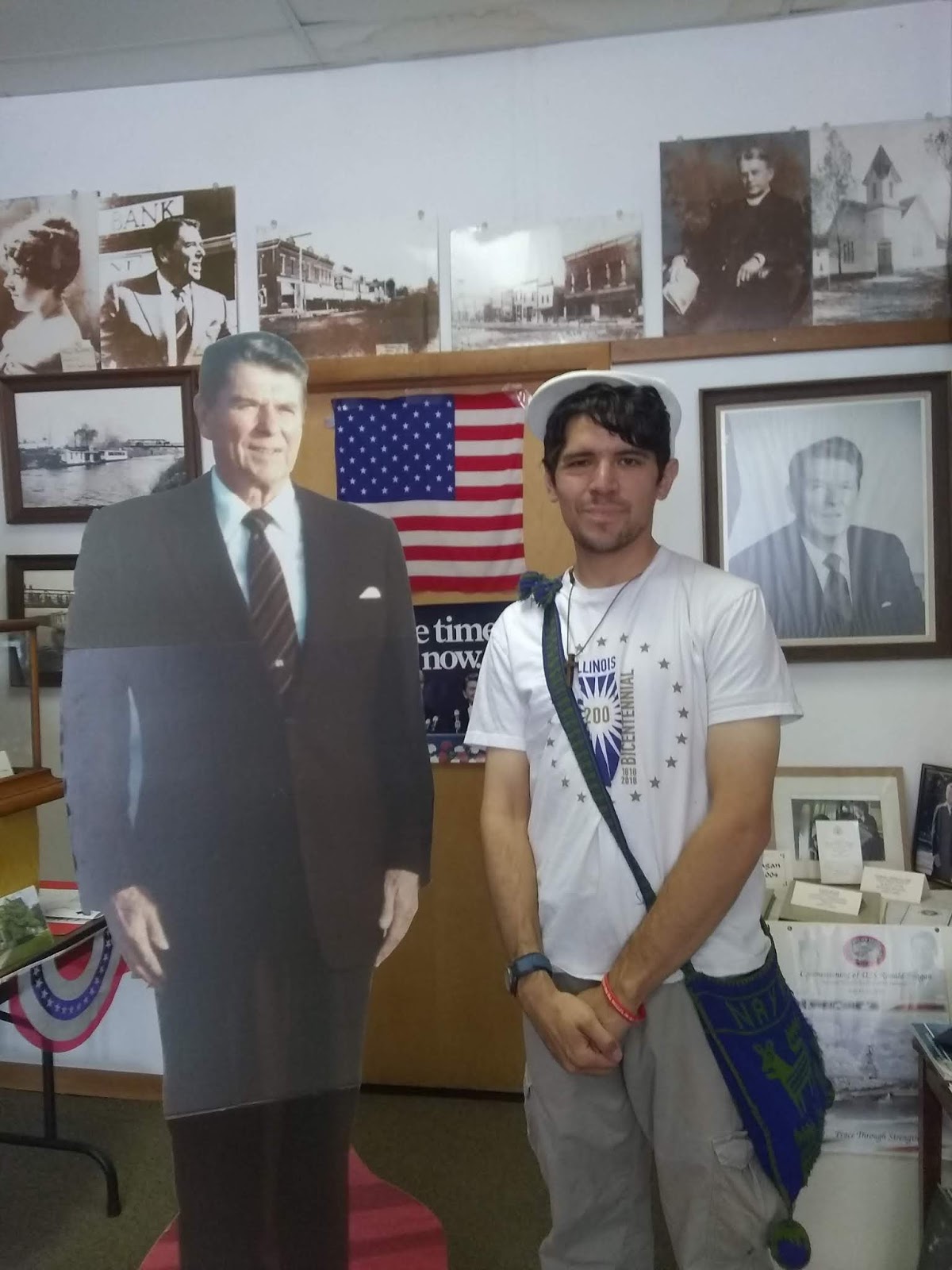 |
| I believe someone other than Sharon photographed me posing with Mr. Reagan. |
It was shortly after 1 PM when I got back in Avila and headed back to Dixon. I stopped in Rock Falls to get a fine sandwich lunch at Arthur's Garden Deli.
Between 2:00-2:30 I was back in Dixon, and went straight to the Reagan Boyhood Home (#76) along Hennepin Avenue near 9th Street for a tour.

I was directed to join a tour that had just started. The tour guide enthusiastically shared about Ronald Reagan in the years of his youth, which included plenty of insights into life in the early 20th Century. He furthermore shared about the process of restoring the home, and President Reagan's visits there.
Apparently, to get the wallpaper just right in the area by the main entrance, they had to get assistance from a Norwegian company that had a design authentic to the original.
From the entry area, we went upstairs to the guest bedroom. Mrs. Reagan was kind-hearted enough to let people stay a night or two there as they got back on their feet. I remember the tour guide mentioned something about how she would extend this offer to those recently released from prison.
Then we went into the room Ronald shared with his older brother Neil. There was paraphernalia from colleges there, including Ronald's alma mater, Eureka College, as well as books and items for their amusement.


I learned that Ronald got his nickname "Dutch" from his build as a child, and his haircut. His older brother Neil got his nickname from the famous cartoon character Moon Mullins, who I had never heard of before.
The tour guide pointed out the moon oil in the bathroom as well as the cologne--the French term for which translates into English as "toilet water".
In the parents' bedroom, the tour guide talked about how Mrs. Reagan's favorite Bible verse was 2 Chronicles 7:14. Ronald Reagan took the oath of office as president with his mother's Bible (#77) opened to that verse. That Bible is on display at the Reagan Presidential Museum in Simi Valley, CA. Our tour guide went there after Mike Pence used it for his inauguration as Vice President in 2017. No one at the museum knew where to find that verse, so they opened it to a random page, but our tour guide set the matter straight when he informed them where he worked.

There were also interesting stories when we went to the rooms on the main level. By the fireplace next to the entryway in the room that functioned as the parlor was a tiled area: Ronald and his older brother Neil stored coins to go see movies underneath a loose tile there.


In the early 1980's, Ronald Reagan returned to Dixon, and visited his old home, which had been newly refurbished. Soon after entering, Mr. Reagan went to that fireplace and jostled a tile loose at that spot, and it is now on display at his presidential museum.

During that visit, he enjoyed a meal with some family members there. The White House chef cooked it in the 1920's-era kitchen. President Reagan insisted on using the dishes in the house, even though the Secret Service was concerned that they hadn't checked to ensure the dishes were safe to eat, i.e., not having been poisoned.
 |
| The dining room table |
It was really interesting to look around in the kitchen at the appliances and kitchen tools used in the 1920's. There was also a sign for the ice delivery. There was a pantry off the kitchen, where they would store the groceries they bought, usually enough to last many months at a time, since it wasn't a good idea to take a horse out to go shopping in the winter months when it could be injured on ice. Our tour guide also pointed out that there were exposed pipes in the kitchen. Indoor plumbing was such a fabulous new innovation back then that people exposed pipes to show it off.
 |
| In this photo of the kitchen, the door to the left leads to the pantry. |
 |
| This photo of the kitchen shows the door leading outside. |
 |
| In this photo, near the sink, you can see the exposed pipes. |
Our tour concluded in the kitchen, and we exited. Toward 9th Street was a lot that used to have a neighboring house, but now is the site of a Reagan statue (#78). An artist donated it, although the people maintaining the home had to pay for the paved brickwork around it. Mr. Reagan is holding corn kernels in his hand, which is a way of noting him as the only president born in Illinois.
 |
| Someone in my tour group was kind enough to get my photo posing by Ronald Reagan. |
There was a garage behind the house, with an old-style car inside. Ronald's father fixed up old cars, like Model T's. And there were corn stalks growing next to the garage.
With the tour finished, I went over to the Northwest Territory Historic Center to look at the museum there, housed in a building where Ronald Reagan attended school. Unable to get inside, I returned to the Reagan Boyhood Home to view a short video in the house next door with the gift shop where I paid admission. On my way out, I bought some Jelly Beans, which was Mr. Reagan's favorite candy.
I made a point to stop by the Dixon Public Library (#79), where Ronald went frequently, which is in the photo below.


I then drove about 10 minutes away from Dixon to Grand Detour (#80) to the John Deere Historic Site (#81). I got there a few minutes before closing time, but that was sufficient to walk around and get a feel for what was there, with several buildings, including the house where the Deere family lived. The staff present were kind enough to show me some things there. I first went to the blacksmith shop where I got to see the process of blacksmithing. John Deere was a blacksmith, and that led to his invention of the plow that made his name famous. That was housed inside a recreated blacksmith shop.


The site of the original blacksmith shop John Deere had is now a museum structure (#82).
 |
| This photo inside the museum structure shows a plow, in the spirit of the original Deere plow design, suspended from the ceiling. Below, and not present in this photo, is an excavation of the original blacksmith shop floor. |
Once the video was over, I got a few photos.
 |
| The lady on staff was kind enough to get this photo of me posing by John Deere's statue. |
And then I drove back to Dixon to get some more photos at the Dixon Arch (#84), the First Christian Church (which the Reagan family attended) (#85), and along the Rock River (#86), which included one of the Lincoln Highway Gazebos (#87) that are along the famed route in Illinois.
 |
| Lincoln Highway Gazebo near the Bridge along the Rock River |
 |
| The Rock River, with the Lincoln Avenue Bridge appearing to the left |
 |
| First Christian Church |
 |
| Signs on a post along Lincoln Avenue in downtown Dixon, with the Arch obscured |
 |
| The Dixon Arch over Lincoln Avenue |
I then drove across the Rock River to get a drink at the McDonald's at 5th and Lincoln/Galena--shown in the photo below--, which sits on the site of a home where the Reagan family lived in Dixon (#88), one of 5.

I then headed back to I-88, concluding a day getting to know Ronald Reagan by riding the road now named for him.
I exited I-88 in Naperville to enjoy a fine meal at Cracker Barrel, a restaurant I associate with road trips, before returning home to Oak Park.
It was a fine day taking in the sights of northern Illinois, especially along the Ronald Reagan Trail (#89). While he largely made his name with his professional pursuits outside of Illinois, he is still the only US president born in Illinois. My travels this day gave me the opportunity to see the places in Illinois where he grew up, and what shaped the years of his youth. And in considering Ronald Reagan's youth, I can think about my own life, I recognize how much Illinois has shaped me, particularly Oak Park, and what I display when I go forth from here to other places.
There's something fitting about the artist who created the Reagan statue that sits in the lot next to his boyhood home, with Mr. Reagan fingering with corn kernels. So much richness has been drawn from that land, certainly the agricultural products, and also the people who were tilled on these soils, many of whom have gone on to contribute significantly to the world at large.

And in the spirit of Illinois's Bicentennial, what those individuals contributed, spurred on by how their time in Illinois shaped them, gives us plenty of reason to celebrate.
Monday, October 28, 2019
The Mysterious, yet Real, Wind of God
On Saturday, October 15, 2005, I was confirmed as a Roman Catholic Christian.
Earlier this month, I marked the 14th anniversary of my Confirmation, and I recognize that with this anniversary, my life is now almost evenly split between my pre-Confirmation years and my post-Confirmation years.
As I reflect on my spiritual journey in the years before and after my Confirmation, I am aware of how much shaped my faith leading up to my Confirmation. And I marvel at the incredible journey that I've had in those 14 years since.
It was very fitting that I spent part of my 14th Confirmation anniversary day, on Tuesday, October 15, 2019, in class with my Religious Education 8th grade students. They, together with my other students on Sunday, and all my former students, are a large part of why October 15, 2005, is such a significant day in my life.
Indeed, the proceedings of that day were momentous: I processed from the Pine Room into Church, with my Uncle Bernie accompanying me as my Confirmation sponsor. After the Liturgy of the Word came the Rite of Confirmation when I renewed the Baptismal promises from 14 years before. And then I had my moment before Bishop Kane to be sealed with the Holy Spirit and His sevenfold gifts. Then the confirmation rite at Mass gave way to the Liturgy of the Eucharist, and then the exuberant concluding song, "Hallelujah, We Sing Your Praises" shortly after 7 o'clock that evening. There were plenty of festivities following Mass, wiht a reception in the Pine Room in the neighboring school building, which included an opportunity for photos with Bishop Kane. Then my party and I made our way to our home to share a celebratory meal together.
As I reveled in these festivities, I had no idea where my faith journey would take me, and certainly I hadn't yet conceived the notion that I would be back at Ascension 14 years later, at that very hour of evening, two floors above the Pine Room, teaching Religious Education. And I marvel at how some of these students who were before me in 8th grade RE class were born around the time I was confirmed. Indeed, it all comes full circle, especially since the students before me would, four days later, have their own experience of Confirmation. My co-catechist Nelson and I spent some time in class focusing on helping them see what Confirmation is all about. Ultimately, Confirmation takes on its full meaning when we put our confirmed faith into action. That's the experience in my own life, as I've seen quite an adventure of faith unfold in the 14 years since.
That's why I was so delighted to share the celebration of my Confirmation anniversary with them, and be part of celebrating their Confirmation day later that week. It was a wondrous opportunity to behold the working of the Holy Spirit.
During our class, Nelson led a study on the conversation between Jesus and Nicodemus as recorded in the Gospel according to St. John chapter 3. In this conversation, in verse 8, Jesus describes the Spirit of God as the wind. We don't know where it comes from or where it's going, but we know it's there.
Truly I marvel at how the Spirit of God has moved in my life, like how I went from celebrating my Confirmation to being in class at the same hour 14 years later handing on the faith to a new group of students. And I marvel at the possibilities of what will happen on their journey as they put their Confirmed faith into action, empowered by the Spirit of God, that He may be magnified. We can't know the full depth of how the Spirit of God moves, but there's no doubt He's there, and fully alive among us, that we may be fully alive in the abundant Life He gives us all through our journey unto Eternity, which we know even now.

I thank Nelson for these photos of me above and below, as I celebrate the 14th anniversary of my Confirmation by being back at the place where it happened, and putting Confirmed faith into action by handing it on to the next group coming along into Confirmed life.

By the way, on the table to the left of me in a blue round tin is orange raspberry bread, which I baked and shared with my students to celebrate the anniversary of my Confirmation, which you can see below. I baked it with the intention of alluding to the liturgical color of fire for the Holy Spirit and Confirmation.

Earlier this month, I marked the 14th anniversary of my Confirmation, and I recognize that with this anniversary, my life is now almost evenly split between my pre-Confirmation years and my post-Confirmation years.
As I reflect on my spiritual journey in the years before and after my Confirmation, I am aware of how much shaped my faith leading up to my Confirmation. And I marvel at the incredible journey that I've had in those 14 years since.
It was very fitting that I spent part of my 14th Confirmation anniversary day, on Tuesday, October 15, 2019, in class with my Religious Education 8th grade students. They, together with my other students on Sunday, and all my former students, are a large part of why October 15, 2005, is such a significant day in my life.
Indeed, the proceedings of that day were momentous: I processed from the Pine Room into Church, with my Uncle Bernie accompanying me as my Confirmation sponsor. After the Liturgy of the Word came the Rite of Confirmation when I renewed the Baptismal promises from 14 years before. And then I had my moment before Bishop Kane to be sealed with the Holy Spirit and His sevenfold gifts. Then the confirmation rite at Mass gave way to the Liturgy of the Eucharist, and then the exuberant concluding song, "Hallelujah, We Sing Your Praises" shortly after 7 o'clock that evening. There were plenty of festivities following Mass, wiht a reception in the Pine Room in the neighboring school building, which included an opportunity for photos with Bishop Kane. Then my party and I made our way to our home to share a celebratory meal together.
As I reveled in these festivities, I had no idea where my faith journey would take me, and certainly I hadn't yet conceived the notion that I would be back at Ascension 14 years later, at that very hour of evening, two floors above the Pine Room, teaching Religious Education. And I marvel at how some of these students who were before me in 8th grade RE class were born around the time I was confirmed. Indeed, it all comes full circle, especially since the students before me would, four days later, have their own experience of Confirmation. My co-catechist Nelson and I spent some time in class focusing on helping them see what Confirmation is all about. Ultimately, Confirmation takes on its full meaning when we put our confirmed faith into action. That's the experience in my own life, as I've seen quite an adventure of faith unfold in the 14 years since.
That's why I was so delighted to share the celebration of my Confirmation anniversary with them, and be part of celebrating their Confirmation day later that week. It was a wondrous opportunity to behold the working of the Holy Spirit.
During our class, Nelson led a study on the conversation between Jesus and Nicodemus as recorded in the Gospel according to St. John chapter 3. In this conversation, in verse 8, Jesus describes the Spirit of God as the wind. We don't know where it comes from or where it's going, but we know it's there.
Truly I marvel at how the Spirit of God has moved in my life, like how I went from celebrating my Confirmation to being in class at the same hour 14 years later handing on the faith to a new group of students. And I marvel at the possibilities of what will happen on their journey as they put their Confirmed faith into action, empowered by the Spirit of God, that He may be magnified. We can't know the full depth of how the Spirit of God moves, but there's no doubt He's there, and fully alive among us, that we may be fully alive in the abundant Life He gives us all through our journey unto Eternity, which we know even now.

I thank Nelson for these photos of me above and below, as I celebrate the 14th anniversary of my Confirmation by being back at the place where it happened, and putting Confirmed faith into action by handing it on to the next group coming along into Confirmed life.

By the way, on the table to the left of me in a blue round tin is orange raspberry bread, which I baked and shared with my students to celebrate the anniversary of my Confirmation, which you can see below. I baked it with the intention of alluding to the liturgical color of fire for the Holy Spirit and Confirmation.

Sunday, October 27, 2019
Where It Started 10 Years Ago
Fall usually is the time of Homecoming festivities for high schools and colleges, when current students and alumni alike celebrate the school community.


 Above is a photo showing the front of Lankenau Hall, which is truly a study in contrasts.
One of the most heartbreaking moments of my life was bidding farewell to my parents near the front door on the evening of August 22, the day I moved to ValpU.
The next day, Sunday, August 23, 2009, brought one of the most joyful, inspirational, and important days of my life: I walked from the lobby inside out through that same main front door and walked on the sidewalk for about 1-2 minutes to reach St. Teresa of Avila (Roman) Catholic Student Center to attend my first Mass there, at 11 AM, an hour that would change my life in the most extraordinary way.
Below is a picture that shows that sidewalk more fully, with St. Teresa's appearing in the background near the center of the photo.

Below shows the section of seating where I sat for my first Mass at St. Teresa's.

It was a couple of months ago, on August 25, when I visited Valparaiso University as part of celebrating the 10th anniversary of when I began my time of studies there.
Here are some photos from that visit as I reflect on those significant days in the 20's of August 2009.

At 9:05 AM CDT on Tuesday, August 25, 2009, I began my first college class in this large classroom/lecture space, appearing in the photo above, in the Christopher Center for Library and Information Resources, specifically room 250. The entire Christ College freshmen class of the Honors College met here as a group for about an hour that day before we went to Mueller Hall to meet in our individual class groups. We met here usually once a week for a lecture related to the text we were studying that week. That morning, everyone fell silent when Dean Mel Piehl stood in front to address us.
|
 |
| I typically sat in the front row in every class, as is depicted in the photo above, and I made a point to sit near the speaker at the lectern. Below is the view from my seat in front looking forward. |

 |
| Here's Kallay-Christopher Hall, where I had my meteorology classes. My first meteorology class met on Wednesday, August 26, 2009. |
 |
| I resided in room 530 of Lankenau Hall my freshman year. Lankenau is the building to the left in the photo above. The windows of 530 are somewhere past the midpoint of the top floor toward the far end of the north wing of the building. |

One of the most heartbreaking moments of my life was bidding farewell to my parents near the front door on the evening of August 22, the day I moved to ValpU.
The next day, Sunday, August 23, 2009, brought one of the most joyful, inspirational, and important days of my life: I walked from the lobby inside out through that same main front door and walked on the sidewalk for about 1-2 minutes to reach St. Teresa of Avila (Roman) Catholic Student Center to attend my first Mass there, at 11 AM, an hour that would change my life in the most extraordinary way.
Below is a picture that shows that sidewalk more fully, with St. Teresa's appearing in the background near the center of the photo.

Below shows the section of seating where I sat for my first Mass at St. Teresa's.

Subscribe to:
Posts (Atom)